Art Deco Jewellery: History, Design Features and Modern Styling
Few decorative movements have influenced luxury accessories as powerfully as Art Deco Jewellery. Recognised for geometric symmetry, bold gemstones, architectural shapes and striking contrasts, this jewellery style emerged during an era fascinated by progress, glamour and modern living. Today, collectors, designers and fashion enthusiasts continue to appreciate Art Deco Jewellery because it combines historical character with a remarkably contemporary appearance.
Unlike jewellery styles built primarily around soft floral patterns and romantic curves, Art Deco Jewellery often celebrates precision. Straight lines, stepped forms, fan motifs, repeating shapes, contrasting colours and highly polished precious metals create designs that immediately command attention. The result is jewellery that can feel vintage and modern at the same time.
For jewellery lovers exploring unique pieces at Virasah, understanding the background of Art Deco Jewellery can make choosing, collecting and styling these pieces far more rewarding. This guide explores its history, defining design characteristics, gemstones, metals, popular pieces, buying considerations and modern styling ideas.
What Is Art Deco Jewellery?
Art Deco Jewellery refers to jewellery influenced by the Art Deco design movement that became internationally prominent during the 1920s and 1930s. The movement influenced architecture, interiors, fashion, automobiles, graphic design and luxury objects. Jewellery makers translated its fascination with geometry, technology and modernity into wearable designs.
Typical Art Deco Jewellery features structured compositions rather than loose naturalistic arrangements. Designers frequently used diamonds, sapphires, rubies, emeralds, onyx, jade, coral and other materials to build strong visual contrasts. Platinum and white gold also became particularly important because their cool colour complemented diamonds and colourful gemstones.
Simple definition: Art Deco Jewellery is characterised by geometric patterns, symmetry, contrasting gemstones, precise craftsmanship and the luxurious visual language associated with the 1920s and 1930s.
The Historical Origins of Art Deco Jewellery
The story of Art Deco Jewellery is closely connected to dramatic social and cultural changes that followed the First World War. Cities were growing rapidly, technology was transforming everyday life and fashion was becoming increasingly streamlined. Women adopted shorter hairstyles, shorter dresses and new approaches to personal style. Jewellery changed alongside these developments.
Designers began moving away from some of the softer organic forms associated with Art Nouveau. Instead, Art Deco Jewellery embraced clean structure, abstraction, repetition and visual rhythm. These qualities mirrored the architecture and industrial design appearing in major international cities.
The 1925 Paris Exhibition
A major milestone was the 1925 Exposition Internationale des Arts Décoratifs et Industriels Modernes held in Paris. The exhibition showcased modern decorative arts and helped popularise the visual language that later became known as Art Deco. Luxury houses presented furniture, fashion, jewellery and decorative objects built around craftsmanship and modern design.
Although styles associated with Art Deco Jewellery had already begun developing before the exhibition, the event became strongly connected with the movement's international identity.
Readers interested in museum-based historical context can explore the Victoria and Albert Museum's Art Deco overview and the collections of The Metropolitan Museum of Art.
Why Art Deco Jewellery Looked So Different
One reason Art Deco Jewellery continues to stand out is its rejection of unnecessary visual softness. Designers treated jewellery almost like miniature architecture. Rings, bracelets and brooches might feature repeating rectangles, triangles, circles, chevrons or stepped arrangements.
The emphasis on structure allowed Art Deco Jewellery to create dramatic visual impact without relying exclusively on extremely large gemstones. Several smaller stones could be carefully calibrated and positioned to form a unified geometric design.
This approach demanded considerable craftsmanship. Precise stone cutting and accurate settings were necessary because even small misalignments could disturb the overall symmetry.
Major Design Features of Art Deco Jewellery
1. Strong Geometric Patterns
Geometry is perhaps the easiest characteristic to recognise in Art Deco Jewellery. Squares, circles, rectangles, triangles and angular lines appear repeatedly. Jewellery may also use stepped outlines inspired by skyscrapers and modern architecture.
These geometric compositions give Art Deco Jewellery a disciplined appearance. Even highly decorative pieces usually retain a sense of order.
2. Symmetry and Balance
Symmetry is another hallmark of Art Deco Jewellery. Designs are frequently mirrored across a central axis. A large centre stone may be surrounded by smaller diamonds or coloured gemstones positioned in carefully balanced arrangements.
This balanced construction makes Art Deco Jewellery visually satisfying and helps elaborate pieces remain elegant rather than chaotic.
3. Contrasting Colours
Designers often combined light and dark materials. Black onyx against white diamonds is one classic example. Emeralds, sapphires and rubies were also used to create vivid colour blocks.
Contrast gave Art Deco Jewellery clarity and drama. Rather than blending colours gradually, designers often created sharp boundaries between different materials.
4. Diamond-Centred Designs
Diamonds became fundamental to many examples of Art Deco Jewellery. Their brightness worked beautifully with platinum settings and geometric arrangements. Various diamond cuts could be combined to create architectural patterns.
If you are exploring diamond jewellery, read the Virasah guide to best diamond cuts for engagement rings . Understanding cut shapes can help explain why certain stones are particularly effective in structured Art Deco Jewellery.
5. Platinum and White Metals
Platinum became strongly associated with luxurious Art Deco Jewellery. Its strength enabled jewellers to create fine settings capable of securely holding numerous stones while maintaining a delicate appearance.
White metals also complemented diamonds particularly well. The metal could visually recede into the design, allowing the stones and geometric composition to dominate.
6. Calibrated Gemstones
Some Art Deco Jewellery incorporates gemstones cut specifically to fit narrow channels or geometric spaces. These calibrated stones allowed jewellers to create clean lines of colour.
The technique could involve sapphires, rubies, emeralds and other stones arranged around diamonds or central gemstones.
7. Architectural Inspiration
Skyscrapers, modern buildings, decorative façades and urban geometry influenced many designers. The resulting Art Deco Jewellery sometimes resembles miniature architectural compositions.
Stepped outlines, vertical lines and repeated shapes create a sense of movement and structure that distinguishes the style from earlier jewellery traditions.
Art Deco Jewellery Compared With Art Nouveau Jewellery
| Feature | Art Deco Jewellery | Art Nouveau Jewellery |
|---|---|---|
| Primary shapes | Geometric, angular and symmetrical | Flowing, curved and organic |
| Inspiration | Architecture, technology, travel and modernity | Flowers, plants, insects and natural forms |
| Colour approach | Strong contrast | Often softer and more blended |
| Visual feeling | Structured and glamorous | Romantic and expressive |
| Common materials | Diamonds, platinum, coloured gemstones, onyx | Enamel, coloured stones, glass and precious metals |
The contrast helps explain why Art Deco Jewellery remains attractive to people who prefer strong, clean design. Its geometry adapts surprisingly well to contemporary fashion.
Popular Gemstones Used in Art Deco Jewellery
Diamonds
Diamonds are among the most recognisable stones used in Art Deco Jewellery. Their brilliance emphasises geometric precision, especially when several stones are positioned within a symmetrical setting.
Authenticating and evaluating diamonds involves more than appearance. Consumers can learn about diamond grading through the Gemological Institute of America diamond resources.
Sapphires
Blue sapphire creates striking contrast against white diamonds. This combination appears frequently in jewellery inspired by the Art Deco period.
For deeper guidance, visit Virasah's sapphire jewelry guide and the detailed article explaining why Kashmir sapphire is so valuable .
Deep blue stones can add dramatic colour to Art Deco Jewellery while preserving the strong visual contrast associated with the style.
Rubies
Ruby provided designers with intense red colour. Combined with diamonds, the gemstone produced glamorous compositions perfectly suited to Art Deco Jewellery.
Collectors interested in ruby quality can explore the Virasah ruby jewelry guide and the article discussing Burmese ruby and its exceptional reputation .
Emeralds
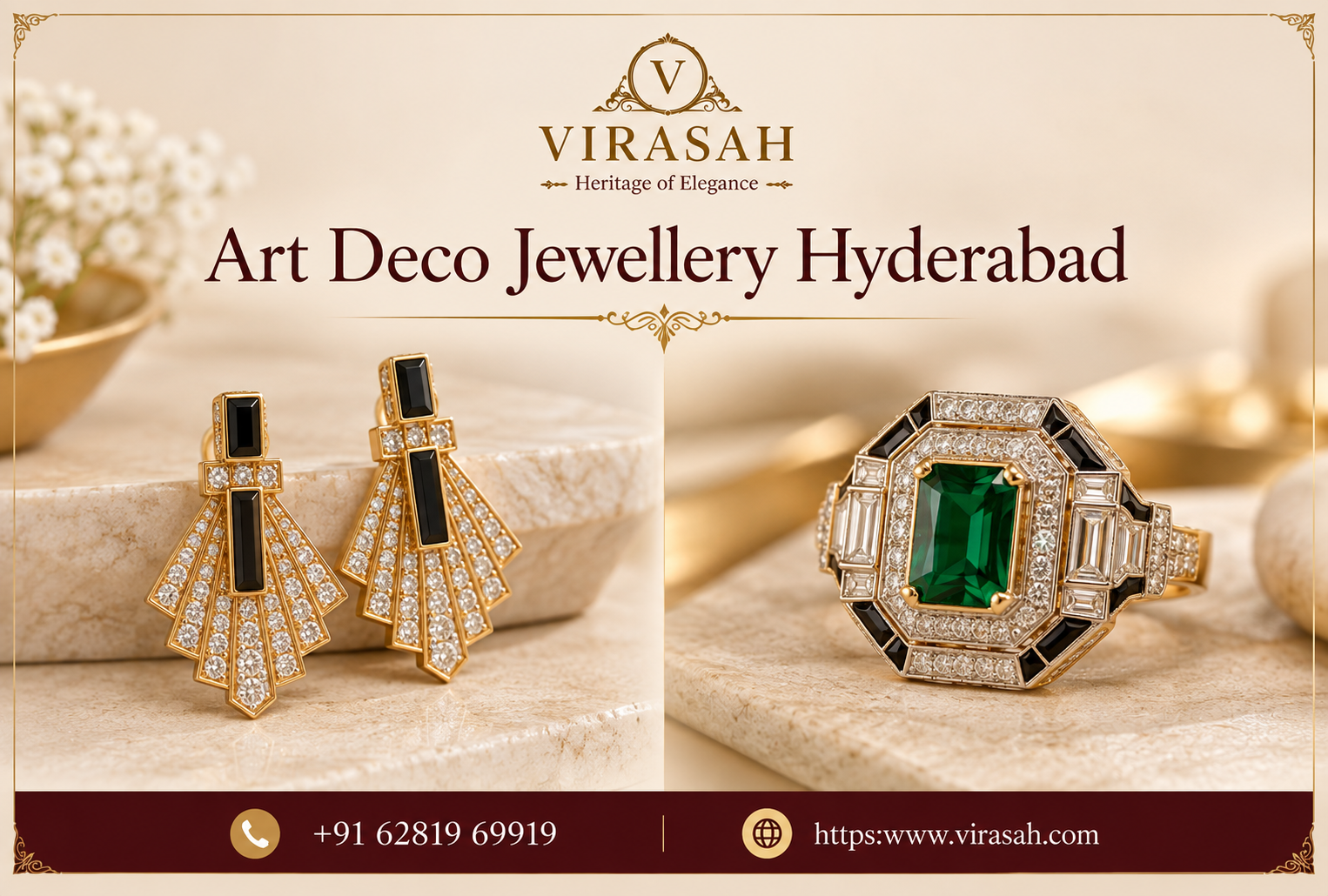
Emeralds offered another strong colour option. Their rich green tone worked beautifully against diamonds and white metal. Emerald-set Art Deco Jewellery can therefore feel dramatic while retaining refinement.
For inspiration, see Virasah's guide to emerald jewelry designs for weddings and special occasions .
Onyx
Black onyx became especially effective in Art Deco Jewellery because it created sharp black-and-white contrast when paired with diamonds. It could be cut into geometric components and incorporated into rings, brooches, earrings and bracelets.
Other Coloured Gemstones
Designers did not restrict themselves to only the most famous precious stones. Jade, coral, turquoise and other materials could also appear in Art Deco Jewellery, particularly when the designer wanted dramatic combinations of colour and texture.
Modern collectors looking beyond traditional stones may enjoy Virasah's guide to rare gemstones in India and the detailed tanzanite jewelry buying guide .
The Influence of Global Cultures
The Art Deco era coincided with expanding international travel, archaeology, exhibitions and cultural exchange. Designers encountered visual influences from many parts of the world. Some Art Deco Jewellery incorporated motifs inspired by Egyptian, Asian, African and Middle Eastern decorative traditions.
The discovery of Tutankhamun's tomb in 1922 created enormous public interest in ancient Egyptian imagery. Lotus forms, scarab-inspired elements, pyramidal shapes and strong colour combinations entered European decorative arts.
Asian materials and motifs also influenced jewellery design. Carved jade and lacquer-inspired colour contrasts appeared in some sophisticated pieces.
These influences were often reinterpreted through the geometric language of Art Deco Jewellery, creating objects that felt exotic to contemporary European audiences while remaining distinctly modern.
Popular Types of Art Deco Jewellery
Art Deco Rings
Rings are one of the most popular categories of Art Deco Jewellery. Typical designs feature a prominent centre gemstone surrounded by symmetrical diamond patterns. Octagonal, rectangular and stepped shapes are especially common.
Modern Art Deco-inspired engagement rings remain popular because geometric halos can frame a centre diamond or gemstone dramatically.
Art Deco Earrings
Long drop earrings matched the glamorous evening fashions of the period. Some Art Deco Jewellery earrings use repeating geometric sections that move as the wearer walks.
Modern versions can be paired with gowns, tailored eveningwear, sarees or contemporary fusion outfits.
Art Deco Bracelets
Wide diamond bracelets became iconic expressions of Art Deco Jewellery. Their structure allowed designers to repeat geometric patterns across the wrist.
Bracelets were often flexible despite their highly architectural appearance. This combination of engineering and decorative craftsmanship demonstrates the technical sophistication of the period.
Art Deco Necklaces
Necklaces ranged from delicate diamond arrangements to dramatic sautoirs. Long necklaces suited the straight silhouettes of 1920s dresses.
Contemporary Art Deco Jewellery necklaces can work equally well with minimalist outfits because the jewellery itself provides a clear focal point.
Art Deco Brooches
Brooches provided jewellers with a larger surface for experimenting with symmetry and geometry. A well-designed Art Deco Jewellery brooch might feature diamonds, coloured stones and contrasting materials arranged into a highly precise composition.
How Art Deco Jewellery Changed Women's Fashion
Fashion changed significantly during the 1920s. Shorter dresses, sleeveless silhouettes and bobbed hairstyles created new opportunities for jewellery. Long earrings became more visible. Bracelets could be stacked on exposed wrists. Long necklaces complemented straighter dresses.
As a result, Art Deco Jewellery became closely connected with the new visual identity of modern urban women. Jewellery was not merely an accessory; it contributed to the overall architecture of an outfit.
Even today, this relationship between clothing and jewellery remains useful. Structured jewellery can bring definition to minimalist outfits, while strong gemstone colours can become the focal point of traditional or contemporary clothing.
Why Art Deco Jewellery Still Looks Modern
Many historical jewellery styles immediately reveal their age. Art Deco Jewellery is different. A geometric diamond ring designed nearly a century ago may still look surprisingly contemporary.
The reason is simple: modern visual culture still relies heavily on geometry, symmetry, minimalism and architectural forms. These qualities allow Art Deco Jewellery to integrate naturally with today's fashion.
A streamlined black dress, tailored blazer or monochrome saree can all work with geometric jewellery. The jewellery adds detail without necessarily making the outfit feel old-fashioned.
How to Style Art Deco Jewellery Today
Keep the Outfit Clean
Because Art Deco Jewellery can be visually detailed, simple clothing often provides the best background. Neutral colours allow diamonds and coloured gemstones to command attention.
For example, geometric diamond earrings can become the central accessory with a black evening dress. Similarly, a structured emerald-and-diamond ring can add colour to a cream or ivory outfit.
Combine Vintage and Contemporary Pieces Carefully
Wearing Art Deco Jewellery does not require recreating a complete 1920s look. In fact, combining one vintage-inspired piece with modern clothing often produces a more sophisticated result.
A geometric bracelet can be paired with a minimalist watch. An Art Deco-inspired ring can complement a contemporary tailored suit. The goal is balance rather than costume.
Use One Statement Piece
Highly detailed Art Deco Jewellery often works best when one major piece receives most of the attention. Wearing a large necklace, oversized earrings, multiple bracelets and an elaborate ring simultaneously can overwhelm the design.
Instead, allow one piece to dominate and keep other accessories restrained.
Style It With Indian Occasion Wear
One of the most interesting modern approaches is pairing Art Deco Jewellery with Indian occasion wear. Geometric diamond earrings can complement an elegant saree. An emerald-and-diamond bracelet can add contrast to a modern lehenga.
Brides looking for broader inspiration can also explore Virasah's complete wedding jewelry checklist for Indian brides .
Experiment With Colour
Ruby, sapphire and emerald accents make Art Deco Jewellery particularly suitable for styling around colour. Instead of matching the gemstone exactly to clothing, consider complementary or neutral colours.
A sapphire ring against white or silver clothing creates a clean contrast. Ruby jewellery can provide warmth against black, beige or ivory. Emerald designs work beautifully with cream, gold, black or deep jewel tones.
Art Deco Jewellery for Weddings
Bridal jewellery does not always need to follow traditional floral or heavily ornamental patterns. For brides who prefer sophisticated geometry, Art Deco Jewellery offers an alternative.
Diamond earrings with stepped shapes can frame the face beautifully. Emerald or sapphire accents can introduce colour. A geometric cocktail ring can become a memorable statement piece for receptions or engagement celebrations.
Modern brides may also mix Art Deco Jewellery with classic Indian jewellery rather than replacing traditional pieces entirely. For example, architectural diamond earrings can be paired with a relatively simple necklace.
Art Deco Engagement Rings
Engagement rings inspired by Art Deco Jewellery have remained popular because their structure naturally highlights a centre stone. A diamond or coloured gemstone may be framed by geometric halos, baguette-cut side stones or contrasting gemstone accents.
Emerald-cut, Asscher-cut and other angular centre stones can reinforce the architectural appearance. Round diamonds can also work when surrounded by square, octagonal or rectangular patterns.
When choosing an engagement ring influenced by Art Deco Jewellery, consider how the ring will pair with a wedding band. Highly geometric outlines may require a custom-fitted band.
Vintage Art Deco Jewellery vs Modern Art Deco-Inspired Jewellery
| Factor | Vintage Art Deco Jewellery | Modern Art Deco-Inspired Jewellery |
|---|---|---|
| Age | Usually originates from the historical Art Deco period | Created recently using Deco-inspired design principles |
| Craftsmanship | May contain period-specific techniques | Benefits from modern jewellery technology |
| Condition | May show wear or previous repair | Normally sold in new condition |
| Stone cutting | May feature older cutting styles | Often uses modern precision cuts |
| Availability | Unique pieces can be difficult to source | More flexible design and sizing options |
Both categories can be attractive. Original Art Deco Jewellery appeals strongly to collectors interested in history and period craftsmanship. Modern pieces may be more suitable for buyers seeking specific sizes, gemstones or daily-wear durability.
How to Identify Genuine Period Art Deco Jewellery
Identifying authentic period Art Deco Jewellery requires more than recognising geometric shapes. Art Deco-inspired designs have been reproduced for decades, so visual appearance alone cannot establish age.
Collectors should consider construction techniques, hallmarks, metal composition, gemstone cutting, wear patterns and documented provenance. When a purchase is financially significant, professional authentication can be valuable.
Check Hallmarks
Hallmarks may provide clues about metal purity, manufacturer and origin. However, marks vary by country and can sometimes be difficult to interpret.
Inspect the Setting
Period Art Deco Jewellery may show construction methods associated with early twentieth-century craftsmanship. Nevertheless, repairs and later modifications are common.
Study the Gemstone Cuts
Older diamonds may display cutting characteristics different from modern precision-cut stones. This alone does not prove age, but it can contribute to a broader assessment.
Request Documentation
For expensive Art Deco Jewellery, ask about provenance, previous ownership, certificates and restoration history. Documentation can help buyers understand what exactly they are purchasing.
Understanding Gemstone Quality
The beauty of Art Deco Jewellery depends heavily on the quality and arrangement of its gemstones. However, buyers should avoid evaluating stones solely by colour intensity or visual size.
For diamonds, internationally recognised concepts include colour, clarity, cut and carat weight. The GIA 4Cs educational guide provides useful consumer information.
Coloured gemstones require different evaluation approaches. Factors such as hue, tone, saturation, transparency, origin and treatment can influence desirability.
The Gem-A and the Swiss Gemmological Institute SSEF provide additional educational and gemmological resources.
Buying Art Deco Jewellery: Important Questions to Ask
Whether you are purchasing antique, vintage or newly created Art Deco Jewellery, ask detailed questions before making a decision.
- Is the piece genuinely from the Art Deco period or merely Art Deco-inspired?
- What metal has been used?
- Are the gemstones natural, treated or laboratory-grown?
- Has the piece been repaired or restored?
- Are any stones replacements?
- Is there an independent laboratory report for important gemstones?
- Is the current setting secure?
- Can the ring or bracelet be safely resized?
- What is the return or exchange policy?
These questions are particularly important for valuable Art Deco Jewellery because age, condition and authenticity can significantly affect desirability.
Art Deco Jewellery and Investment Value
People sometimes describe rare jewellery as an investment. However, buyers should approach this idea carefully. Not every piece of Art Deco Jewellery will increase in value, and resale markets can fluctuate.
Important variables include maker, rarity, provenance, gemstone quality, condition, craftsmanship and current demand. Signed pieces from historically important jewellery houses may attract strong collector interest, but authenticity is essential.
Therefore, purchasing Art Deco Jewellery primarily because you genuinely appreciate the design is usually more sensible than assuming automatic financial appreciation.
Famous Jewellery Houses and the Art Deco Era
Several major jewellery houses produced extraordinary Art Deco Jewellery during the movement's peak. Their designers used exceptional gemstones and advanced craftsmanship to create pieces that are now studied by collectors and museums.
Brands such as Cartier, Van Cleef & Arpels and Boucheron contributed significantly to the development of luxury Art Deco design. Their historical archives demonstrate how geometry, cultural influences and gemstone innovation shaped jewellery during the period.
The Encyclopaedia Britannica overview of Art Deco provides additional historical context for understanding the wider decorative movement.
The Role of Diamond Cuts in Art Deco Jewellery
Diamond shape has a major influence on the appearance of Art Deco Jewellery. Angular cuts naturally complement geometric settings.
Emerald Cut
The rectangular outline and stepped facets of emerald-cut diamonds work particularly well in Art Deco Jewellery. Instead of intense sparkle, the cut creates broad flashes of light and a structured appearance.
Asscher Cut
The Asscher cut provides a square step-cut appearance. Its geometry suits rings and other designs inspired by Art Deco Jewellery.
Baguette Cut
Baguette diamonds can function almost like architectural building blocks. Jewellers use them beside centre stones or in repeated patterns. They are especially effective in Art Deco Jewellery because of their clean rectangular form.
Round Diamonds
Although round diamonds may initially seem less architectural, they can create powerful contrast when placed inside square or octagonal frames. This combination appears frequently in Art Deco Jewellery.
How to Wear Art Deco Jewellery During the Day
Despite its glamorous reputation, Art Deco Jewellery does not need to be reserved exclusively for formal events. Smaller geometric pieces can work beautifully during the day.
Consider a slim diamond bracelet, geometric stud earrings or a modest sapphire ring. These pieces can complement tailored shirts, dresses, business clothing and minimal ethnic wear.
When wearing Art Deco Jewellery casually, reduce the number of competing accessories. A single geometric piece often creates enough visual interest.
How to Style Art Deco Jewellery for Evening Events
Evening wear provides greater freedom to explore dramatic Art Deco Jewellery. Long earrings, diamond bracelets and elaborate rings can reflect artificial light beautifully.
Black, emerald, navy, burgundy and ivory outfits provide particularly effective backgrounds. A monochromatic outfit allows intricate jewellery to become the main visual feature.
If the jewellery includes coloured gemstones, use clothing that supports rather than competes with those colours.
Art Deco Jewellery With Sarees
A saree can provide an elegant canvas for Art Deco Jewellery. The key is choosing pieces that complement the textile rather than competing with it.
For an embroidered saree, consider relatively streamlined diamond earrings. For a minimalist silk saree, a statement Art Deco Jewellery necklace or bracelet can add sophistication.
Emerald, ruby and sapphire accents can also connect jewellery with traditional Indian colour palettes while retaining a distinctly international design language.
Art Deco Jewellery With Lehenga and Reception Looks
Reception outfits are particularly suitable for Art Deco Jewellery because contemporary bridal styling often includes gowns, structured blouses and modern silhouettes.
A diamond choker featuring repeating geometry can complement a modern lehenga. Long earrings can work with swept-back hairstyles. A cocktail ring can provide a final focal point without overwhelming the outfit.
Art Deco Jewellery for Men
The influence of Art Deco Jewellery is not limited to women's accessories. Men's cufflinks, dress watches, tie accessories and rings can also use geometric forms.
Black onyx, diamonds and white metals are particularly effective for masculine interpretations of Art Deco Jewellery. The result can feel formal, precise and understated.
How to Mix Art Deco Jewellery With Modern Jewellery
Mixing eras requires visual discipline. Because Art Deco Jewellery already has strong character, contemporary pieces should generally remain simple.
A geometric vintage-style ring can be combined with a plain modern band. A structured bracelet can sit beside a minimalist watch. Art Deco-inspired earrings can work with a simple chain necklace.
Try repeating one visual element—such as white metal, emerald colour or rectangular shapes—to connect different pieces.
Can You Mix Gold With Art Deco Jewellery?
Although platinum and white metals are strongly associated with Art Deco Jewellery, modern styling does not require strict historical accuracy. Yellow gold can create attractive contrast.
For example, a platinum diamond ring may be combined with restrained yellow-gold bracelets. The key is making the mixture appear deliberate.
Some contemporary designers also reinterpret Art Deco Jewellery entirely in yellow or rose gold, producing a warmer visual effect.
Caring for Art Deco Jewellery
Older Art Deco Jewellery should be handled carefully. Age can weaken settings, clasps and connecting components even when the jewellery looks visually intact.
Inspect Settings Regularly
Before wearing valuable Art Deco Jewellery, check whether stones feel secure. A professional jeweller can inspect prongs, channels and other settings.
Avoid Harsh Chemicals
Perfume, chlorine and household cleaning products can affect metals and gemstones. Remove Art Deco Jewellery before swimming, cleaning or using strong chemicals.
Store Pieces Separately
Diamonds are extremely hard and can scratch other jewellery. Store Art Deco Jewellery in individual soft pouches or lined compartments.
Be Careful With Ultrasonic Cleaning
Ultrasonic cleaners are not suitable for every gemstone or antique setting. Before cleaning valuable Art Deco Jewellery, ask a professional whether the method is appropriate.
Restoring Vintage Art Deco Jewellery
Restoration can preserve wearable condition, but excessive alteration may reduce historical integrity. Owners of important Art Deco Jewellery should therefore work with jewellers experienced in antique pieces.
Replacing missing stones, repairing worn settings and strengthening clasps may sometimes be necessary. However, changing original components unnecessarily can affect authenticity and collector interest.
Before restoring valuable Art Deco Jewellery, document the existing condition with photographs and request a clear explanation of proposed repairs.
What Makes High-Quality Art Deco Jewellery Special?
Excellent Art Deco Jewellery is about more than expensive materials. The finest examples demonstrate exceptional proportion. Every gemstone, line and negative space contributes to the composition.
Look closely at symmetry. Well-made pieces should feel balanced even when the design is complex. Check how stones meet one another and whether the geometry remains clean.
Craftsmanship is particularly important because poor alignment becomes obvious in geometric Art Deco Jewellery. There is nowhere for inaccurate workmanship to hide.
Why Collectors Love Art Deco Jewellery
Collectors are attracted to Art Deco Jewellery for several reasons. First, the designs represent a distinctive moment in cultural history. Second, many pieces demonstrate extraordinary workmanship. Third, the style remains wearable.
A piece of Art Deco Jewellery can therefore function simultaneously as decorative art, historical object and personal accessory.
Collectors may specialise in particular designers, gemstones, jewellery categories or motifs. Others simply choose pieces that speak to their personal taste.
Common Mistakes When Buying Art Deco Jewellery
Assuming Every Geometric Piece Is Antique
Many modern jewellers create designs inspired by Art Deco Jewellery. Geometry alone does not prove that a piece was made during the 1920s or 1930s.
Ignoring Repairs
Vintage jewellery may have been modified several times. Ask whether Art Deco Jewellery has replacement stones, altered settings or repaired clasps.
Focusing Only on Carat Weight
Large stones do not automatically create superior jewellery. In Art Deco Jewellery, proportion, craftsmanship and overall composition can matter just as much.
Buying Without Understanding Treatments
Gemstone treatments can affect value and care requirements. Request accurate disclosure before purchasing valuable Art Deco Jewellery.
Ignoring Wearability
Some dramatic vintage pieces are better suited to occasional use. Consider lifestyle and comfort when choosing Art Deco Jewellery for frequent wear.
How Art Deco Jewellery Inspires Modern Designers
Contemporary jewellers continue to reinterpret Art Deco Jewellery because its underlying design principles remain relevant. Geometry works exceptionally well with modern computer-assisted design and precision stone setting.
Designers may retain the symmetry and stepped forms of historical Art Deco Jewellery while simplifying the overall composition. Others introduce unusual gemstone colours, modern cuts or alternative metals.
This approach allows customers to enjoy Deco aesthetics without requiring an original antique piece.
Art Deco Jewellery as a Personal Style Statement
Jewellery often communicates personality more effectively than clothing. Choosing Art Deco Jewellery can suggest an appreciation for design, precision, history and individuality.
Someone drawn to minimalism may prefer a simple geometric ring. A collector who loves dramatic design may choose an elaborate diamond bracelet. A gemstone enthusiast might favour sapphire, emerald or ruby Art Deco Jewellery.
There is no single correct approach. The strongest personal jewellery collections usually develop around genuine preference rather than temporary trends.
Is Art Deco Jewellery Suitable for Everyday Wear?
Some Art Deco Jewellery is perfectly suitable for regular use, while delicate antiques may require greater caution. The answer depends on construction, gemstone durability and condition.
Rings experience frequent impact and therefore require secure settings. Earrings and necklaces usually face less physical stress. Bracelets may contact desks, doors and other hard surfaces throughout the day.
If you plan to wear valuable Art Deco Jewellery regularly, ask a qualified jeweller to evaluate its condition.
Choosing Art Deco Jewellery Based on Your Wardrobe
Before buying a new piece, consider what you already wear. Art Deco Jewellery is especially versatile with structured clothing, monochrome outfits, evening wear and elegant traditional fashion.
If your wardrobe contains mostly neutral colours, coloured gemstones can become useful accents. If you wear highly decorative clothing, diamond-focused Art Deco Jewellery may integrate more easily.
Thinking about your actual wardrobe can prevent expensive jewellery from remaining unused.
Building an Art Deco Jewellery Collection
You do not need to build a collection immediately. Start with one versatile piece of Art Deco Jewellery that fits your lifestyle.
A ring or pair of earrings is often an accessible starting point. Later, you can add bracelets, necklaces or brooches that share similar design characteristics.
Collectors may choose a consistent gemstone palette or deliberately explore variety. For example, a collection might include sapphire-and-diamond Art Deco Jewellery, followed by emerald and ruby pieces.
Art Deco Jewellery and Sustainable Luxury
Vintage jewellery can appeal to people interested in extending the useful life of existing luxury objects. Purchasing pre-owned Art Deco Jewellery means appreciating materials and craftsmanship that already exist.
Modern buyers can also ask jewellers about recycled precious metals, responsibly sourced gemstones and traceability. Sustainability is a complex topic, but greater transparency can help buyers make more informed choices.
What to Look for Before Purchasing Online
Buying Art Deco Jewellery online requires careful examination of photographs and descriptions. Request high-resolution images showing the front, back, sides, hallmarks and settings.
Dimensions are also important. Product photographs can make jewellery appear larger or smaller than reality. Ask for exact measurements and stone dimensions.
For expensive Art Deco Jewellery, understand the seller's return policy before payment. Independent gemological reports may also be appropriate for important gemstones.
Questions to Ask a Jewellery Seller
- What is the estimated date of manufacture?
- Is this original Art Deco Jewellery or a later reproduction?
- Has the item been resized?
- Have any gemstones been replaced?
- Are there visible hallmarks?
- What gemstones are present?
- Have the gemstones received treatments?
- Is a laboratory report available?
- Has the item undergone restoration?
- What care instructions are recommended?
A reputable seller should be willing to provide clear information rather than relying solely on aesthetic descriptions of Art Deco Jewellery.
Art Deco Jewellery Styling Ideas for Different Occasions
| Occasion | Recommended Jewellery | Styling Approach |
|---|---|---|
| Office | Geometric studs or a simple ring | Keep the rest of the accessories minimal |
| Wedding guest | Emerald or sapphire earrings | Coordinate with one colour from the outfit |
| Reception | Statement Art Deco Jewellery bracelet | Pair with a clean sleeve or sleeveless silhouette |
| Cocktail event | Diamond cocktail ring | Use monochrome clothing for contrast |
| Formal dinner | Long geometric earrings | Wear hair away from the face |
Frequently Asked Questions About Art Deco Jewellery
1. What defines Art Deco Jewellery?
Art Deco Jewellery is generally defined by geometric shapes, symmetry, strong colour contrasts, diamonds, coloured gemstones and architectural design. Historical examples are especially associated with the 1920s and 1930s.
2. When was Art Deco Jewellery most popular?
Art Deco Jewellery became particularly influential during the 1920s and 1930s. Its development was connected with broader changes in architecture, fashion, technology and decorative arts.
3. What gemstones are common in Art Deco Jewellery?
Diamonds, sapphires, rubies, emeralds and onyx are strongly associated with Art Deco Jewellery. Jade, coral and other decorative materials can also appear.
4. Is all Art Deco Jewellery antique?
No. Today, many designers produce new Art Deco Jewellery inspired by historic patterns. A geometric appearance does not automatically mean a piece was manufactured during the original Art Deco period.
5. Is Art Deco Jewellery expensive?
Prices vary considerably. Original signed Art Deco Jewellery with important gemstones can be highly valuable, while modern inspired pieces may be available at a wider range of prices. Craftsmanship, materials, maker, rarity and provenance all influence cost.
6. Can Art Deco Jewellery be worn every day?
Yes, depending on the individual piece. Modern Art Deco Jewellery designed for daily wear may be quite practical. Fragile antique pieces should be professionally inspected before frequent use.
7. How can I tell whether Art Deco Jewellery is genuine?
Authenticating period Art Deco Jewellery may involve examining hallmarks, construction methods, gemstones, metal composition and provenance. For valuable pieces, professional assessment is recommended.
8. Why is platinum common in Art Deco Jewellery?
Platinum is strong and naturally white, allowing jewellers to create fine settings that complement diamonds. These characteristics made the metal highly suitable for intricate Art Deco Jewellery.
9. Can Art Deco Jewellery be paired with Indian clothing?
Absolutely. Art Deco Jewellery can work beautifully with sarees, lehengas, gowns and Indo-western outfits. Geometric diamond pieces are particularly effective with modern bridal and reception styling.
10. Is Art Deco Jewellery still fashionable?
Yes. The geometry and clean structure of Art Deco Jewellery continue to influence contemporary designers. Its ability to complement both vintage and modern fashion has helped the style remain relevant.
Final Thoughts
Nearly a century after its most influential period, Art Deco Jewellery remains one of the most recognisable jewellery styles in the world. Its geometric precision, architectural inspiration, strong gemstone contrasts and sophisticated craftsmanship give it a visual identity that rarely feels outdated.
Whether you are considering a diamond engagement ring, sapphire earrings, emerald bracelet or a genuine antique, understanding the history behind Art Deco Jewellery helps you appreciate the design at a deeper level. The most beautiful pieces do more than display expensive gemstones; they demonstrate balance, proportion, craftsmanship and artistic intention.
For contemporary jewellery lovers, Art Deco Jewellery offers unusual versatility. It can accompany western eveningwear, minimalist tailoring, modern sarees, bridal outfits and sophisticated everyday clothing. A carefully chosen piece can become both a personal signature and an object that remains meaningful for generations.
Explore more gemstone education, jewellery inspiration and buying guides at www.virasah.com.
Contact Virasah:
Looking for distinctive jewellery, gemstone guidance or timeless designs inspired by exceptional craftsmanship? Connect with Virasah for more information.
Phone: +91 62819 69919
Website: www.virasah.com