Natural Diamond Earrings: How to Choose the Right Style and Quality
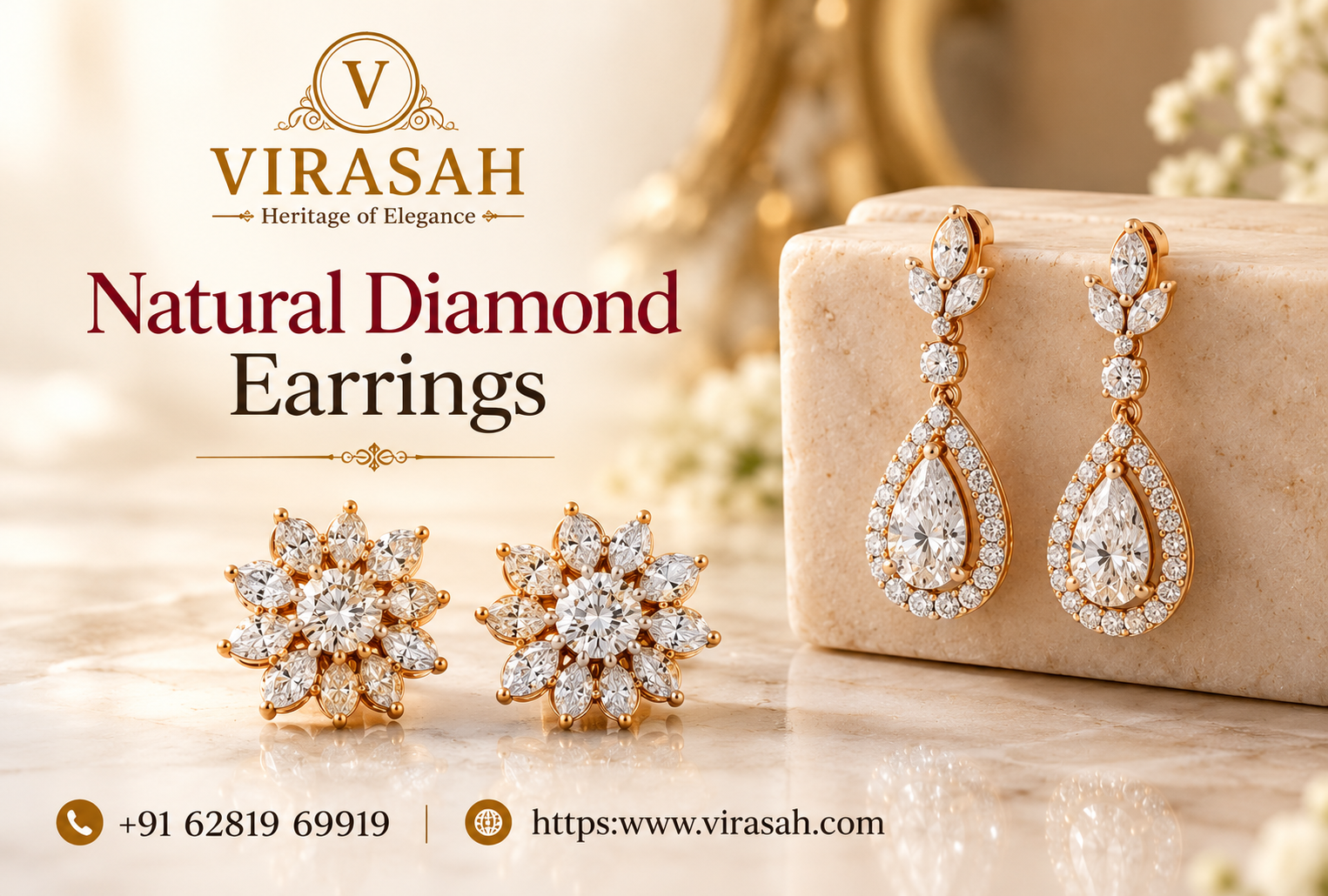
Few pieces of fine jewelry balance elegance, versatility and lasting appeal as successfully as Natural Diamond Earrings. A beautifully selected pair can become part of a woman's everyday wardrobe, complement traditional Indian attire, add refinement to professional clothing and bring effortless brilliance to evening occasions.
However, selecting Natural Diamond Earrings involves much more than choosing the pair with the largest stones. Diamond quality, proportions, matching, metal, setting security, comfort and the relationship between the design and the wearer's lifestyle all influence whether a pair feels genuinely special.
This comprehensive Virasah guide explains how to evaluate Natural Diamond Earrings intelligently so that style and quality work together. Whether you are buying your first pair of diamond studs, planning an anniversary gift, choosing earrings for a wedding or adding an investment-worthy jewel to your collection, understanding the details before purchasing can make an enormous difference.
Explore fine jewelry and gemstone education at Virasah, where timeless design and informed jewelry selection come together.
What You Will Learn
- Why natural diamonds remain important in fine jewelry
- How to choose the correct diamond earring style
- How the 4Cs affect earrings
- Why matching two diamonds matters
- How to choose diamond color and clarity intelligently
- Which diamond shapes work best in earrings
- How carat weight should be evaluated
- How gold and platinum affect the finished design
- How settings and earring backs influence security
- How to select earrings according to face shape
- How to compare everyday, bridal and occasion designs
- What documentation to request
- Common mistakes buyers should avoid
- How to care for fine diamond earrings
What Makes Natural Diamond Earrings Special?
A natural diamond forms deep within the Earth over geological time under extraordinary combinations of heat and pressure. The rough crystal is later recovered, evaluated, cut and polished to reveal the optical properties associated with diamond jewelry. When diamonds are selected specifically for earrings, the jeweler also has the challenge of creating a visually harmonious pair.
This is one reason high-quality Natural Diamond Earrings should be considered as a pair rather than as two unrelated stones. Even diamonds with similar laboratory grades can look slightly different because of proportions, facet patterns, fluorescence, inclusions and individual cutting characteristics.
The appeal of Natural Diamond Earrings is also connected with versatility. Unlike a statement necklace that may be worn only occasionally, well-designed earrings can become part of a person's regular jewelry rotation. Small solitaire studs can work at the office, while larger drops or elaborate diamond designs can complement wedding and evening attire.
For jewelry buyers who enjoy learning about naturally occurring gems, Virasah's guide to rare gemstones in India provides useful background on rarity, beauty and gemstone appreciation.
Start With Lifestyle Before Looking at Carat Weight
One of the most useful questions to ask before purchasing Natural Diamond Earrings is not "How many carats should I buy?" but "How will these earrings actually be worn?"
Someone looking for a pair to wear five days a week has different requirements from someone purchasing jewelry primarily for weddings and formal occasions. Daily earrings need practical settings, comfortable weight and reliable backs. Occasion jewelry can be larger, longer and more elaborate because it may only be worn for a few hours at a time.
For Everyday Wear
For everyday Natural Diamond Earrings, simplicity often delivers the greatest versatility. Solitaire studs, petite halos and delicate diamond hoops can complement western clothes, sarees, kurtas and business wear without dominating the overall look.
Consider earrings that sit securely against the ear, have minimal projections that could catch on clothing and use strong posts or closure mechanisms.
For Weddings
Wedding Natural Diamond Earrings can be substantially more decorative. Drops, chandeliers, floral diamond arrangements and diamond-gemstone combinations can be coordinated with necklaces, bangles and bridal outfits.
Brides planning a complete jewelry wardrobe may also find the Virasah wedding jewelry checklist for Indian brides useful when coordinating earrings with other major pieces.
For Gifting
When buying Natural Diamond Earrings as a gift, classic proportions are generally easier to wear than highly experimental shapes. Studs and restrained drop designs have broad appeal and can suit many wardrobes.
Popular Natural Diamond Earrings Styles
Understanding the main design categories can simplify the search for Natural Diamond Earrings. Each style creates a different visual effect and can emphasize the diamonds in different ways.
1. Solitaire Diamond Stud Earrings
Solitaire studs are among the most recognizable Natural Diamond Earrings. Each ear usually displays one principal diamond held by prongs or another minimal setting.
Because very little metal distracts from the stones, the quality and matching of the diamonds become especially noticeable. Round brilliant diamonds are traditional, although princess, cushion, oval, pear and emerald-cut diamonds can create distinctive alternatives.
Diamond studs can transition easily between daytime and evening wear. Their visual simplicity also makes them particularly useful for buyers building a fine-jewelry collection gradually.
2. Halo Diamond Earrings
Halo Natural Diamond Earrings feature a principal diamond surrounded by smaller stones. The surrounding diamonds increase the overall visual diameter and add additional sparkle.
Halo earrings can be especially attractive for someone who enjoys a richer look while keeping the center diamonds at a moderate individual carat weight.
3. Diamond Drop Earrings
Drop Natural Diamond Earrings extend below the earlobe. They may use a single suspended diamond, a graduated sequence of stones or more intricate geometric and floral compositions.
Movement can make drop earrings particularly captivating because the changing angle allows different facets to interact continuously with light.
4. Diamond Hoop Earrings
Hoop Natural Diamond Earrings offer a contemporary balance between casual jewelry and luxury. Designs can range from small huggies to larger hoops covered with multiple diamonds.
For everyday use, check the hinge and clasp carefully. A beautifully set diamond hoop is valuable only when its mechanical components are dependable.
5. Cluster Diamond Earrings
Cluster designs arrange multiple diamonds close together to create a larger visual composition. These Natural Diamond Earrings may use floral, circular, geometric or abstract patterns.
A well-designed cluster can deliver considerable surface sparkle while distributing the total diamond weight across several stones.
6. Diamond and Colored Gemstone Earrings
Not all Natural Diamond Earrings need to contain diamonds alone. Natural diamonds are frequently used to frame, surround or accent important colored gemstones.
For example, buyers interested in vivid blue gems can explore Virasah's sapphire jewelry guide and the article explaining why Kashmir sapphire is so valuable .
Those attracted to strong red gemstones can read the ruby jewelry buying guide and Virasah's overview of Burmese ruby .
Understanding Diamond Quality: The 4Cs
When comparing Natural Diamond Earrings, buyers should understand the internationally recognized 4Cs: cut, color, clarity and carat weight.
The Gemological Institute of America explains that these characteristics provide a systematic language for describing diamond quality. You can review the GIA diamond buying guidance .
Importantly, the four characteristics interact. Two Natural Diamond Earrings with the same total carat weight can have noticeably different appearances and prices because their cut, color and clarity differ.
1. Cut: The Quality That Controls Sparkle
For many buyers, cut deserves particular attention when choosing Natural Diamond Earrings because it strongly influences brightness, fire and scintillation.
Cut should not be confused with diamond shape. "Round" describes shape. Cut quality describes how successfully proportions, symmetry and polishing work together to return light.
Beautifully cut diamonds can appear lively even from across a room. Poorly proportioned stones may look dull or dark despite having high color or clarity grades.
When buying round brilliant Natural Diamond Earrings, compare stones under multiple lighting conditions rather than relying exclusively on intense jewelry-store spotlights.
2. Diamond Color: How White Should Earrings Look?
Diamond color refers to the presence or absence of body color in diamonds that fall within the standard colorless-to-light range. GIA uses a D-to-Z grading scale for these diamonds.
When choosing Natural Diamond Earrings, buyers do not necessarily need the highest possible color grade. Earrings are viewed at greater distance than rings, and subtle differences between neighboring grades may be difficult to distinguish once diamonds are mounted.
The choice of metal can also affect perception. White gold and platinum create a cool frame around the stones, while yellow or rose gold introduces warmer surrounding tones.
For Natural Diamond Earrings containing multiple visible stones, color consistency often matters more than pursuing an unnecessarily high grade for one individual diamond.
3. Clarity: Do Earrings Need Flawless Diamonds?
Natural diamonds commonly contain internal characteristics known as inclusions and external characteristics known as blemishes. Clarity grading evaluates their nature, number, position, size and visibility under standardized conditions.
When selecting Natural Diamond Earrings, the practical goal for many buyers is an attractive pair where inclusions do not distract from beauty or compromise durability.
Very high clarity grades can significantly increase price, yet many differences are difficult to see without magnification. This makes clarity an area where educated buyers can sometimes allocate their budget strategically.
For smaller Natural Diamond Earrings, paying a large premium solely for microscopic clarity differences may provide less visual benefit than improving cut or overall design.
Nevertheless, clarity should never be considered only as a grade printed on paper. The type and position of inclusions matter, especially in stones with more transparent facet patterns such as emerald cuts.
4. Carat Weight: Understand Total Weight and Per-Ear Weight
Carat is a unit of diamond weight rather than a direct measurement of visible size. This distinction becomes especially important when shopping for Natural Diamond Earrings.
A listing may describe earrings by total carat weight, sometimes abbreviated as CTW or TCW. For example, a pair described as one carat total may contain approximately half a carat on each ear, depending on the design.
Always confirm whether the advertised carat figure refers to each center diamond or to the combined diamonds across both Natural Diamond Earrings.
The face-up diameter of a diamond also depends on shape and proportions. Two stones of identical weight can present differently when viewed from the front.
The 4Cs at a Glance
| Factor | What It Means | Why It Matters for Earrings | Buying Priority |
|---|---|---|---|
| Cut | Proportions, symmetry and quality of light return | Influences brilliance and liveliness | Very High |
| Color | Degree of colorlessness in the D-Z system | Affects overall whiteness and metal pairing | High |
| Clarity | Relative presence of inclusions and blemishes | Should be clean-looking and structurally suitable | Moderate to High |
| Carat | Diamond weight | Influences scale and price | Personal Preference |
Matching Is Crucial for Natural Diamond Earrings
Buying a diamond ring generally means evaluating one principal stone. Buying Natural Diamond Earrings introduces an additional challenge: the two sides should look harmonious together.
Matching does not necessarily mean that every microscopic characteristic must be identical. Instead, diamonds should appear balanced when worn.
For solitaire Natural Diamond Earrings, compare:
- Visible diameter
- Carat weight
- Color
- Clarity appearance
- Cut and light performance
- Shape outline
- Table proportions
- Overall brightness
- Fluorescence when relevant
If one diamond looks visibly warmer, larger or darker than the other, the imbalance can be noticeable. A knowledgeable jeweler should therefore select Natural Diamond Earrings as a coordinated pair rather than simply combine two stones with superficially similar certificates.
Choosing the Right Diamond Shape
Shape significantly changes the personality of Natural Diamond Earrings. Some shapes emphasize brilliance; others emphasize clean geometry, elegance or individuality.
Round Brilliant
Round brilliant Natural Diamond Earrings remain a classic choice because the shape is associated with strong sparkle and symmetrical proportions.
They are suitable for buyers who want a pair that can remain stylish across changing fashion trends.
Princess Cut
Princess-cut Natural Diamond Earrings offer a square or rectangular appearance with brilliant-style faceting. They can create a modern, architectural look while maintaining considerable sparkle.
Oval Cut
Oval Natural Diamond Earrings combine brilliance with an elongated outline. The shape can appear elegant in both stud and drop settings.
Pear Shape
Pear-shaped diamonds combine curved and pointed geometry. They are particularly effective in drop Natural Diamond Earrings because the shape naturally encourages a vertical composition.
Emerald Cut
Emerald-cut Natural Diamond Earrings have large step-cut facets and a sophisticated, understated appearance. Rather than emphasizing intense scintillation, they often display broader flashes of light and a hall-of-mirrors effect.
Because step-cut diamonds make internal characteristics easier to observe, clarity can deserve additional attention.
Cushion Cut
Cushion-cut Natural Diamond Earrings combine a soft square or rectangular outline with rounded corners. The result can feel romantic and slightly vintage.
Marquise Cut
Marquise Natural Diamond Earrings create a distinctive elongated appearance with pointed ends. Their dramatic outline works especially well when a buyer wants something less conventional than a round stud.
What Is the Best Diamond Cut for Earrings?
There is no universal shape that makes the best Natural Diamond Earrings. The correct choice depends on aesthetic preference, face shape, desired sparkle and whether the earrings will be worn every day or mainly for occasions.
Buyers comparing multiple cuts may find Virasah's complete guide to the best diamond cuts useful for understanding how different shapes influence the appearance of a diamond.
Choosing the Right Metal
The metal surrounding Natural Diamond Earrings influences color, durability, styling and maintenance. Gold and platinum are among the most common choices for fine diamond jewelry.
Yellow Gold
Yellow gold creates a warm contrast against Natural Diamond Earrings. It is particularly attractive for buyers who already wear traditional yellow-gold jewelry and want the new earrings to coordinate easily with an existing collection.
White Gold
White gold offers a cool-toned appearance that allows the eye to concentrate on the diamonds. White-gold Natural Diamond Earrings can work particularly well with contemporary wardrobes.
Rose Gold
Rose gold brings a warm pink tone that can soften the appearance of Natural Diamond Earrings. It is often selected for romantic, modern or vintage-inspired designs.
Platinum
Platinum is a naturally white precious metal valued for durability and density. It may be chosen for premium Natural Diamond Earrings, particularly when a buyer prefers a naturally white metal.
Understanding Diamond Earring Settings
A beautiful diamond still requires an effective setting. The setting of Natural Diamond Earrings influences both appearance and security.
Four-Prong Settings
Four-prong settings leave substantial portions of diamonds visible, allowing Natural Diamond Earrings to appear clean and open.
Six-Prong Settings
Six-prong settings provide additional points of contact around a round stone. They may create a more traditional appearance while offering extra security.
Bezel Settings
A bezel surrounds all or part of the diamond's circumference with metal. Bezel-set Natural Diamond Earrings can be particularly practical for active lifestyles because fewer exposed edges can catch on clothing.
Halo Settings
Halo settings place smaller diamonds around a principal stone. These Natural Diamond Earrings create more sparkle across the visible surface and can make the central design appear larger.
Pavé Settings
Pavé designs place multiple small diamonds closely together to create a continuous glittering surface. Pavé Natural Diamond Earrings require careful craftsmanship because many small stones must be secured precisely.
Do Not Ignore the Earring Backs
Buyers often concentrate so heavily on the front of Natural Diamond Earrings that they overlook the mechanism responsible for keeping them on the ears.
For valuable earrings, the backs deserve careful consideration. Common systems include push backs, screw backs, locking backs and hinged closures.
Push Backs
Push backs are simple and convenient. They work well for many lightweight Natural Diamond Earrings, but fit should be checked periodically because friction components can loosen with extended use.
Screw Backs
Screw backs require the backing to rotate onto a threaded post. They may take slightly longer to put on but are popular for valuable Natural Diamond Earrings because accidental removal is more difficult.
Locking Backs
Locking systems use a mechanism that must be intentionally released. For substantial Natural Diamond Earrings, this additional security may be worth considering.
How Face Shape Can Influence Earring Style
There are no absolute rules for matching Natural Diamond Earrings with face shape. Personal preference should always lead. Nevertheless, understanding visual balance can make comparing styles easier.
| Face Shape | Styles to Consider | Visual Effect |
|---|---|---|
| Round | Drop, pear, oval and vertical designs | Introduces length |
| Oval | Studs, hoops, drops and clusters | Works with many proportions |
| Square | Round, oval and curved designs | Introduces softer lines |
| Heart | Teardrop and wider-bottom designs | Balances a narrower chin |
| Long | Studs, halos and wider clusters | Adds visual width |
Try Natural Diamond Earrings while wearing your hair in the style you use most often. Long hair, short hair, tied-back hairstyles and bridal hairstyles can all change how much of an earring remains visible.
Diamond Earrings for Indian Ethnic Wear
One strength of Natural Diamond Earrings is their ability to work with both western and Indian wardrobes.
Solitaire studs can add subtle brightness to a silk saree without competing with a detailed necklace. Diamond drops can complement lehengas, anarkalis and formal sarees, while elaborate Natural Diamond Earrings may become the principal jewelry statement when the neckline is kept relatively simple.
When coordinating diamond jewelry with embroidery, consider the visual temperature of the garment. Silver zari and cool embellishments often coordinate naturally with white-metal Natural Diamond Earrings, while yellow-gold settings may complement warmer embroidery beautifully.
Diamond Earrings for Western and Professional Clothing
Minimal Natural Diamond Earrings can work particularly well in professional settings. A well-proportioned stud provides polish without feeling excessively formal.
For evening clothing, larger hoops, halos or drop Natural Diamond Earrings can increase visual impact while maintaining the sophistication associated with fine jewelry.
When building a capsule jewelry collection, consider starting with versatile earrings before moving into more specialized statement designs.
Natural Diamonds and Colored Gemstones
Diamonds are frequently paired with colored gems because their relative neutrality allows the gemstone's hue to remain the center of attention. Consequently, Natural Diamond Earrings can incorporate emeralds, rubies, sapphires, tanzanite and other fine gemstones without losing their diamond character.
For green gemstone inspiration, explore Virasah's guide to emerald jewelry designs for weddings and special occasions .
For a less common blue-violet gemstone, read the Virasah tanzanite jewelry guide , which explains its meaning, rarity and buying considerations.
A colored center gemstone surrounded by diamonds can make Natural Diamond Earrings especially suitable for celebrations where color is part of the desired jewelry story.
Natural Diamond Earrings vs Lab-Grown Diamond Earrings
Consumers today may encounter both natural and laboratory-grown diamonds. They should be clearly represented so that customers understand what they are purchasing.
The distinction is particularly important when shopping for Natural Diamond Earrings. Ask for a written description specifying whether the stones are natural, laboratory-grown or another material.
The U.S. Federal Trade Commission Jewelry Guides provide consumer-oriented information concerning accurate representations of jewelry, gemstones, laboratory-created products and precious metals.
Consumers choosing Natural Diamond Earrings specifically because they value natural geological origin should make sure that invoices and relevant documentation clearly describe what has been purchased.
Should Natural Diamond Earrings Have Certificates?
Diamond grading reports can provide valuable independent information about significant stones. However, certification practices for Natural Diamond Earrings vary because many earrings contain numerous small diamonds rather than one large center stone.
For substantial solitaire Natural Diamond Earrings, individual grading reports may be more relevant. With pavé, cluster or multi-stone earrings, buyers may instead receive detailed jewelry documentation describing total diamond weight and quality specifications.
The GIA explains that grading reports provide an independent record of characteristics including the 4Cs. Buyers can learn more through the GIA natural diamond buyer's guide .
When documentation exists for your Natural Diamond Earrings, make sure relevant report numbers, weights and characteristics correspond with the product being purchased.
How Much Should You Spend?
There is no single correct budget for Natural Diamond Earrings. Price depends on diamond size, quality, number of stones, design complexity, metal weight, craftsmanship and brand-related factors.
A better strategy is to determine an overall budget and then decide which visual features matter most.
For simple solitaire Natural Diamond Earrings, allocating more toward cut and attractive matching can often provide a visible advantage. For decorative earrings, craftsmanship and overall design become increasingly important because the jewel must function as a complete composition.
Size vs Quality: Where Should You Compromise?
A common decision is whether to purchase larger Natural Diamond Earrings with moderate grades or smaller earrings with higher grades.
There is no universal answer, but buyers should remember that earrings are usually viewed from a greater distance than rings. Extremely small differences in clarity may therefore be less meaningful than overall brightness, size balance and design.
Instead of chasing one specification, compare complete Natural Diamond Earrings side by side. Ask yourself which pair actually looks more beautiful when worn.
Natural Diamond Earrings Buying Comparison
| Buyer Type | Recommended Style | Quality Priority | Practical Consideration |
|---|---|---|---|
| First-time fine jewelry buyer | Solitaire stud | Cut and matching | Choose versatile proportions |
| Daily wearer | Stud or huggie | Durability and sparkle | Secure backs are essential |
| Bridal buyer | Drop, halo or statement design | Overall design harmony | Coordinate with other jewelry |
| Gift buyer | Classic stud or petite halo | Balanced quality | Choose broadly wearable styling |
| Collector | Fancy shape or exceptional pair | Rarity, craftsmanship and documentation | Study individual stones carefully |
Pros and Cons of Natural Diamond Earrings
Advantages
- Timeless fine-jewelry appeal
- Suitable for everyday and occasion wear
- Available in many diamond shapes and designs
- Easy to coordinate with different wardrobes
- Can be paired with colored gemstones
- Available from subtle studs to elaborate statement pieces
- Potential to become sentimental heirloom jewelry
Considerations
- High-quality natural diamonds can require significant budgets
- Matching two stones requires expertise
- Fine earrings require secure backs and careful handling
- Diamonds can accumulate oils and need periodic cleaning
- Complex pavé designs may require professional inspection
- Large earrings may feel heavy during extended wear
Common Mistakes When Buying Natural Diamond Earrings
Choosing Only by Carat Weight
Buying the largest Natural Diamond Earrings available within a budget can backfire if the stones have weak cut quality or poor matching.
Look at the complete visual impression rather than using weight as the only definition of quality.
Ignoring Matching
Two individually attractive diamonds do not automatically create excellent Natural Diamond Earrings. They should appear harmonious together when viewed from normal wearing distance.
Overpaying for Invisible Clarity Differences
A very high clarity grade can be desirable, but buyers should consider whether moving several grades higher will noticeably improve their Natural Diamond Earrings without magnification.
Ignoring Setting Security
Check that every major stone is adequately protected. The value of Natural Diamond Earrings makes secure construction particularly important.
Ignoring Comfort
Heavy earrings may look impressive for several minutes but become uncomfortable during a long wedding or event. Try Natural Diamond Earrings whenever possible and evaluate weight distribution.
Buying Without Proper Documentation
Ask for an invoice describing important characteristics of your Natural Diamond Earrings. For major diamonds, request relevant grading documentation when applicable.
How to Buy Natural Diamond Earrings Online
Online jewelry shopping offers convenience and access to a wide variety of designs, but purchasing Natural Diamond Earrings online requires careful attention to product information.
Before completing your purchase, review:
- Whether the diamonds are explicitly described as natural.
- Total carat weight and whether it refers to both earrings.
- Diamond shape.
- Color and clarity specifications when provided.
- Metal type and purity.
- Approximate product dimensions.
- Type of setting.
- Closure or backing mechanism.
- Product photographs.
- Documentation and invoice details.
- Return, exchange and service policies.
For expensive Natural Diamond Earrings, discussing details with a jewelry expert before ordering can resolve ambiguities that product photographs cannot answer.
A Practical Quality Checklist
Use this checklist when comparing Natural Diamond Earrings:
- Do the two principal diamonds appear similar in size?
- Do they show similar color when placed side by side?
- Do they exhibit balanced sparkle?
- Are visible inclusions distracting?
- Are the shapes symmetrical and well matched?
- Is the setting professionally finished?
- Are the posts straight and strong?
- Do the backs engage securely?
- Does the metal color suit the wearer?
- Are the earrings comfortable?
- Does the scale suit their intended use?
- Is the product accurately documented?
These checks can help buyers compare Natural Diamond Earrings as complete pieces of jewelry instead of focusing on a single number.
Why Craftsmanship Matters
Diamond grades describe the stones, but craftsmanship determines how those stones function as jewelry. Beautiful Natural Diamond Earrings should appear refined from the front, side and back.
Examine whether prongs are even, whether stones sit at matching heights, whether halos are symmetrical and whether moving sections articulate naturally.
In elaborate Natural Diamond Earrings, craftsmanship becomes even more important because dozens of tiny components may contribute to the finished design.
Fine workmanship also affects comfort. Rough edges, poorly balanced weight or thick posts can reduce the pleasure of wearing otherwise beautiful Natural Diamond Earrings.
Natural Diamond Earrings for Bridal Jewelry
Indian bridal jewelry often contains multiple major components, so Natural Diamond Earrings should be evaluated as part of the entire ensemble rather than in isolation.
If the necklace is highly elaborate, slightly restrained earrings may create better visual balance. If the neckline is relatively simple, statement Natural Diamond Earrings can become a dramatic focal point.
Consider the hairstyle too. A bun may expose the entire earring, whereas loose hair can partially conceal delicate designs.
Bridal Natural Diamond Earrings can also incorporate emeralds, rubies or sapphires to coordinate with clothing, necklaces and other jewelry.
Natural Diamond Earrings as Anniversary Gifts
A pair of Natural Diamond Earrings can mark an anniversary without requiring the recipient to know an exact ring size.
For a milestone gift, consider whether the recipient already owns diamond studs. If yes, an upgrade in size, an elegant halo, a pair of hoops or distinctive drop Natural Diamond Earrings may add variety to the collection.
The most successful gift usually reflects the recipient's actual lifestyle rather than the giver's assumptions about what luxury jewelry should look like.
Natural Diamond Earrings for Daily Wear
For frequent wear, comfort should influence every aspect of Natural Diamond Earrings. Select practical dimensions and inspect backing systems carefully.
Low-profile settings are often easier to wear with scarves, dupattas, jackets and everyday clothing. Moderate-size Natural Diamond Earrings can provide noticeable sparkle without becoming distracting during work or travel.
Daily wear also means more exposure to cosmetics, oils and environmental residue, so simple designs may be easier to clean at home.
Natural Diamond Earrings for Special Events
Special occasions provide an opportunity to choose more expressive Natural Diamond Earrings. Larger drops, cascading diamonds, colored gemstone combinations and sculptural settings can all create visual impact.
When selecting dramatic earrings, try them with the intended outfit before the event. The neckline, embroidery, hairstyle and other jewelry can dramatically change how Natural Diamond Earrings appear.
Should Earrings Match Your Necklace?
Your Natural Diamond Earrings do not have to reproduce your necklace exactly. Coordinated jewelry often looks more sophisticated than perfectly identical sets.
Look for relationships between shapes, metal tones or gemstone colors. For example, an emerald-centered necklace might pair beautifully with smaller diamond and emerald earrings even if the patterns are different.
If a necklace already has significant visual weight, simpler Natural Diamond Earrings may create better balance.
How to Inspect Diamond Earrings in Person
When viewing Natural Diamond Earrings in person, first inspect them together rather than studying one earring at a time.
Place them side by side and look for consistent shape, brightness and color. Then inspect them from the side to understand setting depth and construction.
Next, wear the Natural Diamond Earrings and move into different lighting conditions. Jewelry-store lighting can make nearly every polished diamond appear intensely brilliant. More neutral lighting can provide another useful perspective.
Finally, evaluate the backs. Open and close each mechanism several times. Well-designed Natural Diamond Earrings should inspire confidence not just visually but mechanically.
How Lighting Changes Diamond Appearance
A diamond's appearance changes with its lighting environment. This is especially noticeable in highly reflective Natural Diamond Earrings.
Spotlights can create intense flashes. Diffused daylight may reveal overall brightness. Office lighting can produce a different appearance again.
Therefore, buyers should avoid judging Natural Diamond Earrings under a single dramatic light source whenever another viewing environment is available.
The Importance of Proportion
Good design depends on proportion. The center stone, surrounding diamonds, metal borders and overall dimensions of Natural Diamond Earrings should feel visually balanced.
In halo designs, for example, an overly heavy halo can overwhelm the center diamond. In drop earrings, extremely large lower sections can make the piece look visually or physically unbalanced.
Proportion also influences whether Natural Diamond Earrings look delicate, contemporary, traditional or dramatic.
Can Natural Diamond Earrings Become Heirloom Jewelry?
Well-designed Natural Diamond Earrings can certainly become sentimental pieces passed from one generation to another. Their suitability depends not only on diamond quality but also on construction, maintenance and design longevity.
Classic studs and refined diamond drops can remain wearable even as fashion changes. Properly maintained Natural Diamond Earrings may therefore carry both material and emotional importance across decades.
Keep invoices, grading reports and other documentation together in a safe location so that future owners understand the history and characteristics of the jewelry.
How to Clean Natural Diamond Earrings
Diamonds attract oils, and a thin film from skincare products, makeup or normal handling can reduce visible brilliance. Regular cleaning helps Natural Diamond Earrings maintain their sparkle.
For many uncomplicated designs, gentle cleaning with warm water, mild soap and a very soft brush may be suitable. However, always consider the complete jewelry piece rather than the diamonds alone.
If your Natural Diamond Earrings contain emeralds, pearls or other materials that require special treatment, follow professional care advice appropriate for the most sensitive component.
The GIA provides additional consumer education through its 4Cs diamond education resource .
How Often Should Earrings Be Professionally Checked?
There is no universal schedule appropriate for every pair of Natural Diamond Earrings. Frequency depends on how often the jewelry is worn, setting complexity and the type of activities it encounters.
Regular wearers should periodically inspect prongs and closures. If a diamond moves, a prong catches on fabric or the backing becomes loose, stop wearing the Natural Diamond Earrings and consult a professional jeweler.
Preventive maintenance is generally preferable to waiting until a stone is lost.
Storing Natural Diamond Earrings Correctly
Store Natural Diamond Earrings separately from other jewelry where possible. Diamonds are extremely hard and can scratch other gemstones, metals or even other diamonds under certain contact conditions.
A lined compartment or individual soft pouch can prevent pieces from rubbing together.
For valuable Natural Diamond Earrings, keep documentation separately from the jewelry and consider appropriate insurance depending on value and circumstances.
Ethical and Responsible Diamond Considerations
Some consumers want information about diamond sourcing when selecting Natural Diamond Earrings. Buyers can ask retailers about sourcing policies, supplier standards and available origin information.
The Kimberley Process is an international certification framework relating to international trade in rough diamonds.
Consumers interested in broader responsible jewelry practices can also learn about standards developed by the Responsible Jewellery Council .
When sourcing is personally important, discuss your expectations before purchasing Natural Diamond Earrings rather than assuming that all products carry identical forms of traceability.
Questions to Ask Your Jeweler
Before purchasing Natural Diamond Earrings, consider asking:
- Are all principal diamonds natural?
- What is the combined carat weight?
- What is the approximate weight of each principal diamond?
- How closely are the two center diamonds matched?
- What are their color and clarity specifications?
- Are grading reports available for significant stones?
- What metal and purity are used?
- What type of earring backs are fitted?
- Can the backs be upgraded if desired?
- How should the earrings be cleaned?
- What after-sales maintenance is recommended?
- What documentation is supplied?
Clear answers make it easier to compare Natural Diamond Earrings objectively rather than relying only on appearance or price.
Expert Recommendations From Virasah
1. Prioritize beauty before numbers.
Specifications are useful, but Natural Diamond Earrings are ultimately worn and enjoyed visually. Compare complete pairs rather than buying purely from a grading table.
2. Give cut serious attention.
Well-cut diamonds can deliver the brightness and movement buyers typically want from Natural Diamond Earrings.
3. Demand good matching.
The two sides should appear balanced in size, color and overall brilliance.
4. Do not overspend automatically on clarity.
Choose a clarity level appropriate to the size, shape and visibility of the diamonds.
5. Invest in secure construction.
Fine Natural Diamond Earrings should have reliable posts, prongs and backs.
6. Think beyond one event.
Unless the earrings are being commissioned for a specific occasion, consider designs that can remain useful after the celebration is over.
More Fine Jewelry Guides From Virasah
Learning about gemstones alongside diamonds can make it easier to develop a well-rounded jewelry collection. After exploring Natural Diamond Earrings, you may find these Virasah guides useful:
- Tanzanite Jewelry: Meaning, Rarity and Buying Guide
- Burmese Ruby: Why It Is One of the World's Most Valuable Gemstones
- Kashmir Sapphire: Why This Rare Gemstone Is So Valuable
- Rare Gemstones in India: Complete Guide for Jewelry Lovers
- Sapphire Jewelry Guide: How to Choose the Perfect Sapphire
- Ruby Jewelry Guide: Meaning, Quality and Buying Tips
- Best Emerald Jewelry Designs for Weddings and Special Occasions
- Best Diamond Cuts: A Complete Buying Guide
- Best Wedding Jewelry for Indian Brides: Complete Checklist
Frequently Asked Questions About Natural Diamond Earrings
1. What should I look for when buying Natural Diamond Earrings?
When purchasing Natural Diamond Earrings, evaluate cut, color, clarity, carat weight, matching, setting quality, metal, backing security and overall craftsmanship. Do not evaluate the earrings on carat weight alone. The two diamonds should also appear balanced when viewed together.
2. What clarity is suitable for Natural Diamond Earrings?
The ideal clarity depends on diamond size, shape and personal expectations. Many buyers prioritize diamonds that appear clean during normal wear rather than paying automatically for extremely high grades that require magnification to distinguish. Evaluate Natural Diamond Earrings individually because inclusion placement can matter as much as the grade itself.
3. What color grade is best for Natural Diamond Earrings?
There is no single best color grade. The appropriate choice depends on the setting metal, diamond size, shape, budget and sensitivity to warmth. Matching between the two stones can be particularly important in Natural Diamond Earrings.
4. Are diamond studs suitable for everyday use?
Yes. Stud Natural Diamond Earrings are among the most versatile fine-jewelry choices for everyday wear. Select secure settings and backs, avoid wearing valuable jewelry during activities that may expose it to impact, and inspect the earrings periodically.
5. Should both diamonds have exactly the same carat weight?
Not necessarily to the final hundredth of a carat, but the diamonds should appear balanced. A well-matched pair of Natural Diamond Earrings should have similar visible dimensions, color and overall light performance.
6. Are screw backs better for expensive earrings?
Screw backs are popular for valuable Natural Diamond Earrings because they require deliberate rotation before removal. However, high-quality locking systems and other professionally designed mechanisms can also provide security. Comfort and ease of use should be considered alongside security.
7. Which diamond shape is best for earrings?
Round brilliant diamonds remain a classic choice, but oval, pear, princess, cushion and emerald-cut Natural Diamond Earrings can all be beautiful. The best shape is the one that suits the wearer's style, desired sparkle and overall design.
8. How can I tell whether Natural Diamond Earrings are genuine?
Purchase Natural Diamond Earrings from a reputable jeweler and request appropriate product documentation. Significant diamonds may have independent grading reports. Avoid relying solely on home tests or visual appearance to determine whether a diamond is natural.
9. How should I clean Natural Diamond Earrings at home?
Many uncomplicated Natural Diamond Earrings can be cleaned gently with mild soap, warm water and a soft brush, followed by careful rinsing and drying. However, earrings containing other gemstones may require different care, so always follow advice appropriate to the complete piece.
10. Can Natural Diamond Earrings be worn at Indian weddings?
Absolutely. Natural Diamond Earrings can complement sarees, lehengas, anarkalis and contemporary bridal outfits. The key is coordinating the size, metal, gemstone colors and overall design with the necklace, hairstyle and clothing.
11. Are Natural Diamond Earrings a good anniversary gift?
Yes. Natural Diamond Earrings can make a meaningful anniversary gift because they do not require ring sizing and can be worn for many different occasions. Consider the recipient's existing jewelry before choosing between classic studs and more elaborate designs.
12. Do Natural Diamond Earrings require grading reports?
Not every pair of Natural Diamond Earrings will have individual reports for every stone, particularly designs containing many small diamonds. For earrings with substantial center diamonds, independent reports may be valuable. Regardless, buyers should receive accurate product documentation.
Authoritative Diamond and Jewelry Resources
Consumers researching Natural Diamond Earrings can use the following independent and industry resources for additional education:
- Gemological Institute of America – Natural Diamond Buyer's Guide
- GIA 4Cs – How to Buy a Diamond
- GIA – How Diamonds Are Graded
- Federal Trade Commission – Jewelry Guides
- Kimberley Process
- Responsible Jewellery Council
Final Thoughts: Choosing Natural Diamond Earrings With Confidence
Choosing Natural Diamond Earrings becomes far easier when you stop treating carat weight as the only measure of value. A truly satisfying pair brings several qualities together: attractive diamonds, strong light performance, harmonious matching, thoughtful proportions, secure construction and a style appropriate for the person wearing them.
Start by deciding whether the earrings are intended for everyday use, gifting, bridal wear or formal occasions. Then compare Natural Diamond Earrings according to the 4Cs while remembering that the stones must also function as a coordinated pair.
Give particular attention to cut because lively diamonds can create greater visual impact than stones chosen simply for size. Consider color and clarity in relation to the setting, diamond shape and viewing distance rather than automatically choosing the highest available grades.
Next, evaluate craftsmanship. Excellent Natural Diamond Earrings should look balanced from the front, feel comfortable on the ears and inspire confidence in their prongs, posts and backing mechanisms.
Finally, purchase based on beauty you genuinely appreciate. Certificates, grades and measurements provide essential information, but jewelry remains intensely personal. The right Natural Diamond Earrings should suit the wearer's wardrobe, personality and lifestyle rather than simply achieving impressive numbers on paper.
Whether you prefer understated solitaire studs, sophisticated halos, elegant drops, contemporary hoops or diamonds paired with colorful natural gemstones, thoughtful selection can turn Natural Diamond Earrings into jewelry that continues to feel meaningful long after the purchase.
For more fine-jewelry inspiration, gemstone education and buying guides, visit www.virasah.com.
Discover Fine Jewelry With Virasah
Looking for beautiful jewelry or guidance while selecting diamonds and gemstones? Explore Virasah's fine-jewelry collection and educational resources.
Website: www.virasah.com
Call Us: +91 62819 69919