Ruby Necklace Designs: Timeless Styles for Traditional and Modern Looks
Few gemstones carry the emotional power, visual richness, and ceremonial presence of ruby. From heirloom-inspired bridal pieces to clean contemporary collars, ruby necklace styles can move effortlessly between generations, dress codes, and personal styles. This guide explores how to choose a necklace that feels beautiful today while still carrying the kind of elegance that can be treasured for years.
- Why ruby necklaces remain timeless
- Traditional and modern design families
- How to choose ruby color, cut, setting, and length
- Bridal styling and festive styling
- Minimal everyday looks and statement pieces
- Ruby care, quality checks, and buying questions
- FAQs for buyers and jewellery lovers
Why Ruby Necklaces Never Really Go Out of Style
Ruby Necklace Designs have a visual language that is instantly recognisable. Red gemstones naturally draw the eye, yet ruby also has enough depth to feel refined rather than loud. In traditional jewellery, ruby may appear beside uncut diamonds, pearls, emeralds, gold beads, temple motifs, or intricate handwork. In modern jewellery, the same gemstone can be used as a clean solitaire pendant, a geometric station necklace, a ruby-and-diamond line, or a sculptural collar. This adaptability is one of the main reasons Ruby Necklace Designs remain relevant even as fashion cycles change.
A ruby necklace can also occupy many roles in a jewellery wardrobe. It can be the central bridal piece, a family celebration necklace, a gift for an anniversary, a festive accessory, or an elegant evening jewel. Because Ruby Necklace Designs can be designed with different proportions, metal tones, and levels of ornamentation, a buyer does not need to choose between “traditional” and “modern” in a strict sense. The most memorable pieces often borrow from both worlds.
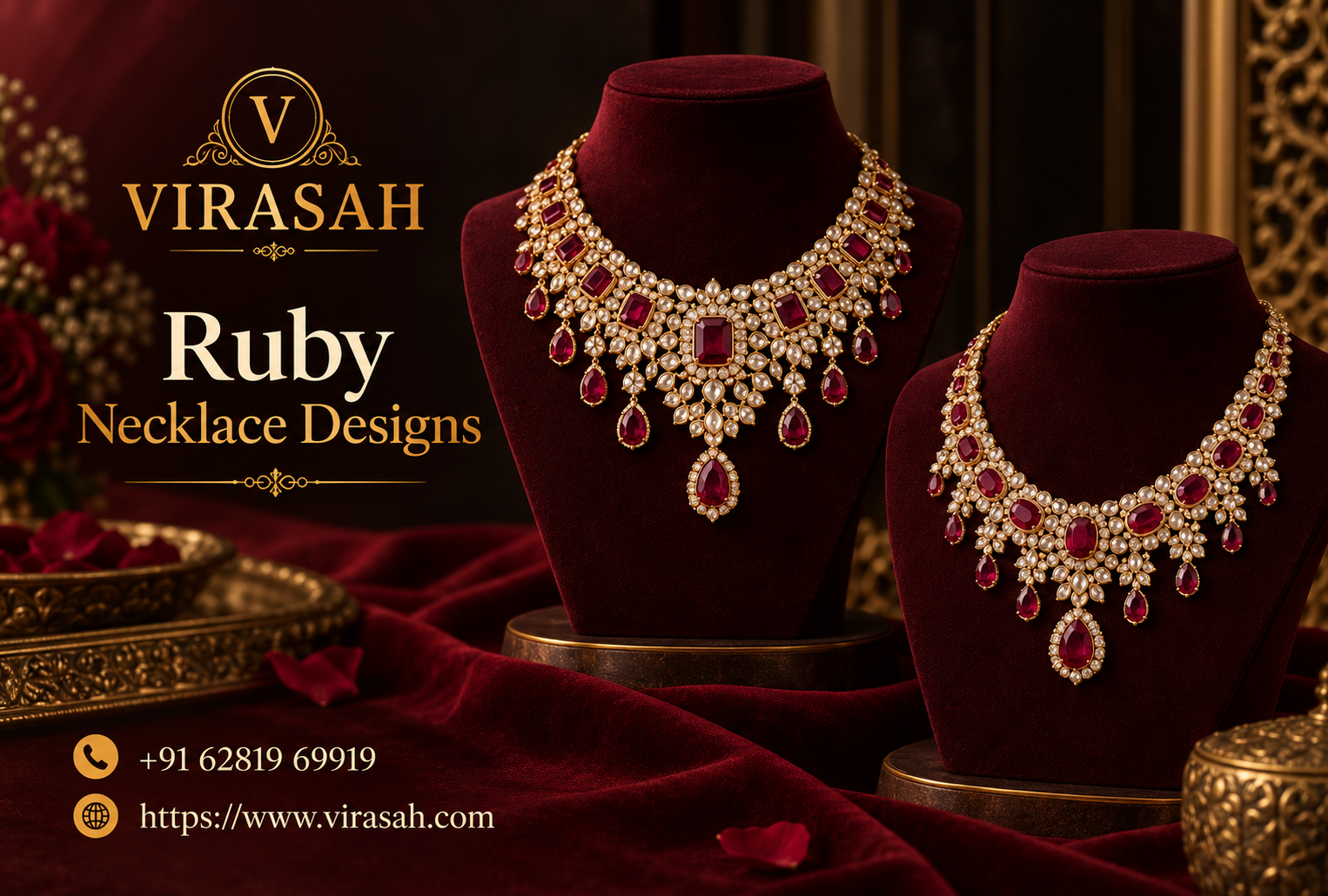
The Character of Ruby: Colour, Light, and Presence
The strongest Ruby Necklace Designs are designed around the personality of the stones rather than forcing every ruby into the same visual formula. Some rubies appear vivid and lively, while others have deeper wine-red, purplish-red, or slightly warm red tones. A lighter, brighter ruby can make delicate necklaces feel fresh and youthful. A richer, darker ruby can give traditional compositions a regal, ceremonial mood. Neither approach is automatically better; the best choice depends on the desired effect.
Lighting matters more than many first-time buyers expect. Jewellery viewed under warm boutique lighting may appear different in daylight, indoor white light, or evening event lighting. When evaluating Ruby Necklace Designs, it is useful to see the necklace in more than one light source. This helps you understand whether the rubies retain attractive colour and liveliness rather than looking appealing only under a particular lamp.
Traditional Ruby Necklace Designs for Weddings, Festivals, and Heirloom Dressing
Traditional Ruby Necklace Designs often use rhythm, repetition, symbolism, and layered ornament. Instead of relying on a single large centre stone, they may combine multiple ruby shapes with supporting diamonds, pearls, carved elements, beads, or enamel. This creates visual richness across the full neckline. For bridal dressing, that continuity can be especially important because the necklace needs to hold its presence next to embroidered textiles, zari, gemstones, and other jewellery.
1. Ruby Choker Necklaces
Chokers are among the most impactful Ruby Necklace Designs because they sit high on the neck and create a strong frame around the face. A traditional ruby choker may feature closely set gemstones, kundan-style construction, polki-inspired accents, pearl drops, or a repeating floral pattern. The short length works beautifully with deep, square, sweetheart, boat, and off-shoulder necklines, although the exact placement should be tested with the blouse or outfit before the final event.
2. Rani Haar and Long Ruby Necklaces
Long Ruby Necklace Designs inspired by rani haar proportions are ideal when the outfit has enough visual space to support vertical jewellery. These pieces can use ruby beads, carved drops, pendant centres, repeated floral clusters, or alternating ruby and diamond sections. The longer silhouette creates graceful movement and works especially well when paired with a shorter choker, allowing a bride to create a layered jewellery story without making the neck area feel crowded.
When layering, the two Ruby Necklace Designs should not compete at the same visual level. One piece can be dense and architectural while the other is more open and fluid. Another effective strategy is to repeat one element—such as a pearl edge, ruby shape, or gold motif—across both necklaces. This creates continuity even when the two pieces have different lengths and designs.
3. Temple-Inspired Ruby Necklaces
Temple-inspired Ruby Necklace Designs bring together sculptural gold work and the intensity of red gemstones. Traditional motifs may include floral borders, divine forms, peacocks, lotus patterns, coins, or granulated textures. Ruby accents can be used to highlight the eyes of a motif, create a gemstone frame, define a lower edge, or add movement through suspended drops. This style often looks particularly striking with silk sarees and richly woven textiles.
For a modern wearer, temple-inspired Ruby Necklace Designs do not need to be extremely heavy. A simplified pendant with a clean chain, a single motif at the centre, or a narrow row of ruby accents can preserve the cultural character while making the jewellery easier to repeat. This is a useful direction for buyers who want heritage references without committing to a highly ceremonial piece.
4. Ruby and Pearl Combinations
For lighter occasions, Ruby Necklace Designs with fine pearl detailing can bridge traditional and contemporary wardrobes. A ruby pendant with pearl fringe can work with a silk kurta one day and a solid-colour evening dress on another. The key is scale. When the pearls are small and the metalwork is controlled, the overall necklace becomes more versatile.
Modern Ruby Necklace Designs for Contemporary Wardrobes
Modern Ruby Necklace Designs usually reduce ornament but increase emphasis on proportion, negative space, and gemstone placement. Instead of covering the neckline, a contemporary design may focus attention on a few well-chosen rubies. This can make gemstone quality more visible and can also allow the necklace to move easily between formal and semi-formal dressing. A modern ruby piece should feel intentional from every angle, especially when its design is simple enough that small details become noticeable.
5. Minimal Ruby Pendants
The simplicity of these Ruby Necklace Designs means quality should be viewed carefully. When there is only one centre stone, its colour, cut, polish, and setting are highly visible. Ask how the ruby has been treated, whether there is a laboratory report where appropriate, and how the setting protects the stone from impact. A small pendant can still be a fine-jewellery purchase and deserves the same attention as a larger piece.
6. Ruby and Diamond Line Necklaces
Ruby-and-diamond line necklaces are among the most polished modern Ruby Necklace Designs. They may alternate rubies and diamonds, concentrate rubies near the centre, or use diamonds as subtle spacers between larger coloured stones. This creates sparkle without losing the red gemstone identity. The style works beautifully with evening gowns, cocktail saris, tailored suits, and clean monochrome outfits.
Because these Ruby Necklace Designs follow the curve of the neck, articulation matters. Each linked section should move smoothly so the necklace rests flat instead of twisting. The clasp should feel proportional to the weight of the piece. For expensive gemstone necklaces, a safety mechanism can provide additional confidence without disturbing the design.
7. Geometric and Asymmetrical Ruby Necklaces
These Ruby Necklace Designs are ideal for buyers who enjoy jewellery as design rather than ornament alone. They pair naturally with contemporary Indian clothing, fusion wear, minimalist evening outfits, and architectural silhouettes. If the necklace is strongly asymmetrical, keep earrings simpler so the eye has one clear focal point.
8. Ruby Station Necklaces
Station-style Ruby Necklace Designs place rubies at intervals along a fine chain rather than clustering them at the centre. This creates visual lightness and allows the skin or clothing beneath the chain to become part of the composition. Small bezel-set stones are especially practical because they reduce snagging and keep the necklace comfortable. The style can be worn alone or layered with fine gold chains.
A well-made station necklace proves that Ruby Necklace Designs do not need to be reserved for weddings or formal celebrations. With smaller stones and a refined chain, ruby becomes a daily colour accent. The necklace can work with a white shirt, black dress, linen saree, or tailored kurta, making it one of the most adaptable categories for a modern jewellery wardrobe.
Traditional vs Modern Ruby Necklaces: A Practical Comparison
| Design Direction | Typical Features | Best For | Styling Approach |
|---|---|---|---|
| Traditional Ruby Necklace Designs | Layered motifs, gold work, pearls, polki-inspired accents, dense gemstone placement | Bridal wear, festivals, family occasions, heirloom collections | Coordinate with outfit embroidery, earrings, bangles, and neckline |
| Modern these ruby pieces | Cleaner settings, negative space, geometric lines, fewer stones, refined chains | Evening wear, contemporary Indian fashion, work events, repeat styling | Use as a single focal piece with restrained supporting jewellery |
| Fusion Ruby Necklace Designs | Traditional gemstone language with simplified structure | Destination weddings, intimate functions, festive dinners, multi-use wardrobes | Mix classic textiles with modern blouse cuts or minimal tailoring |
How to Choose the Right Ruby Colour
Colour is usually the first decision when comparing Ruby Necklace Designs. Some buyers prefer a bright, vibrant red that remains lively from a distance. Others are drawn to darker or slightly purplish stones because they create a richer, more dramatic mood. When choosing, consider the necklace as a whole rather than judging an individual stone in isolation. A row of medium-sized rubies can create more impact than one very dark centre stone if the overall colour harmony is stronger.
In multi-stone Ruby Necklace Designs, consistency matters. The rubies do not need to be absolutely identical, especially in handcrafted jewellery, but major differences in tone or saturation can be distracting unless the variation is intentional. Look at the piece from arm’s length. If one stone appears noticeably dull or dark, it may interrupt the visual rhythm.
Ruby Cuts and Shapes That Change the Look of a Necklace
Shape strongly influences the personality of Ruby Necklace Designs. Oval rubies are versatile and can feel both classic and modern. Pear shapes create direction and movement, making them excellent for centre drops and lower borders. Cushion shapes feel substantial and romantic. Round rubies create strong repetition in line necklaces, while emerald-cut or rectangular stones can give the jewellery a more architectural identity.
Cabochon rubies offer a completely different mood. Their smooth domed surfaces can feel ancient, tactile, and sculptural, which makes them suitable for heritage-inspired Ruby Necklace Designs. Faceted stones, by contrast, interact with light through multiple polished surfaces and can feel sharper and more brilliant. A necklace may also combine both, using cabochons for the main composition and small faceted rubies for accents.
When evaluating cut, look beyond shape labels. In Ruby Necklace Designs, each ruby should contribute to balanced brightness, colour distribution, and symmetry appropriate to its position. Extremely shallow or poorly proportioned stones may appear less lively. A well-designed necklace considers not only each gemstone but how the entire group behaves together.
How Gold, Diamonds, and Other Gems Transform ruby jewellery designs
Yellow gold is the most recognisable partner for traditional Ruby Necklace Designs because the warmth of the metal supports the warmth of red. High-polish gold creates a festive effect, while matte, antique, or textured gold can make the necklace feel more artisanal. The amount of visible metal also changes the impression: broad gold borders feel ceremonial, while fine prongs and slender links allow ruby colour to dominate.
Diamonds add contrast and brightness to Ruby Necklace Designs. A diamond halo can sharpen the outline of an individual ruby, while small pavé accents can make a contemporary necklace feel luxurious without adding visual weight. In traditional pieces, diamonds or diamond-like white accents can break up large areas of red and gold, helping the eye read complex patterns more clearly.
Emeralds introduce a classic red-and-green palette that is closely associated with festive and bridal jewellery. Pearls soften that contrast, while sapphires can create a jewel-toned composition. When combining multiple gemstones in Ruby Necklace Designs, it is useful to choose one clear hero. If ruby is the focal stone, supporting colours should enhance its presence rather than dilute it.
Choosing Necklace Length for Neckline and Occasion
Length can completely change how Ruby Necklace Designs look on the body. A choker sits close to the neck and creates intensity around the face. A princess-length necklace falls slightly lower and is often the most adaptable choice for both Indian and Western clothing. A longer matinee or rani-haar proportion creates vertical movement and can be layered over higher necklines or open blouse shapes.
For bridal styling, Ruby Necklace Designs should also be planned in relation to the maang tikka, earrings, hair, dupatta or pallu, and blouse embroidery. If every element occupies the same visual zone, the result can look crowded. Good styling creates breathing room so the ruby necklace remains visible even in full-length photographs.
Bridal Ruby Necklace Designs: Building a Cohesive Wedding Jewellery Story
Bridal Ruby Necklace Designs should feel connected to the bride’s clothing, ceremony, and personal identity. Start with the outfit colour. Ruby works naturally with red, maroon, ivory, gold, blush, green, and many jewel tones, but the exact ruby shade and metal finish should complement rather than disappear into the fabric. On a heavily embellished blouse, a strongly outlined necklace may photograph better than a design with tiny scattered details.
Finally, consider movement and comfort. Wedding days involve long hours, photography, greetings, and repeated outfit adjustments. Heavy Ruby Necklace Designs should distribute weight evenly and sit securely. Earrings should be tested together with the necklace so the total jewellery weight remains comfortable. A spectacular look is most successful when the wearer does not need to constantly touch or reposition it.
Ruby Necklaces for Sarees
Sarees offer enormous freedom for Ruby Necklace Designs because blouse necklines, drapes, fabrics, and regional styling traditions vary widely. A silk saree with a broad border can support a temple-inspired necklace or traditional choker. A chiffon or organza saree may look better with a lighter ruby-and-diamond line necklace. A handloom saree can be beautifully contrasted with a clean pendant or a short ruby bead strand.
When styling Ruby Necklace Designs with a patterned saree, identify the dominant visual area. If the pallu has dense motifs near the shoulder, a simpler necklace may prevent competition. If the saree is mostly plain, the jewellery can carry more detail. The same ruby necklace can look completely different when moved from a heavily woven textile to a minimalist drape.
Ruby Necklaces for Lehengas and Anarkalis
Lehengas and anarkalis often create a broad decorative field across the torso, so Ruby Necklace Designs should be chosen with proportion in mind. Deep necklines can support chokers and layered combinations. Higher necklines usually work better with longer pendants or necklaces that sit above the garment rather than colliding with the embroidery. The goal is to create clear separation between jewellery and textile detail.
Ruby Necklaces with Modern Dresses and Tailoring
One of the most exciting uses of Ruby Necklace Designs is with modern clothing. A ruby pendant over a black column dress feels clean and dramatic. A fine ruby-and-diamond necklace with a white shirt creates an unexpected luxury detail. A structured pantsuit can be paired with a short ruby necklace instead of a traditional pendant, especially for receptions, formal dinners, and cultural events where the wearer wants a fusion look.
With contemporary outfits, let Ruby Necklace Designs carry the colour. Avoid adding too many competing red accessories unless a monochromatic look is intentional. Ruby is powerful enough to act as the visual anchor, so shoes, bag, and makeup can remain neutral or pick up small supporting tones rather than repeating the same red everywhere.
How to Build a Ruby Necklace Wardrobe at Different Investment Levels
A jewellery wardrobe does not need several large Ruby Necklace Designs at once. A sensible starting point is a small pendant or short station necklace that can be worn repeatedly. The next addition might be a more formal ruby-and-diamond piece for celebrations. A highly traditional or bridal necklace can then become the statement investment. Building slowly allows each purchase to serve a distinct role.
Understanding Ruby Quality Before You Buy
When comparing Ruby Necklace Designs, buyers commonly hear about colour, clarity, cut, and carat weight. These factors matter, but coloured gemstones are not evaluated in exactly the same way as diamonds. Ruby often contains natural inclusions, and an expectation of absolute internal perfection can be unrealistic. The key question is whether inclusions significantly affect transparency, beauty, or durability.
Colour is generally the strongest visual driver for Ruby Necklace Designs. Look for a red that feels attractive to you across different lighting conditions. Then consider how well the stones are matched, how the cut supports brightness, and whether the necklace has a lively appearance at normal viewing distance. A technically impressive stone is not useful if it looks dull in the finished design.
For higher-value ruby jewellery designs, independent gemological documentation can add useful information about whether a ruby is natural or laboratory-grown and whether detectable treatments are present. Documentation should complement, not replace, careful visual evaluation and a clear conversation with the jeweller.
Ruby Treatments: Questions Every Buyer Should Ask
Many rubies in the market are treated, and heat treatment is widely encountered. Some rubies may have other forms of enhancement. When purchasing Ruby Necklace Designs, ask the seller to explain treatment status in clear language and to provide written disclosure where appropriate. Treatment can affect value, care requirements, and how two apparently similar necklaces should be compared.
Do not treat the word “natural” as if it automatically means “untreated.” A natural ruby can still have been heated. Likewise, laboratory-grown ruby is chemically and physically similar in many respects to natural ruby but has a different origin. Reputable descriptions of Ruby Necklace Designs should make these distinctions clear so buyers understand what they are purchasing.
If Ruby Necklace Designs use valuable centre stones or unusually large rubies, ask whether reports from recognised independent laboratories are available. For necklaces with many small stones, documentation may be provided in a different form. The important point is transparency: the invoice, product description, and verbal explanation should not contradict one another.
Internal Reading from Virasah
To deepen your understanding before comparing Ruby Necklace Designs, explore these related Virasah guides:
- Ruby Jewelry Guide: Meaning, Quality and Buying Tips
- Burmese Ruby: Why It Is One of the World’s Most Valuable Gemstones
- Best Wedding Jewelry for Indian Brides: Complete Checklist
- Rare Gemstones in India: Complete Guide for Jewelry Lovers
- Sapphire Jewelry Guide: How to Choose the Perfect Sapphire
- Kashmir Sapphire: Why This Rare Gemstone Is So Valuable
- Tanzanite Jewelry: Meaning, Rarity and Buying Guide
- Best Emerald Jewelry Designs for Weddings and Special Occasions
- Best Diamond Cuts for Engagement Rings: A Complete Buying Guide
How ruby necklace styles Can Move Between Generations
A powerful reason to invest in fine Ruby Necklace Designs is their potential to be restyled across generations. A necklace purchased as a bridal jewel may later be worn with a simpler saree, separated into detachable components, or paired with modern earrings. Thoughtful construction can make this easier. Detachable pendants, removable pearl strands, convertible side chains, and modular drops can extend the life of a design.
Heirloom value is not only about monetary appreciation. Ruby Necklace Designs can carry memories of weddings, anniversaries, family milestones, and personal achievements. When choosing a long-term piece, pay attention to whether the design feels connected to the wearer’s identity rather than simply following the loudest current trend. Jewellery that feels personal is more likely to remain meaningful.
Storage and maintenance also affect heirloom potential. Keep Ruby Necklace Designs in a dry, protected jewellery box with enough separation to prevent metal and gemstones from rubbing against harder pieces. Retain invoices, lab reports, service records, and photographs. Documentation makes future maintenance, insurance, valuation, and family transfer easier.
Everyday Ruby Necklaces: Making Red Gemstones Easy to Wear
Everyday ruby necklaces should prioritise comfort, secure settings, and simple silhouettes. A small bezel-set ruby pendant is an excellent example because the metal edge protects the stone and reduces snagging. Fine station necklaces can also work well if each ruby is securely set and the chain has enough strength for routine use.
For office wear, Ruby Necklace Designs can add polish without becoming the centre of the entire outfit. Choose smaller stones, restrained diamond accents, and a chain length that sits neatly with shirts or modest necklines. A ruby necklace can look sophisticated with navy, cream, charcoal, beige, olive, and black, not only with red or gold clothing.
For weekend styling, combine Ruby Necklace Designs with softer fabrics and simpler earrings. Ruby works well with linen, cotton, denim, and unstructured silhouettes because the contrast makes the jewellery feel less formal. The result is especially effective when the necklace itself has a modern setting and visible negative space.
Statement Ruby Necklaces: When More Is the Right Choice
Statement Ruby Necklace Designs are designed to command attention, and that is not a flaw. The key is allowing enough visual space around them. If a necklace has multiple rows, large rubies, heavy gold work, or elaborate drops, reduce competing jewellery near the face. A strong pair of earrings may still work, but additional necklaces can make the styling feel unresolved.
Comfort remains important. Large Ruby Necklace Designs should be tried while sitting, walking, turning the neck, and raising the arms. Check whether the lower edge flips, whether the side sections pull toward the back, and whether the clasp stays centred. High-impact jewellery is best when its engineering is as considered as its ornament.
Matching Earrings with Ruby Necklaces
Not every pair of Ruby Necklace Designs and earrings needs to be an exact set. Matching ruby colour, metal finish, and one design motif is often enough. For a heavy choker, medium studs or shorter drops can keep the face open. For a simple pendant, longer ruby earrings can carry more of the visual drama. The balance should respond to hairstyle, face shape, and neckline.
When Ruby Necklace Designs contain pearls or emerald accents, the earrings can repeat those secondary materials. This creates a coordinated look without making the entire set identical. Modern styling can go further by pairing ruby necklaces with plain diamond studs, sculptural gold earrings, or even no earrings for a very clean evening look.
Styling Ruby Necklaces with Other Jewellery
Bracelets, bangles, rings, and hair jewellery should support Ruby Necklace Designs rather than compete with them. If the necklace is traditional and dense, choose one or two repeating visual cues for the rest of the jewellery—perhaps ruby cabochons, pearl drops, or a similar gold texture. Repetition creates unity.
What Makes a Ruby Necklace Look Expensive Without Looking Excessive
The most luxurious Ruby Necklace Designs are not always the largest. Expensive-looking design often comes from proportion, precise setting, gemstone matching, refined finishing, and restraint. A necklace with clean articulation and well-spaced stones can appear more sophisticated than one that simply adds more material. This is especially true in contemporary jewellery where each detail is exposed.
In traditional Ruby Necklace Designs, richness should still have structure. Repeated motifs need consistent scale. Pearl fringes should hang evenly. Centre drops should align with the necklace’s axis. The back and side construction should feel as polished as the front. These details may be subtle, but together they create the difference between jewellery that feels crafted and jewellery that feels merely crowded.
Common Buying Mistakes to Avoid
One common mistake is choosing Ruby Necklace Designs only from close-up photos. Macro images are useful for seeing details, but they do not show scale on the body. Request or view photographs of the necklace being worn, and note the model’s approximate proportions. If possible, try the piece with a neckline similar to your own clothing.
A third mistake is neglecting disclosure and after-sales support. Before buying Ruby Necklace Designs, understand gemstone treatment, metal purity, return or exchange terms, repair options, resizing possibilities, and documentation. Fine jewellery may need clasp servicing, chain repair, stone tightening, or professional cleaning over time, so the relationship with the jeweller matters.
How to Evaluate Craftsmanship
Turn Ruby Necklace Designs over and inspect the back. The reverse side can reveal how carefully the piece is constructed. Settings should look neat, edges should be smooth, and linked sections should move without catching. In necklaces with multiple articulated elements, each joint should have enough freedom to follow the body while remaining secure.
Inspect stone alignment from the front. In symmetrical Ruby Necklace Designs, the left and right sides should feel balanced. In asymmetrical pieces, the imbalance should look intentional and visually stable. Check whether centre stones sit straight and whether lower drops hang freely. Tiny errors become more visible once a necklace is photographed.
Clasp quality deserves special attention. Valuable Ruby Necklace Designs need a closure appropriate to their weight. A delicate spring-ring clasp may be suitable for a light pendant but not for a heavy multi-row necklace. Ask how the clasp locks, whether there is a secondary safety feature, and whether replacement or servicing is available.
How to Care for Ruby Necklaces
Cleaning methods depend on the ruby, setting, treatments, and any additional materials in the necklace. Although ruby itself is durable, Ruby Necklace Designs may include pearls, filled stones, adhesives, enamel, or delicate settings that require gentler care. When treatment history is uncertain, avoid aggressive home cleaning and ask a professional jeweller for guidance.
Perfume, hairspray, lotions, and makeup are best applied before putting on Ruby Necklace Designs. Remove jewellery before swimming, heavy exercise, household cleaning, or activities where the necklace may be hit or pulled. Periodic professional inspection is especially useful for frequently worn pieces and necklaces with many small stones.
Authoritative Gemstone Resources
For readers researching ruby quality and gemmology alongside Ruby Necklace Designs, these independent educational resources are useful. These are standard do-follow links; no nofollow attribute is applied.
How to Make ruby necklaces Feel Personal
Personalisation can turn beautiful Ruby Necklace Designs into jewellery with a specific story. This may be as simple as choosing a ruby shade that connects to a wedding outfit or family tradition. It may involve incorporating an inherited gemstone into a new setting, adding a removable pendant, using a motif with personal meaning, or selecting a chain length that suits the wearer’s everyday wardrobe.
Custom Ruby Necklace Designs should begin with lifestyle questions, not only visual references. How often will the necklace be worn? Will it be used with sarees, dresses, or both? Does the wearer prefer close-fitting jewellery or longer pieces? Are detachable components important? Answers to these questions help a designer make choices that remain useful long after the first occasion.
Ruby Necklaces as Anniversary and Milestone Gifts
Ruby Necklace Designs make memorable gifts because ruby is strongly associated with passion, vitality, and lasting affection in jewellery tradition. A pendant can mark an anniversary without requiring the recipient to dress formally, while a more elaborate necklace can celebrate a major family milestone. July birthdays are another natural occasion because ruby is the traditional July birthstone.
Ruby Necklaces for Different Age Groups
Age should not dictate style, but lifestyle often changes how Ruby Necklace Designs are worn. Younger buyers may prefer station chains, slim chokers, or geometric pendants that can be paired with both Indian and Western clothing. Brides and frequent event-goers may invest in layered or more elaborate pieces. Mature collectors may prioritise gemstone quality, craftsmanship, provenance, and designs that coordinate with established wardrobes.
The most successful Ruby Necklace Designs cross these categories. A well-proportioned ruby-and-diamond necklace can look fresh on a younger wearer and elegant decades later. A traditional pendant can be moved onto a modern chain. A family choker can be worn with a contemporary blouse. Flexibility is one of the strongest signs that a design has longevity.
How Trends Should Influence Your Choice
Trends can be useful inspiration for Ruby Necklace Designs, especially in chain length, layering, mixed materials, asymmetry, and styling. The mistake is allowing a trend to control every permanent part of an expensive piece. If you love a current look, consider making trend-sensitive elements detachable or choosing a core necklace that can be styled in multiple ways.
Timeless Ruby Necklace Designs usually have one strong idea rather than many competing fashion signals. That idea may be a beautiful sequence of oval rubies, a sculptural centre pendant, a traditional floral border, or an elegant collar line. When the design has clarity, it is easier to reinterpret with different outfits over time.
Planning a Custom Ruby Necklace: A Step-by-Step Approach
- Define the main use. Decide whether the the necklace style will be bridal, festive, evening, or everyday.
- Set a design direction. Choose traditional, modern, or fusion before selecting every small detail.
- Choose the neckline placement. Decide where the necklace should sit on the body.
- Select ruby character. Compare brighter and deeper red stones in multiple lighting conditions.
- Choose supporting materials. Decide whether diamonds, pearls, emeralds, enamel, or textured gold are necessary.
- Review comfort and engineering. For Ruby Necklace Designs, articulation, clasp security, and weight distribution are essential.
- Ask for disclosure. Confirm gemstone identity, treatments, metal purity, and relevant documentation.
- Review the final design at scale. Ensure the drawing or rendering reflects actual necklace proportions.
Why Ruby Works So Well in Indian Jewellery Design
Ruby Necklace Designs fit naturally into Indian jewellery because red already has a strong presence in wedding textiles, festive clothing, ceremonial colour palettes, and historic ornament traditions. Ruby can act as the dominant gem, a border, a centre accent, or a rhythmic detail. This allows designers to use it across very different regional and stylistic influences.
At the same time, Ruby Necklace Designs do not need to feel traditional in a predictable way. Indian fine jewellery increasingly moves between heritage craftsmanship and international styling. A necklace can use familiar ruby-and-gold language while simplifying the silhouette. It can use a traditional centre motif with a modern chain. It can pair rubies with diamonds in a structure that works equally well with a saree or a black evening dress.
Ruby Necklace Design Ideas by Occasion
Engagement or Roka
For engagement events, ruby jewellery designs with a defined centre and moderate scale work well because they remain visible in photographs without overwhelming the outfit. Consider a ruby-and-diamond collar, an oval ruby pendant with matching side accents, or a refined short necklace with pearl drops. These styles can often be reused for later celebrations.
Mehendi or Haldi
For colourful pre-wedding events, lighter Ruby Necklace Designs are usually easier to wear. Station necklaces, short bead strands, or delicate pendants can add colour while allowing movement. If the outfit already includes floral jewellery or vivid embroidery, keep the ruby piece clean so it does not compete.
Wedding Ceremony
The wedding ceremony can support more elaborate Ruby Necklace Designs, especially when the necklace is planned with the blouse neckline and dupatta drape. A traditional choker layered with a longer ruby necklace is a classic option. A single grand collar can also work if the rest of the jewellery is coordinated around it.
Reception
Reception styling gives room for more contemporary Ruby Necklace Designs. Diamond-forward ruby lines, asymmetrical collars, and sleek pendants can pair beautifully with gowns, contemporary lehengas, and structured sarees. This is often the ideal event to shift from heritage ornament to a cleaner evening-jewellery mood.
How to Compare Two Ruby Necklaces Side by Side
Take photos of both Ruby Necklace Designs against the same outfit and in the same lighting. Look again a few hours later. Often the better choice becomes clearer when you are no longer standing under showroom lights. The necklace that still feels balanced and distinctive in ordinary photographs may be the one you wear more often.
Questions to Ask a Jeweller Before Purchasing
- Are the rubies natural, laboratory-grown, or a combination?
- What treatments have been disclosed for the rubies used in these Ruby Necklace Designs?
- Is independent laboratory documentation available for significant stones?
- What is the metal purity and total metal weight?
- How is the necklace clasp secured?
- Can the necklace be adjusted, shortened, lengthened, or converted?
- What care instructions apply to the entire piece, including pearls or other gems?
- What after-sales inspection, repair, and cleaning services are available for Ruby Necklace Designs?
Frequently Asked Questions About Ruby Necklace Designs
1. Are ruby necklaces suitable only for bridal wear?
No. ruby necklaces range from elaborate bridal chokers to tiny pendants and fine station chains. The setting, stone size, necklace length, and amount of supporting ornament determine how formal the piece feels. A minimal ruby pendant can be worn frequently, while a multi-row necklace may be reserved for major celebrations.
2. Which metal looks best with ruby?
Yellow gold gives Ruby Necklace Designs a warm and classic appearance, white gold or platinum can create crisp contrast, and rose gold produces a softer romantic effect. There is no single best metal. Choose based on skin tone, existing jewellery, outfit palette, and the mood you want the necklace to create.
3. How can I tell whether a ruby necklace is good quality?
Evaluate Ruby Necklace Designs at two levels: the gemstones and the construction. Look at ruby colour, transparency, cut, matching, and disclosed treatments, then inspect setting quality, articulation, clasp security, finishing, and comfort. For significant stones, independent gemological reports may provide additional identification and treatment information.
4. Are natural inclusions in ruby a problem?
Not automatically. Natural rubies commonly contain inclusions. In Ruby Necklace Designs, the important question is whether inclusions significantly reduce transparency, beauty, or durability. A ruby does not need to be completely inclusion-free to be attractive or valuable, but major fractures or very obvious inclusions should be understood before purchase.
5. Can I wear a ruby necklace every day?
Some these ruby pieces are well suited to frequent wear, especially pendants and securely set station necklaces. The entire piece must be considered, including chain strength, setting style, treatment history, and any additional materials. Remove fine jewellery before heavy exercise, swimming, cleaning, or activities that may expose it to impact.
6. What necklace length is best for a ruby choker?
The ideal length for choker-style Ruby Necklace Designs depends on the wearer’s neck circumference and the structure of the necklace. A choker should sit close without feeling restrictive. Adjustable back chains can be useful, especially for bridal jewellery that may be worn with different blouse necklines.
7. Can ruby necklaces be paired with emerald earrings?
Yes. Ruby Necklace Designs can work beautifully with emerald accents, especially in festive and bridal styling. To keep the combination coherent, repeat one connecting element such as gold tone, diamond details, pearl drops, or a shared design motif. The two colours should look intentionally balanced rather than randomly mixed.
8. Are heat-treated rubies acceptable in fine jewellery?
Heat treatment is commonly encountered in the ruby market. When considering Ruby Necklace Designs, the important issue is clear disclosure. Different treatments can influence value and care, so ask what has been done to the stones and whether the information is stated on the invoice or relevant documentation.
9. How should I store a ruby necklace?
Store Ruby Necklace Designs separately in a lined box or soft pouch so the necklace does not rub against other jewellery. Lay articulated pieces in a natural curve rather than folding them sharply. Keep chains untangled, protect delicate drops, and retain certificates, invoices, and service records in a separate safe place.
10. Can an old ruby necklace be redesigned?
Often, yes. Older the necklace style may be redesigned into lighter necklaces, detachable pendants, earrings, bracelets, or modular sets, depending on the stones and construction. Before altering an heirloom, document the original piece and ask a skilled jeweller to assess stone condition, setting limitations, and sentimental value.
Final Thoughts: Choosing a Ruby Necklace You Will Still Love Years Later
The best Ruby Necklace Designs are not simply the pieces with the largest stones or the most elaborate workmanship. They are the ones in which gemstone character, design, comfort, craftsmanship, and personal meaning come together. Traditional styles can preserve the richness of Indian jewellery heritage, while modern styles can make ruby easier to wear in contemporary life. Fusion designs can do both at once.
When you compare Ruby Necklace Designs, give yourself time to look beyond the first impression. Study the necklace in different lighting, inspect the back, ask about treatments and documentation, try it with real clothing, and think about how often you will wear it. Fine jewellery is most satisfying when it works not only in a showroom but in the life of the person who owns it.
Whether you are choosing a bridal choker, an heirloom-inspired long necklace, a minimal pendant, or a clean ruby-and-diamond line, Ruby Necklace Designs offer a rare combination of warmth, colour, tradition, and modern elegance. A carefully chosen piece can become part of celebrations today and a meaningful object for the next generation.
Explore more fine jewellery inspiration and gemstone guides at Virasah. If you are exploring ruby jewellery designs for a wedding, special occasion, gift, or personal collection, begin with the design that feels true to your style and then evaluate the gemstones and craftsmanship that bring that idea to life.
Contact Virasah :
For enquiries about Ruby Necklace Designs and fine jewellery, contact Virasah.
Phone: +91 62819 69919
Website: www.virasah.com