Pear Cut vs Marquise Cut Diamond: Complete Comparison
Choosing between elongated diamond shapes can be surprisingly difficult because both designs create a graceful, eye-catching appearance while delivering very different personalities. Pear Cut vs Marquise Cut Diamond is therefore not simply a comparison of two silhouettes. It is a decision involving sparkle, finger coverage, symmetry, durability, setting style, proportions, personal expression, budget and the way the finished jewelry will be worn.
The pear combines the rounded softness of one end with a single elegant point, while the marquise creates a longer, symmetrical silhouette with pointed ends on both sides. In a detailed Pear Cut vs Marquise Cut Diamond evaluation, neither shape should automatically be called superior. The better choice depends on the visual effect you want and, more importantly, on the quality of the individual stone.
This Virasah guide approaches Pear Cut vs Marquise Cut Diamond from a practical jewelry-buying perspective. We will compare shape, brilliance, bow-tie visibility, proportions, face-up appearance, clarity, color, carat weight, durability, settings, engagement-ring styling and buying considerations so that you can evaluate actual diamonds rather than relying only on photographs.
If you are exploring fine jewelry and gemstone education, visit Virasah. Understanding Pear Cut vs Marquise Cut Diamond in detail can help you identify which elongated silhouette fits your aesthetic and lifestyle before you begin comparing individual stones.
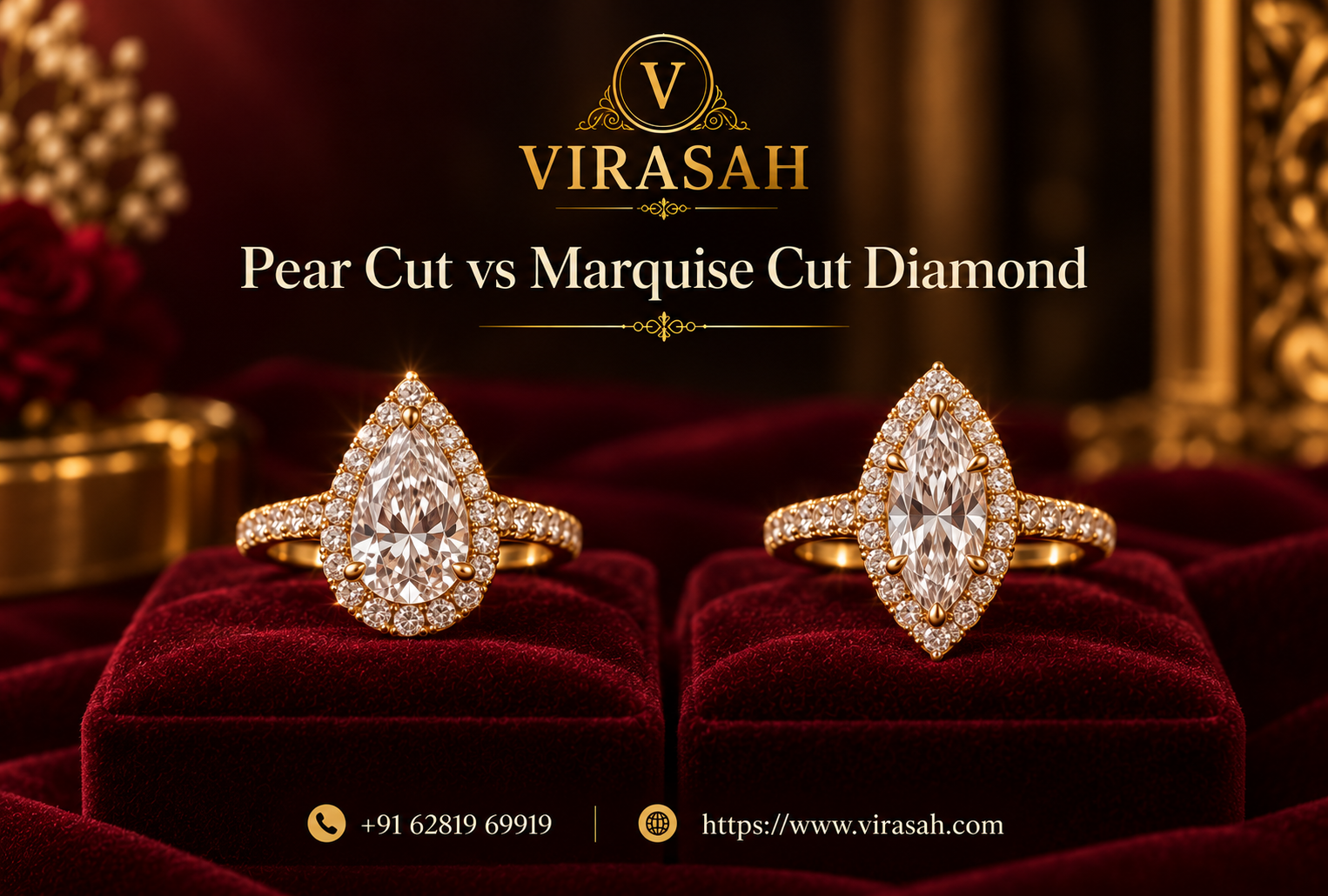
Quick Comparison: Pear-Shaped and Marquise Diamonds
At first glance, the decision may appear to be purely stylistic. However, Pear Cut vs Marquise Cut Diamond involves several technical characteristics that influence how large, bright and balanced a stone appears once it is mounted.
For shoppers who want asymmetry and a soft romantic profile, the pear is distinctive without appearing overly geometric. For those who prefer dramatic length and maximum visual extension across the finger, the marquise is especially compelling. This difference is central to Pear Cut vs Marquise Cut Diamond selection.
| Feature | Pear-Shaped Diamond | Marquise-Shaped Diamond |
|---|---|---|
| Silhouette | Rounded end with one tapered point | Elongated body with two pointed ends |
| Overall Personality | Romantic, graceful, artistic | Bold, elegant, dramatic |
| Finger Effect | Creates an elegant lengthening effect | Creates particularly strong length and finger coverage |
| Orientation | Point can face toward or away from the wearer | Usually aligned vertically along the finger |
| Bow-Tie | Possible and should be visually evaluated | Possible and often important to evaluate |
| Point Protection | One vulnerable tip | Two vulnerable tips |
| Symmetry | Important, although intentionally asymmetric end-to-end | Extremely noticeable due to two matching pointed ends |
| Best For | Distinctive romantic rings and pendants | Statement rings with elongated presence |
A useful way to approach Pear Cut vs Marquise Cut Diamond is to first decide which outline you love and then judge the actual stone for proportions, brightness, bow-tie intensity and symmetry. Selecting a shape first but remaining flexible about exact carat weight can often produce a more attractive final result.
The most important lesson in Pear Cut vs Marquise Cut Diamond shopping is that fancy-shaped diamonds should be judged visually. Numbers narrow the search, but they cannot completely describe how beautiful a particular pear or marquise will appear.
Understanding the Pear-Shaped Diamond
The pear-shaped diamond is sometimes described as a teardrop shape. Its combination of curves and a defined point creates an unusual balance between softness and direction. Within a Pear Cut vs Marquise Cut Diamond comparison, this asymmetry is one of the pear's most important design characteristics.
A well-proportioned pear should have graceful shoulders rather than looking excessively broad, boxy or narrow. The rounded end should flow naturally toward the point, and the point should align with the center of the stone. In Pear Cut vs Marquise Cut Diamond shopping, examine the pear face-up rather than evaluating it only from measurements on a grading report.
Why People Choose Pear-Shaped Diamonds
Pears work particularly well for buyers who want a diamond that feels different from traditional round, oval or princess shapes but remains elegant. They can be worn with the point facing toward the fingertip for a lengthening effect or rotated in the opposite direction for a different visual balance.
The pear's outline also gives jewelry designers opportunities to create halos, botanical motifs, drop earrings and pendants. The Pear Cut vs Marquise Cut Diamond decision may therefore change depending on whether the diamond is intended for an engagement ring, necklace, earrings or a statement piece.
Buying tip: When assessing Pear Cut vs Marquise Cut Diamond, check that the pear's rounded end is neither flattened nor excessively bulged and that the pointed end appears centered when viewed directly from above.
Understanding the Marquise-Shaped Diamond
A marquise diamond has an elongated brilliant-style outline that narrows into points at both ends. Its dramatic length is immediately recognizable. In Pear Cut vs Marquise Cut Diamond comparisons, marquise stones usually create a more symmetrical and architectural appearance than pear shapes.
The ideal visual profile depends partly on taste. Some buyers prefer a fuller marquise with gently rounded sides, while others enjoy a slender design that emphasizes length. When considering Pear Cut vs Marquise Cut Diamond, avoid choosing solely by length-to-width ratio because two stones with similar measurements can still display different outlines and light performance.
Why Marquise Diamonds Attract Attention
The long face-up spread can create significant visual presence. Because much of the diamond's weight can be distributed across its length and width instead of depth, a beautifully proportioned marquise may appear impressively large for its carat weight.
This quality makes the Pear Cut vs Marquise Cut Diamond discussion particularly relevant for buyers who care about finger coverage. A marquise often delivers a strong elongated effect, but its two pointed tips also require thoughtful setting protection.
Symmetry matters enormously with this shape. In a high-quality Pear Cut vs Marquise Cut Diamond comparison, the two sides of the marquise should mirror each other, both points should align with the central axis and the widest areas should feel balanced rather than uneven.
Design Personality, History and Visual Character
Jewelry preferences are shaped not only by grading specifications but also by emotional response. Pear Cut vs Marquise Cut Diamond presents two silhouettes with very different personalities despite both belonging to the broader family of elongated brilliant-style diamonds.
The pear feels fluid because a rounded curve gradually transforms into a point. It can suggest a teardrop, leaf or drop of water, which makes it particularly suited to romantic and organic jewelry compositions. The marquise has a stronger sense of geometry and symmetry, with an outline that appears energetic because both ends taper outward.
When considering Pear Cut vs Marquise Cut Diamond, think about the jewelry already in your collection. Someone who consistently chooses soft curves may naturally prefer a pear. Someone attracted to striking symmetry, elongated shapes and vintage-inspired silhouettes may respond more strongly to a marquise.
Virasah readers who enjoy exploring gemstone character can also read our Tanzanite Jewelry Meaning, Rarity and Buying Guide and our guide to Burmese Ruby and its remarkable value. These guides demonstrate why gem selection is rarely based on a single specification.
A thoughtful Pear Cut vs Marquise Cut Diamond choice should therefore begin with emotional preference and then be validated with technical inspection. Jewelry is worn visually, so the silhouette you continue to enjoy after repeated viewing deserves serious consideration.
Ultimately, Pear Cut vs Marquise Cut Diamond is as much about visual identity as measurable quality. The objective specifications help you avoid poor stones; personal style determines which successful stone belongs in your jewelry.
Shape and Visual Proportions
Proportion determines whether an elongated diamond appears elegant, heavy, narrow, short or beautifully balanced. This is one of the most important considerations in Pear Cut vs Marquise Cut Diamond evaluation.
With a pear, look closely at the shoulders near the rounded end. Extremely broad shoulders can produce a bulky appearance, while very narrow shoulders may make the stone look thin. With a marquise, inspect how smoothly the sides curve before meeting the tips. Abrupt transitions can disrupt the silhouette.
The outline becomes particularly important because fancy-shaped diamonds do not all conform to a single universally preferred appearance. A Pear Cut vs Marquise Cut Diamond buyer may legitimately prefer a slender version while another buyer wants a fuller stone.
Do Not Judge Proportions From Ratio Alone
Length-to-width ratio is useful because it describes elongation, but it is not a beauty grade. Two pears with the same ratio may have entirely different shoulders and points. Two marquise diamonds with identical ratios may differ in curvature, bow-tie appearance and symmetry.
That is why Pear Cut vs Marquise Cut Diamond shopping should combine report data with high-resolution face-up viewing whenever possible. Measurements are a filtering tool; appearance remains the final test.
For buyers who are still learning how different shapes interact with settings, our complete guide to the best diamond cuts for engagement rings provides additional context. Use it alongside your Pear Cut vs Marquise Cut Diamond research when comparing these shapes with round, oval, emerald and other popular cuts.
Sparkle, Brilliance and Light Performance
Both shapes can produce lively brilliance, but every fancy-shaped diamond handles light differently. The optical performance of Pear Cut vs Marquise Cut Diamond should therefore be assessed stone by stone rather than predicted from shape alone.
Brightness describes the white light returning from a diamond, while fire describes flashes of spectral color and scintillation relates to changing patterns of light and dark as the diamond, light source or viewer moves. A beautiful elongated diamond should create a pleasing combination rather than large lifeless areas.
The Pear Cut vs Marquise Cut Diamond decision becomes easier when you compare candidates in similar lighting. Jewelry-store spotlights can make almost every diamond look dramatic, so request views under softer ambient light if possible.
Why Fancy Shapes Need Visual Inspection
GIA's cut grading system assigns an overall cut grade to standard round brilliant diamonds in the D-to-Z color range, while fancy shapes require more visual judgment. You can learn more about the principles behind diamond light performance from the GIA diamond cut reference.
That distinction matters in Pear Cut vs Marquise Cut Diamond shopping because buyers sometimes expect a simple cut-grade label to make the decision for them. Instead, inspect videos and photographs while paying attention to brightness distribution, symmetry and distracting dark regions.
A balanced Pear Cut vs Marquise Cut Diamond comparison asks a straightforward question: does the diamond look lively across most of its surface as it moves, or does one large area remain persistently dark? Visual performance should carry more weight than chasing a single measurement.
The Bow-Tie Effect: What Buyers Should Know
Bow-tie patterns are commonly discussed when buying elongated brilliant-style diamonds. A dark area may appear across the center because of how light interacts with the stone's facet arrangement and viewing environment. It is a significant part of Pear Cut vs Marquise Cut Diamond evaluation.
A subtle bow-tie is not automatically a defect. In fact, some contrast can contribute to scintillation and visual character. The concern is an extremely dark or persistent bow-tie that dominates the center and makes the diamond appear visually divided.
In Pear Cut vs Marquise Cut Diamond shopping, do not attempt to judge bow-tie intensity from a grading report alone. Videos of the actual diamond are much more useful because you can observe how the central region behaves as the stone moves.
How to Check a Bow-Tie
- View the diamond face-up rather than only at an angle.
- Look at it under more than one lighting condition.
- Rotate or tilt it slowly.
- Observe whether the dark center disappears and returns naturally.
- Compare multiple stones of similar size.
- Avoid assuming every visible contrast pattern is undesirable.
A well-selected Pear Cut vs Marquise Cut Diamond should show enough contrast to create life without allowing a heavy dark band to overpower the stone. This is an area where seeing several candidates side by side can be more valuable than memorizing theoretical proportions.
When evaluating Pear Cut vs Marquise Cut Diamond, treat bow-tie appearance as one characteristic among several. A slight bow-tie may be perfectly acceptable if the stone offers excellent shape, brightness, symmetry and overall visual appeal.
Face-Up Size and Finger Coverage
Carat is a unit of weight rather than a direct measurement of visible size. This distinction becomes particularly relevant with Pear Cut vs Marquise Cut Diamond because elongated stones can distribute weight very differently.
A marquise is famous for its long outline and can deliver substantial finger coverage, particularly when mounted north-south along the finger. A pear also creates a strong visual spread, but the single rounded end gives it a more concentrated and softer appearance.
When comparing stones of identical carat weights, record the actual millimeter dimensions. For Pear Cut vs Marquise Cut Diamond, length and width often explain face-up appearance more clearly than carat weight by itself.
Visual Size Is Not Everything
Do not automatically select the longest diamond available. An extremely shallow stone may produce impressive measurements but disappointing light performance. Likewise, excessive depth can hide unnecessary weight below the setting.
The goal in Pear Cut vs Marquise Cut Diamond selection is to find a pleasing balance between spread and beauty. An attractive outline with good light return usually looks more luxurious than a larger measurement accompanied by weak optical performance.
For Pear Cut vs Marquise Cut Diamond, try viewing scaled photographs or gemstone outlines on a finger similar in size to the intended wearer. This can help you understand how a 10 mm stone differs from a 12 mm stone in real visual terms instead of relying only on carat labels.
Length-to-Width Ratio and the Look of Elongation
Length-to-width ratio is calculated by dividing a diamond's length by its width. It is one of the most useful measurements when narrowing a Pear Cut vs Marquise Cut Diamond search, but there is no single ratio that suits every buyer.
Pear-shaped diamonds are often selected in a moderately elongated range, with many shoppers gravitating toward ratios roughly around 1.45 to 1.75. Marquise diamonds are naturally longer and buyers often explore ratios around approximately 1.75 to 2.15. These are preference ranges rather than absolute quality rules.
In Pear Cut vs Marquise Cut Diamond selection, a lower ratio generally creates a fuller appearance while a higher ratio produces a slimmer silhouette. The outline should still appear harmonious at whichever ratio you prefer.
How Ratio Influences Jewelry Design
A very slender pear can create an elegant pendant drop, while a fuller pear may provide greater presence in a halo engagement ring. A long marquise can appear especially dramatic in a solitaire, whereas a somewhat fuller marquise may combine more naturally with side stones.
This illustrates why Pear Cut vs Marquise Cut Diamond cannot be reduced to a universal "ideal ratio." Ring size, setting style, personal taste and stone-specific proportions all influence what looks balanced.
Use ratios to build a shortlist and then compare actual outlines. When shopping Pear Cut vs Marquise Cut Diamond, the best ratio is ultimately the one that delivers the shape you find attractive without compromising obvious symmetry or light performance.
Why Symmetry Is Especially Important
Symmetry is important for almost every diamond, but elongated pointed shapes make irregularities particularly easy to notice. As a result, symmetry deserves special attention during Pear Cut vs Marquise Cut Diamond comparison.
For a pear, imagine a line running from the center of the rounded end through the point. The two sides should create a harmonious mirror-like flow around that central line even though the top and bottom of the stone are intentionally different.
For a marquise, both halves and both pointed ends should appear balanced. If one side bulges or one tip sits slightly off-axis, the asymmetry may become increasingly noticeable once the diamond is centered in a ring.
A useful Pear Cut vs Marquise Cut Diamond inspection technique is to look at a large face-up image and mentally divide the stone along its vertical axis. Focus on the outline first, before sparkle distracts your attention.
Symmetry and Setting Alignment
Even a beautifully cut elongated diamond can look incorrect if it is mounted slightly crooked. The jeweler should carefully align the diamond's long axis with the shank or intended design.
Because Pear Cut vs Marquise Cut Diamond shapes naturally draw the eye toward their points, small alignment errors may be more obvious than on a round stone. Setting craftsmanship therefore contributes significantly to the final appearance.
During Pear Cut vs Marquise Cut Diamond evaluation, do not focus only on the laboratory symmetry notation. Inspect the actual external silhouette as well. Your eye responds to the finished outline every time the jewelry is worn.
Comparing Diamond Color
Diamond color can influence both beauty and price. The GIA D-to-Z system evaluates the normal color range from colorless toward increasing traces of yellow, brown or gray. Color becomes an interesting consideration in Pear Cut vs Marquise Cut Diamond because elongated shapes can concentrate visible color differently from round diamonds.
The pointed ends and facet patterns may reveal warmth, particularly in larger stones. That does not automatically make a lower color grade unattractive. Some buyers enjoy subtle warmth, especially when the diamond is mounted in yellow or rose gold.
When comparing Pear Cut vs Marquise Cut Diamond, view candidates against a neutral background and compare them in similar lighting. Differences that seem obvious on grading reports can be surprisingly subtle face-up.
For an authoritative explanation of grading, see the GIA diamond color guide. Buyers interested in colored gemstones may also enjoy Virasah's guide to Kashmir Sapphire and our detailed Sapphire Jewelry Guide.
Matching Color to Metal
A white-metal setting can emphasize a crisp colorless appearance, while yellow or rose gold may complement moderate warmth. In Pear Cut vs Marquise Cut Diamond selection, the prongs surrounding the stone should also be considered because their metal color can influence visual perception.
The practical Pear Cut vs Marquise Cut Diamond strategy is to purchase the color you can appreciate visually rather than paying for a grade difference that you cannot notice in the finished jewelry.
Clarity: Where Inclusions Matter
Clarity grades describe inclusions and blemishes according to established gemological criteria. Yet the practical goal for many buyers is an attractive diamond whose inclusions do not interfere with beauty or durability. This makes clarity an important part of Pear Cut vs Marquise Cut Diamond research.
GIA evaluates clarity under 10× magnification and considers characteristics such as size, number, nature, position and relief. You can review the GIA diamond clarity reference for a detailed explanation of the scale.
During Pear Cut vs Marquise Cut Diamond shopping, inclusion location can matter as much as the grade label. A small inclusion hidden near an edge or under a prong may be less visually significant than a dark inclusion located directly beneath the center table.
Be Careful Near Pointed Ends
Because both shapes have points, structural characteristics close to those vulnerable areas deserve attention. The pear has one tip; the marquise has two. A qualified jeweler or gemologist can help assess whether a surface-reaching feature presents a durability concern.
For many Pear Cut vs Marquise Cut Diamond buyers, an eye-clean stone in a sensible clarity range can deliver greater value than paying a significant premium for microscopic perfection that cannot be seen without magnification.
That does not mean clarity should be ignored. Instead, approach Pear Cut vs Marquise Cut Diamond by asking three questions: Can I see the inclusion? Does it affect transparency or brilliance? Is its location a durability concern? Those questions make clarity more practical.
Carat Weight Versus Actual Dimensions
One carat equals 0.2 grams, but equal-weight diamonds can appear very different because their proportions and shapes distribute that weight differently. This is crucial when comparing Pear Cut vs Marquise Cut Diamond.
You can learn more from the GIA carat-weight guide. For shoppers, the most important takeaway is simple: carat tells you weight, while millimeter dimensions help describe visible spread.
Suppose two diamonds both weigh one carat. A well-spread marquise may appear longer across the finger, while the pear may look broader around its rounded lower half. In Pear Cut vs Marquise Cut Diamond comparison, neither appearance is inherently preferable.
Avoid Paying Only for the Carat Number
Popular milestone weights such as 1.00, 1.50 or 2.00 carats can influence market pricing. A diamond just below a milestone may sometimes provide similar visible dimensions while fitting a different budget.
Therefore, Pear Cut vs Marquise Cut Diamond buyers should compare carat weight together with length, width, depth, visual spread and overall appearance rather than placing all emphasis on one number.
When assessing Pear Cut vs Marquise Cut Diamond, ask for exact millimeter measurements and compare stones side by side at the same visual scale. A smaller carat label does not always mean a dramatically smaller-looking diamond.
Durability and Protecting Pointed Tips
Diamond is exceptionally hard, but hardness does not mean a diamond is impossible to chip. Pointed areas can be more vulnerable to impact, which makes setting design important for Pear Cut vs Marquise Cut Diamond.
The pear has one pointed tip that should generally receive secure protection. The marquise has two tips, so both ends deserve the same attention. V-shaped prongs are commonly considered for protecting pointed diamond shapes.
In practical Pear Cut vs Marquise Cut Diamond ownership, lifestyle should influence the final setting. Someone who works frequently with their hands may prefer additional protection compared with someone who wears a ring only occasionally.
Prongs Need Maintenance
Prongs can wear, loosen or catch over years of use. Fine jewelry should be periodically inspected, especially when it contains pointed diamonds. A jeweler can check prong security before a small problem leads to stone loss.
The marquise requires protection at two tips, while the pear requires it at one. This gives the pear a modest practical advantage in the Pear Cut vs Marquise Cut Diamond durability discussion, although good craftsmanship can securely protect either shape.
Do not reject a design simply because it is pointed. Instead, treat Pear Cut vs Marquise Cut Diamond durability as a combination of sound diamond selection, thoughtful setting engineering, appropriate wear habits and regular jewelry maintenance.
Best Settings for Pear and Marquise Diamonds
The setting changes how a diamond looks almost as much as the shape itself. For Pear Cut vs Marquise Cut Diamond, the right setting should support the stone visually while also protecting vulnerable areas.
Solitaire
A solitaire keeps attention on the center stone. Pear solitaires feel graceful and modern, while marquise solitaires emphasize length and symmetry. A carefully designed basket should secure the diamond without hiding too much of its outline.
Halo
A halo adds visual width and sparkle. In Pear Cut vs Marquise Cut Diamond designs, the halo should follow the center stone precisely. Poorly shaped halos can make an elegant diamond appear bulky or uneven.
Three-Stone Settings
Side stones introduce another layer of proportion. Tapered baguettes can produce a structured appearance, while smaller rounds create softer contrast. Pear side stones can also complement a marquise center and vice versa when intentionally designed.
Bezel and Partial-Bezel Designs
Bezel-inspired settings may offer additional edge protection, though they also alter the visible outline and can create a more contemporary aesthetic.
The best Pear Cut vs Marquise Cut Diamond setting is the design that protects the tips, keeps the stone securely aligned and supports the desired aesthetic without overwhelming the center.
Before finalizing Pear Cut vs Marquise Cut Diamond jewelry, view the proposed setting from the top and side. The profile determines ring height, comfort, wedding-band compatibility and how exposed the diamond will be during everyday wear.
Which Shape Works Better for an Engagement Ring?
Engagement rings make the Pear Cut vs Marquise Cut Diamond question especially personal because the ring may be worn every day for decades.
A pear-shaped engagement ring often feels romantic, feminine and slightly unconventional. The wearer can orient the point toward the fingertip to create a strong lengthening effect. Pears also pair beautifully with curved halos, delicate pavé bands and organic-inspired settings.
A marquise engagement ring usually has more dramatic visual length. It can look vintage, regal or boldly modern depending on the setting. A minimal solitaire can make the silhouette feel contemporary, while decorative halos and milgrain can produce a heritage-inspired character.
For Pear Cut vs Marquise Cut Diamond engagement rings, consider how a wedding band will sit beside the center setting. Highly elongated or low-set designs may require a contoured band to achieve a flush appearance.
Our Wedding Jewelry for Indian Brides checklist can help coordinate engagement jewelry with bridal pieces. If your collection includes colored stones, you may also find inspiration in our Emerald Jewelry Designs for Weddings and Special Occasions.
The smartest Pear Cut vs Marquise Cut Diamond engagement-ring choice is the one the wearer loves from several viewing angles, not simply the shape currently receiving the most attention on social media.
Since personal style remains the deciding factor, try the Pear Cut vs Marquise Cut Diamond silhouettes on the hand whenever possible before committing to a final setting.
Pear and Marquise Diamonds in Indian Wedding and Occasion Jewelry
Indian fine jewelry frequently combines strong center stones with intricate detailing, which gives Pear Cut vs Marquise Cut Diamond shapes a wide range of design possibilities beyond engagement rings.
Pear-shaped stones are particularly suited to drop earrings, chandelier earrings and pendants because their teardrop outline naturally follows vertical movement. They can also form floral patterns when arranged with their points facing outward.
Marquise shapes can create striking necklace borders and leaf-like motifs. When several marquise diamonds radiate from a center, their pointed geometry produces a dramatic pattern without requiring every stone to be large.
In Pear Cut vs Marquise Cut Diamond bridal jewelry, designers can also combine diamonds with rubies, emeralds and sapphires. Contrast between elongated diamonds and richly colored gemstones can make the individual shapes more visible.
For gemstone inspiration, explore our Ruby Jewelry Guide and Rare Gemstones in India Guide.
The Pear Cut vs Marquise Cut Diamond choice for occasion jewelry should also account for movement. Earrings and necklaces change orientation as they are worn, so security and balanced mounting become particularly important.
For custom bridal pieces, Pear Cut vs Marquise Cut Diamond can even be used together. A pear center can be surrounded by smaller marquise stones to create petals, or marquise centers can be accented with pear drops for a more fluid design.
Everyday Comfort and Practical Wear
Jewelry that looks spectacular in photographs may feel very different after ten hours of wear. Practical comfort deserves attention when making a Pear Cut vs Marquise Cut Diamond decision.
Because marquise diamonds can extend significantly along the finger, very long stones may approach the knuckle on smaller hands. That can be visually impressive, but buyers should confirm that the ring does not restrict comfortable movement.
Pears are also elongated but have only one point. Depending on orientation and setting height, this can make certain designs feel slightly less exposed. However, the point can still catch clothing when poorly protected.
For Pear Cut vs Marquise Cut Diamond, ring height is another major factor. A high basket creates space below the diamond and can make stacking easier, but it may also increase the likelihood of catching the ring on objects.
Consider Your Routine
- How often do you wear gloves?
- Do you work extensively with your hands?
- Do you frequently exercise while wearing jewelry?
- Will you stack the ring with other bands?
- Do you prefer a low-profile or elevated center stone?
Answering these questions before buying Pear Cut vs Marquise Cut Diamond jewelry helps a jeweler design the setting around real life rather than appearance alone.
The practical winner in Pear Cut vs Marquise Cut Diamond varies by wearer. A secure, thoughtfully proportioned marquise can be comfortable every day, while a poorly designed pear can be inconvenient, so craftsmanship matters as much as silhouette.
Price and Value Considerations
Price comparisons between fancy shapes are never as simple as assigning one fixed percentage. The cost of Pear Cut vs Marquise Cut Diamond varies with carat weight, color, clarity, proportions, visual quality, certification, market supply and the individual diamond.
Fancy shapes may sometimes offer different pricing from round brilliant diamonds of comparable grades, but buyers should avoid treating lower price per carat as proof of better value. An inexpensive stone with unattractive proportions or a severe bow-tie is not necessarily a good purchase.
Spend Where You Can See the Difference
A practical strategy is to prioritize shape, light performance and visual cleanliness. Once those elements satisfy you, decide how much you want to spend on improvements in color or microscopic clarity.
In Pear Cut vs Marquise Cut Diamond shopping, it is often more rewarding to select a beautiful stone slightly below a major carat threshold than to sacrifice appearance merely to reach a round-number weight.
Availability also affects the decision. If the exact combination of ratio, color, clarity and size you want is rare in one shape at the moment, the price difference may reflect inventory rather than a universal rule about the shape.
Therefore, compare several actual Pear Cut vs Marquise Cut Diamond candidates within the same budget. Record dimensions, report details and visual impressions rather than focusing only on the cheapest listing.
Virasah buying perspective: Good value in Pear Cut vs Marquise Cut Diamond means paying for qualities that create visible beauty, secure wear and lasting satisfaction—not merely obtaining the highest grade combination on paper.
Grading Reports, Disclosure and Responsible Buying
A grading report provides independent information that helps buyers understand what they are purchasing. For meaningful Pear Cut vs Marquise Cut Diamond comparison, obtain documentation from a respected gemological laboratory for significant center stones.
The report typically records identifying measurements, carat weight, color, clarity and other characteristics. It can also provide information that helps confirm the identity of the diamond being offered.
GIA provides educational information about its process through its diamond grading and reports guide. Buyers should still remember that a report describes important characteristics but cannot replace personal inspection of fancy-shape beauty.
In Pear Cut vs Marquise Cut Diamond shopping, also confirm whether a diamond is natural or laboratory-grown and make sure the product description accurately reflects what is being sold. Treatments and other relevant disclosures should be clearly communicated.
The U.S. Federal Trade Commission Jewelry Guides provide useful consumer-oriented context regarding accurate representation of jewelry products, including gemstone characteristics and laboratory-created substitutes.
A trustworthy Pear Cut vs Marquise Cut Diamond purchase should provide enough information for you to understand exactly what you are paying for. Do not hesitate to ask how a stone was sourced, graded, described and matched to its documentation.
Documentation is particularly helpful if you compare several Pear Cut vs Marquise Cut Diamond options online because it creates a consistent starting point. The final decision, however, should still consider videos, images, proportions and actual visual appeal.
Metal Choice, Side Stones and Design Balance
The center diamond does not exist in isolation. Metal, side stones and band width can substantially change the way Pear Cut vs Marquise Cut Diamond appears.
Platinum and white gold create a bright neutral frame, while yellow and rose gold introduce visible warmth. Some designs use a colored band with white-metal prongs around the diamond to maintain a neutral visual environment near the stone.
Side-Stone Pairings
Tapered baguettes can provide architectural contrast to both shapes. Round brilliant side stones add softer sparkle, while smaller pear or marquise diamonds can repeat the center stone's geometry.
When designing Pear Cut vs Marquise Cut Diamond jewelry, side stones should support rather than visually compete with the center. Oversized side stones may reduce the distinctive elongated outline that made you choose the shape.
Band Width
A very thin band can exaggerate the visual size of the center diamond, while a broader band creates more balance with larger stones. Neither approach is inherently better; the correct proportion depends on the wearer's hand and the overall design.
For Pear Cut vs Marquise Cut Diamond, also consider whether the setting visually continues the diamond's long axis. A carefully tapered shank can make an already elongated shape appear even more graceful.
Custom jewelry offers the greatest control because the mount can be built around the actual stone instead of forcing an unusual diamond into a generic setting. That is particularly valuable for Pear Cut vs Marquise Cut Diamond, where small differences in outline can affect how prongs, halos and side stones should be positioned.
Step-by-Step Buying Checklist
A systematic process makes Pear Cut vs Marquise Cut Diamond shopping considerably easier. Rather than comparing dozens of specifications simultaneously, work through the following steps in order.
- Choose your preferred silhouette. Decide whether the fluid single-point pear or the symmetrical double-point marquise appeals more strongly.
- Set a realistic budget. Include the setting and any side stones rather than budgeting only for the center diamond.
- Choose a size range. Use both carat weight and millimeter dimensions.
- Select your preferred elongation. Determine whether you like fuller or slimmer stones.
- Inspect outline symmetry. Reject obviously uneven shapes regardless of attractive grading numbers.
- Evaluate brightness. Look for a lively appearance across the stone.
- Assess bow-tie intensity. Moderate contrast may be acceptable; a dominant dark center may not be.
- Check clarity characteristics. Pay attention to visibility and location.
- Compare color face-up. Decide how much warmth you personally notice.
- Review the grading report. Confirm that report details match the offered stone.
- Choose protective prongs. Pay particular attention to pointed tips.
- Evaluate comfort. Consider ring height, finger size and daily routine.
This process prevents Pear Cut vs Marquise Cut Diamond selection from becoming a contest for the highest certificate grades. The visual quality of the whole diamond matters more than optimizing one isolated number.
Final inspection tip: Place your leading Pear Cut vs Marquise Cut Diamond candidates side by side on a screen at identical scale. Look at them first without reading the specifications. Note which outline and light pattern attracts your eye, and only then return to the grading reports.
A disciplined Pear Cut vs Marquise Cut Diamond buying process also makes budget decisions easier. If two diamonds look almost identical to you, the lower-priced option may allow more budget for a stronger setting, wedding band or complementary jewelry.
Frequently Asked Questions
These frequently asked questions address practical concerns that commonly arise during Pear Cut vs Marquise Cut Diamond research.
1. Which looks larger, a pear or marquise diamond?
Both can provide excellent face-up spread. Marquise diamonds often create particularly strong visual length because their weight is distributed through a narrow elongated outline. However, actual measurements and proportions should be compared rather than assuming every marquise looks larger than every pear.
2. Which shape sparkles more?
Both can be highly brilliant when well cut. Sparkle depends on the individual diamond's proportions, facet relationships and light performance. Compare actual stones or good-quality videos rather than choosing purely from the shape name.
3. Is the bow-tie effect bad?
Not necessarily. Elongated brilliant-style diamonds often display some contrast through the center. A mild bow-tie can contribute to visual pattern. A very dark, persistent bow-tie that dominates the stone is generally less desirable. This is one reason Pear Cut vs Marquise Cut Diamond should be judged visually.
4. Is a pear-shaped diamond suitable for daily wear?
Yes, when properly set and cared for. Its pointed tip deserves protection, commonly through an appropriate prong configuration. The setting should also match the wearer's lifestyle.
5. Is a marquise diamond too delicate for an engagement ring?
No. Marquise diamonds can be excellent engagement-ring stones, but their two points should be properly protected. Good setting craftsmanship and normal jewelry-care habits are important.
6. What length-to-width ratio should I buy?
There is no universal ratio that makes every pear or marquise beautiful. Ratios help describe whether a stone is fuller or slimmer. Choose the appearance that suits your hand and setting, then verify symmetry and light performance.
7. Should I prioritize color or clarity?
Prioritize the characteristics that are visibly important in the specific diamond. An eye-clean stone with a slightly lower clarity grade may provide better practical value than an extremely high clarity stone if the difference is invisible without magnification.
8. Does a higher carat always look bigger?
No. Carat measures weight, while visible size is influenced by length, width, depth and shape. Compare millimeter dimensions and face-up appearance alongside carat weight.
9. Which shape is more suitable for smaller fingers?
Both elongated shapes can visually lengthen the finger. A moderately sized pear may provide a softer look, while a slender marquise can create a stronger vertical effect. Trying scaled examples on the hand is the most reliable approach.
10. Should I buy online without seeing the actual stone?
If purchasing remotely, request clear face-up photographs, high-resolution video, measurements and reputable grading documentation. A strong return or inspection policy is also valuable because fancy shapes have visual characteristics that reports cannot fully communicate.
Final Thoughts: Choosing the Shape You Will Love
The central lesson from this Pear Cut vs Marquise Cut Diamond guide is that there is no universally superior shape. Pear diamonds deliver a graceful transition from soft curve to point, while marquise diamonds offer dramatic symmetry, length and finger coverage.
Instead of asking which shape is universally better, decide what you want your jewelry to express. Then compare actual diamonds for outline, dimensions, brightness, bow-tie intensity, color, clarity and point protection.
When those factors are evaluated together, the Pear Cut vs Marquise Cut Diamond decision becomes much easier. The right diamond is the one whose beauty remains convincing after you have considered both the grading information and the way it looks in real conditions.
Discover Fine Jewelry With Virasah
Looking for guidance while choosing a diamond or designing a special piece? Connect with Virasah for assistance with fine jewelry and gemstone selection.
Phone: +91 62819 69919
Website: www.virasah.com