Cushion Cut vs Princess Cut Diamond: Which One Should You Choose?
Choosing an engagement ring often begins with a simple question about shape, yet the decision quickly becomes more personal once sparkle, proportions, setting style, durability, budget and everyday wear enter the picture. Cushion Cut vs Princess Cut Diamond is therefore more than a contest between two square-looking stones. It is a choice between two very different visual personalities, each capable of creating a beautiful engagement ring when selected with care.
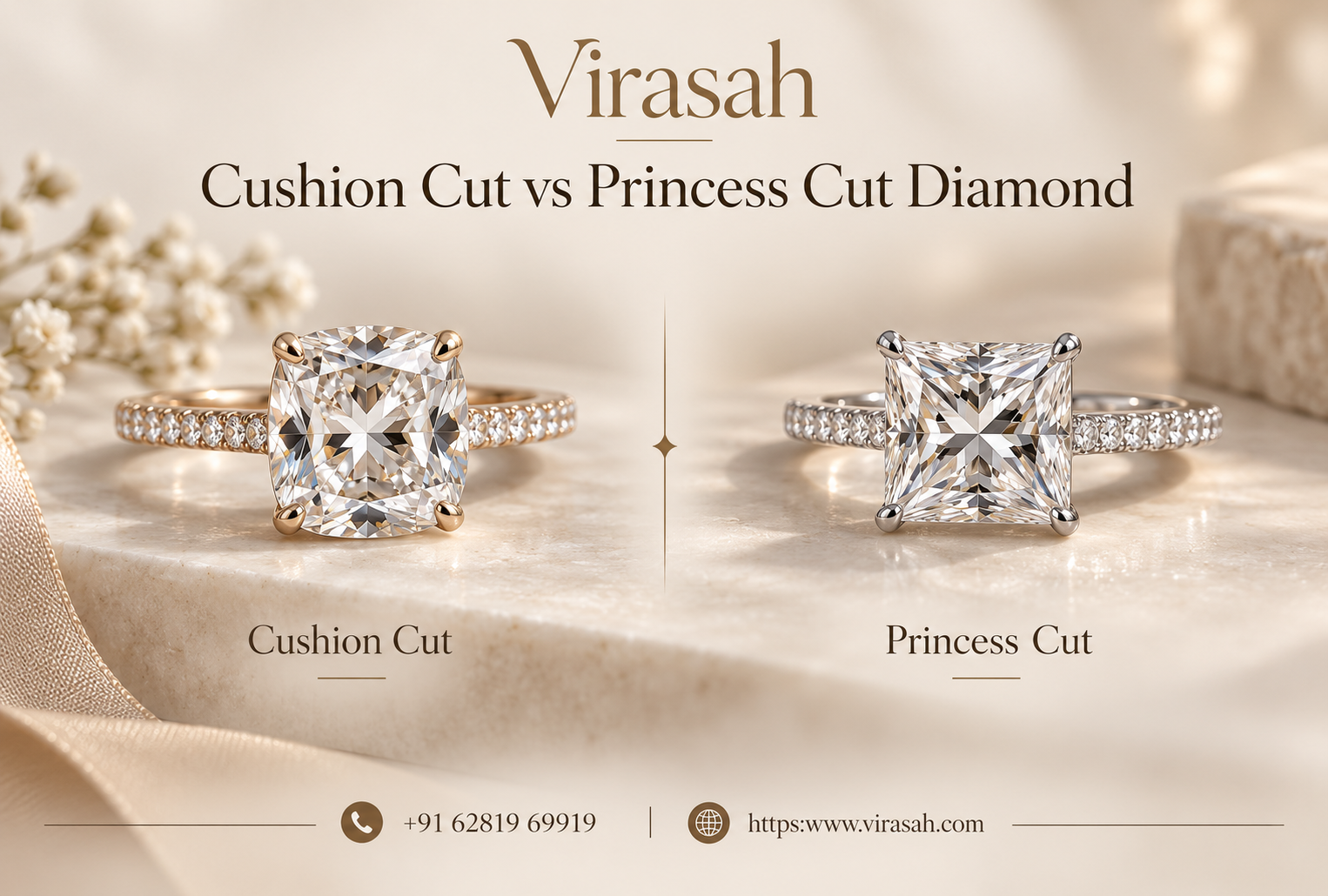
A cushion diamond generally has softened corners and curved sides, producing a romantic outline that can feel vintage, graceful and luxurious. A princess diamond usually presents straighter edges, pointed corners and a geometric appearance. When examining Cushion Cut vs Princess Cut Diamond, those contrasting outlines are often the first thing a buyer notices, but they are only the beginning of the practical differences between the two shapes.
Both shapes can deliver impressive brilliance, but they do not necessarily create the same pattern of light. Facet arrangement, depth, symmetry, proportions and the individual quality of the stone matter greatly. For this reason, evaluating Cushion Cut vs Princess Cut Diamond should involve viewing actual diamonds rather than assuming that every example of one shape performs exactly like another stone carrying the same shape name.
This guide is designed for buyers who want to make a considered decision rather than simply following a trend. We will examine sparkle, appearance, color, clarity, settings, durability, carat weight, proportions, lifestyle and long-term appeal so that Cushion Cut vs Princess Cut Diamond becomes an easier choice based on what genuinely matters to you. You can also explore Virasah for more fine-jewelry inspiration and diamond buying guidance.
For Romantic Styling
In Cushion Cut vs Princess Cut Diamond, the cushion shape often appeals to someone who wants softness without choosing a round diamond. Rounded corners work beautifully with halos, pavé bands, vintage-inspired settings and delicate details, while the squarish outline still gives the ring a distinctive center-stone presence.
For Modern Geometry
When Cushion Cut vs Princess Cut Diamond is considered from a contemporary design perspective, princess cuts stand out through straight edges and sharp corners. They coordinate naturally with sleek solitaire bands, channel-set diamonds, geometric side stones and minimalist white-gold or platinum settings.
For Everyday Practicality
The lifestyle side of Cushion Cut vs Princess Cut Diamond deserves attention because the shapes have different vulnerable areas. A cushion's rounded profile is forgiving, while the pointed corners of a princess cut benefit from a setting engineered to protect them from accidental knocks.
For Personal Expression
Ultimately, Cushion Cut vs Princess Cut Diamond has no universal winner. Two diamonds with similar carat, color and clarity can create completely different emotions when worn. Your hand shape, preferred jewelry style and reaction to the diamond in natural movement should have more influence than popularity alone.
1. Understanding the Fundamental Difference Between the Two Shapes
The most important starting point in Cushion Cut vs Princess Cut Diamond is understanding that shape and cutting style work together to create the personality of the finished gemstone. Cushion diamonds are usually square or rectangular with curved sides and rounded or softened corners. This creates the pillow-like outline responsible for the name and gives designers flexibility to move between vintage and modern jewelry aesthetics.
Princess diamonds take a more architectural approach. They are typically square when viewed from above and feature strong straight sides with pointed corners. In Cushion Cut vs Princess Cut Diamond, this creates one of the clearest visual contrasts: the cushion feels flowing and gentle, whereas the princess feels precise, structured and intentionally geometric.
There can also be considerable variation within each category. Cushion stones may be nearly square, noticeably elongated or somewhere between the two, while their internal facet patterns can produce different styles of sparkle. Princess stones can also vary in squareness, depth and facet arrangement. Therefore, Cushion Cut vs Princess Cut Diamond should never be evaluated only by reading the shape description on a product page.
Look at the actual outline and light performance of the individual stone. Ask whether the shape looks balanced from top to bottom and left to right. A beautiful example should appear visually intentional rather than uneven. This individual evaluation is particularly important in Cushion Cut vs Princess Cut Diamond because fancy-shaped diamonds are not all visually identical even when their laboratory grades look similar.
2. Which Shape Has the More Attractive History?
History gives the cushion shape much of its emotional character. Modern cushion diamonds evolved from older brilliant-cut traditions associated with antique diamond jewelry. That heritage helps explain why Cushion Cut vs Princess Cut Diamond often feels like a decision between romantic tradition and contemporary design. A cushion can look entirely modern, yet its rounded silhouette naturally references earlier jewelry aesthetics.
The princess cut belongs to a much newer chapter of diamond design. GIA describes it as a square modified brilliant, and its popularity is strongly connected with buyers who want brilliant-style sparkle in a square form. Within Cushion Cut vs Princess Cut Diamond, that makes the princess especially attractive for someone who appreciates clean modern lines but does not want to choose the traditional round brilliant.
Historical associations can influence how a ring feels even when the buyer never consciously thinks about diamond-cut history. A cushion in a milgrain halo may instantly look heirloom-inspired, while a princess stone on a polished platinum band can look futuristic and minimalist. This stylistic flexibility is why Cushion Cut vs Princess Cut Diamond should be matched to the complete ring concept rather than center stone alone.
If you regularly wear jewelry featuring curved forms, floral details or antique motifs, cushion may integrate naturally with your collection. If your jewelry features straight lines, contemporary metalwork and structured silhouettes, princess may feel more coherent. Using existing jewelry as a reference can make Cushion Cut vs Princess Cut Diamond surprisingly easy because it reveals what you already enjoy wearing.
3. Cushion Shape: Soft, Romantic and Versatile
One of the strongest arguments on the cushion side of Cushion Cut vs Princess Cut Diamond is visual softness. The corners do not create the same sharp transition seen in a princess cut, so the eye moves smoothly around the diamond. This can make larger cushion stones feel luxurious without appearing severe, especially when paired with delicate prongs and a refined band.
Cushions are particularly adaptable because the outline can vary from square to elongated. An elongated cushion may visually lengthen the finger, while a squarer cushion provides stronger symmetry. In Cushion Cut vs Princess Cut Diamond, this extra variation can be an advantage for buyers who want to fine-tune their ring's proportions instead of accepting a single standard-looking silhouette.
The shape is also comfortable beside many side-stone styles. Round accents soften the composition further, tapered baguettes introduce contrast, and a halo can emphasize the center stone's outline. For buyers comparing Cushion Cut vs Princess Cut Diamond, it is useful to imagine not only the loose stone but also how each shape interacts with the surrounding diamonds and metal.
Do not assume that every cushion should look antique. Modern cushion cuts can be placed in sleek solitaire settings, hidden halos and minimal pavé designs with highly contemporary results. This ability to cross stylistic categories makes Cushion Cut vs Princess Cut Diamond especially interesting for couples who want a ring that combines a sense of heritage with modern craftsmanship.
4. Princess Shape: Sharp, Modern and Distinctive
The princess cut makes a very different first impression. Its straight sides and defined corners create a confident frame that immediately communicates geometry. In Cushion Cut vs Princess Cut Diamond, buyers who prefer square forms often lean toward princess because the shape appears crisp and deliberate, particularly when viewed in a solitaire setting that leaves the outline clearly visible.
A princess stone can also coordinate beautifully with contemporary architecture-inspired jewelry. Straight bands, channel-set accent stones and angular side diamonds repeat the center stone's geometry. When evaluating Cushion Cut vs Princess Cut Diamond, consider whether you want contrast between your center diamond and setting or whether you want every design element to follow a consistent visual language.
Princess diamonds are generally cut in a modified brilliant style, helping produce lively scintillation and brightness when proportions and workmanship are attractive. That makes Cushion Cut vs Princess Cut Diamond a meaningful comparison for buyers who want substantial sparkle but prefer a square center stone over a round one. The individual diamond's performance should still be judged visually.
The pointed corners are the feature requiring the most practical attention. They contribute to the princess cut's identity but can be more exposed to damage if not properly protected. Consequently, Cushion Cut vs Princess Cut Diamond should include a discussion with your jeweler about prong positioning, especially if the ring will be worn daily in an active lifestyle.
5. Sparkle and Light Performance
Sparkle is frequently treated as a simple ranking, but the reality is more nuanced. In Cushion Cut vs Princess Cut Diamond, both shapes can create attractive brilliance, fire and scintillation, yet their light patterns may look different. Cushion diamonds can display broader flashes or a more fragmented pattern depending on the particular facet arrangement and cutting style.
Princess diamonds tend to deliver an energetic visual effect built around their modified-brilliant faceting. The square outline and angular facet pattern can create a crisp style of movement. When comparing Cushion Cut vs Princess Cut Diamond, do not evaluate sparkle under only intense jewelry-store spotlights, because almost every well-presented diamond can look impressive under highly directional lighting.
Ask to see the stones under several conditions if possible: diffused indoor light, normal office-type lighting and daylight near a window. Rotate the ring rather than holding it perfectly still. This practical approach to Cushion Cut vs Princess Cut Diamond reveals whether you enjoy the way the stone reacts during normal movement, which is ultimately how an engagement ring will be experienced.
Brightness should also appear balanced across the diamond. Persistent dark zones, lifeless areas or an unattractive pattern may reduce visual appeal even if the paper specifications seem impressive. For a deeper understanding of shape and brilliance before deciding on Cushion Cut vs Princess Cut Diamond, read Virasah's complete guide to the best diamond cuts for engagement rings.
6. Shape, Symmetry and Length-to-Width Ratio
Proportion has a major influence on how both shapes look. A squarer cushion provides balanced symmetry, while an elongated cushion creates a more stretched appearance. When assessing Cushion Cut vs Princess Cut Diamond, length-to-width ratio is therefore not simply a laboratory number; it determines whether the stone looks compact, rectangular or visually lengthening on the finger.
Princess cuts are generally selected for their square appearance, although examples can vary. Buyers who want that classic sharp square should look carefully for sides that appear balanced rather than obviously rectangular. In Cushion Cut vs Princess Cut Diamond, a symmetrical outline is important because irregularities become easier to notice when the ring is aligned with a straight band.
Cushion symmetry deserves equal scrutiny even though the outline is softer. Look for similar curvature on opposing sides and corners that feel balanced. During Cushion Cut vs Princess Cut Diamond, view candidate stones face-up rather than judging only measurements. The eye can identify subtle shape characteristics that may not be obvious from dimensions alone.
There is no single length-to-width ratio that guarantees beauty for every buyer. Some people intentionally want elongated cushions, while others strongly prefer a compact square. The best approach to Cushion Cut vs Princess Cut Diamond is to compare several stones side by side and record which proportions you consistently choose before becoming distracted by carat weight or grading terminology.
7. Face-Up Size and Carat Weight
Carat is a measurement of weight rather than a direct measurement of visible diameter or surface area. That distinction matters greatly in Cushion Cut vs Princess Cut Diamond. Two one-carat stones may not look equally large from above because depth, outline, proportions and distribution of weight can differ between individual diamonds and cutting styles.
A stone carrying more weight in its pavilion may appear smaller face-up than another diamond of equal carat weight that distributes its mass differently. Buyers studying Cushion Cut vs Princess Cut Diamond should therefore compare millimeter dimensions alongside carat. This prevents paying solely for weight that may not contribute to the visual presence you actually want.
An elongated cushion can sometimes create an impression of greater finger coverage because its length becomes visually prominent. A square princess produces a different form of coverage through corners and straight sides. During Cushion Cut vs Princess Cut Diamond, think about whether you prefer vertical length, strong square geometry or overall surface presence rather than simply searching for the highest carat number.
Setting design can further change perceived size. A halo makes either center stone appear more expansive, while a slim band can make the center diamond visually dominate the ring. For this reason, Cushion Cut vs Princess Cut Diamond should be evaluated at ring level. A slightly smaller center stone with an intelligent setting may create more presence than a larger stone placed in a heavier design.
8. Color: How Each Shape Handles Warmth
Color is another area where individual diamonds must be judged rather than purchased by a universal formula. In Cushion Cut vs Princess Cut Diamond, facet arrangement, size, setting metal and personal sensitivity to warmth can influence what you actually see. A grade that looks wonderfully white to one person may show a subtle warmth to someone with a highly color-sensitive eye.
Cushions can be especially attractive in yellow or rose gold settings where a small amount of warmth may harmonize with the metal rather than appearing undesirable. When considering Cushion Cut vs Princess Cut Diamond, decide first whether your priority is an icy white appearance or a warmer, more romantic overall palette. That design decision can prevent unnecessary spending on grades you may not visually need.
A princess stone in white gold or platinum often appeals to buyers seeking a clean, high-contrast modern presentation. Yet the correct color grade still depends on the individual diamond. The practical lesson in Cushion Cut vs Princess Cut Diamond is to compare neighboring color grades in the same metal whenever possible and let your eyes determine where the visible difference becomes meaningful.
Color preferences in diamonds also become easier to understand when you compare them with colored gemstones. Virasah's sapphire jewelry guide explains how hue and appearance influence gemstone buying, while Cushion Cut vs Princess Cut Diamond requires a subtler evaluation of body color and how the setting affects perception.
9. Clarity and Eye-Clean Appearance
Clarity grades describe internal and external characteristics, but the location and visibility of those characteristics matter. When studying Cushion Cut vs Princess Cut Diamond, do not assume that a higher clarity grade automatically creates a more beautiful engagement ring. The important practical question is whether inclusions are noticeable without magnification and whether any characteristics create durability concerns.
Some inclusions are positioned where facet patterns make them difficult to notice, while others may sit beneath the table or near an exposed area. During Cushion Cut vs Princess Cut Diamond, ask to view magnified imagery as well as normal face-up photographs or video. Then return to the unaided view so you do not become overly concerned with microscopic features invisible in everyday wear.
Princess cuts require particular attention around corners because their geometry makes corner protection important. Cushion stones have softer corners, although every diamond still deserves careful inspection. An intelligent Cushion Cut vs Princess Cut Diamond purchase balances clarity, visual cleanliness and structural confidence rather than simply purchasing the highest grade within the budget.
This philosophy also applies across valuable gemstones. Virasah's ruby jewelry buying guide discusses how quality should be assessed through several characteristics together. The same holistic thinking improves Cushion Cut vs Princess Cut Diamond because no single line on a grading report tells the entire visual story.
10. Durability and Corner Protection
Diamonds are exceptionally hard, but hardness does not mean they are impossible to chip. A sharp point can be more vulnerable to a strong impact than a rounded contour. Therefore, durability deserves a meaningful place in Cushion Cut vs Princess Cut Diamond, particularly for someone who plans to wear the engagement ring every day while working, exercising, traveling or handling objects frequently.
The cushion cut's rounded or softened corners eliminate the exposed pointed corners associated with princess stones, giving it a practical advantage in this particular aspect of Cushion Cut vs Princess Cut Diamond. That does not make every cushion ring indestructible, but the shape can be reassuring for buyers who are concerned about snagging and accidental corner impacts.
For a princess cut, appropriately positioned prongs or protective setting designs are important. V-shaped prongs are often considered for corner protection because they cover the points more comprehensively. When making a Cushion Cut vs Princess Cut Diamond decision, examine the finished mounting as carefully as the diamond because an excellent stone deserves a setting engineered around its geometry.
Regular professional inspection is also sensible. Prongs can gradually wear, bend or loosen, especially on jewelry worn continuously. A thoughtful approach to Cushion Cut vs Princess Cut Diamond includes long-term maintenance: remove the ring for high-impact tasks, keep it clean, store it separately from other jewelry and have its security checked periodically.
11. Choosing the Right Setting
The setting can completely change the personality of a center stone. In Cushion Cut vs Princess Cut Diamond, a cushion halo emphasizes softness and can evoke vintage glamour, while a minimalist four-prong cushion solitaire feels much more contemporary. The same diamond shape can therefore communicate entirely different styles depending on the surrounding metal and accent stones.
A princess cut works beautifully in modern solitaires, geometric halos and structured three-stone designs. The important functional consideration remains corner protection. For Cushion Cut vs Princess Cut Diamond, buyers should ask whether the setting merely looks attractive in photographs or whether its prongs, gallery and band have been designed to support everyday wear.
Band width also affects proportion. A very broad band may visually reduce the apparent scale of a modest center diamond, while an extremely fine band can make a stone appear larger. During Cushion Cut vs Princess Cut Diamond, compare complete ring mockups or try on similar designs. Seeing the proportions on your own hand can change a preference formed from isolated loose-diamond photographs.
Wedding-band compatibility is another useful consideration. Straight-edged princess settings may pair naturally with straight wedding bands, although the ring gallery can create spacing. Cushion settings can also sit flush or require a shaped band depending on construction. Thinking about the eventual stack while making your Cushion Cut vs Princess Cut Diamond choice can prevent compromises after the engagement ring has already been purchased.
12. Price, Budget and Getting Better Visual Value
Price depends on numerous variables including carat, color, clarity, proportions, certification, natural or laboratory-grown origin, and market conditions. Consequently, Cushion Cut vs Princess Cut Diamond should not be reduced to a fixed statement that one shape is always cheaper. Instead, compare real candidate stones that meet the same visual requirements and total ring budget.
The most effective budget strategy is to decide what you can actually see. If two clarity grades both look clean without magnification, the lower grade may allow more budget for size, setting craftsmanship or color. Applying that principle to Cushion Cut vs Princess Cut Diamond helps shift money toward characteristics that make a meaningful difference when the ring is on the hand.
The same reasoning applies to carat thresholds. A diamond slightly below a popular whole or half-carat benchmark can sometimes deliver nearly the same visual impression depending on its measurements. While evaluating Cushion Cut vs Princess Cut Diamond, compare millimeter dimensions and visual spread rather than assuming that a symbolic carat number automatically gives the best value.
Finally, reserve part of the budget for workmanship. A beautifully finished setting contributes to comfort, stone security and long-term satisfaction. The cheapest mounting can undermine an otherwise excellent Cushion Cut vs Princess Cut Diamond purchase, particularly when the design includes delicate pavé work, multiple prongs or a princess center that requires careful protection at its corners.
13. Comparing the 4Cs Correctly
The 4Cs—color, clarity, cut-related quality and carat weight—provide an essential framework for understanding diamonds, but fancy shapes require careful interpretation. In Cushion Cut vs Princess Cut Diamond, proportions and visual performance cannot be understood by looking at carat, color and clarity alone. Measurements, symmetry, polish, facet pattern and actual face-up appearance remain important.
Begin with carat only as a budget and size reference. Then inspect dimensions to understand visual spread. For Cushion Cut vs Princess Cut Diamond, color should be considered alongside metal choice, while clarity should be interpreted through inclusion location and whether the diamond appears clean to the eye. This approach is far more useful than automatically choosing the highest grades.
Laboratory documentation is valuable because it provides an independent description of key characteristics. GIA's natural diamond grading information explains the type of assessment included in its reports. When researching Cushion Cut vs Princess Cut Diamond, documentation should support your visual evaluation rather than replace it.
GIA also provides educational information on how diamonds are graded. Use resources like these to understand terminology before comparing stones. An informed Cushion Cut vs Princess Cut Diamond purchase becomes much easier when you can distinguish between characteristics that influence beauty, those that influence rarity and those that matter mainly on paper.
14. A Side-by-Side Comparison
A structured table can help organize the decision, but remember that Cushion Cut vs Princess Cut Diamond ultimately depends on individual stones. The descriptions below represent common characteristics rather than promises about every diamond. Always compare photographs, videos, grading information and ideally the stones themselves before making a final purchase.
| Factor | Cushion Cut | Princess Cut |
|---|---|---|
| Outline | Square or rectangular with softened, rounded corners | Usually square with straight sides and pointed corners |
| Overall Style | Romantic, graceful, vintage-inspired or modern | Contemporary, geometric and structured |
| Sparkle Character | Can range from broad flashes to highly lively modified patterns | Typically energetic modified-brilliant appearance |
| Corner Design | Rounded or softened | Sharp and requires thoughtful protection |
| Shape Variety | Available in square and elongated silhouettes | Most often selected for a square appearance |
| Setting Personality | Excellent with halos, solitaires and vintage details | Excellent with modern solitaires and geometric settings |
| Best For | Buyers wanting softness and romantic versatility | Buyers wanting sharp geometry and modern character |
Use the table as a first filter rather than a final verdict. Someone may initially choose cushion because of its rounded corners, then discover that the sparkle pattern of a particular princess is irresistible. That possibility is why Cushion Cut vs Princess Cut Diamond should eventually move from specifications to a real visual comparison rather than remaining entirely theoretical.
If your style is romantic, intricate or heirloom-inspired, cushion is often the easier starting point. If your wardrobe and jewelry lean minimalist, modern and architectural, princess may feel instinctive. Yet Cushion Cut vs Princess Cut Diamond can also work through deliberate contrast—for example, a cushion in a sleek contemporary setting or a princess surrounded by softer round accents.
Your engagement ring will be seen at arm's length far more often than under magnification. Therefore, make the final Cushion Cut vs Princess Cut Diamond decision based on the overall impression from a normal viewing distance. Details matter, but the stone should first create an emotional response when you simply look at your hand.
15. Matching the Diamond to Your Personal Style
Personal style is one of the most reliable decision-making tools because an engagement ring is worn with many different outfits over many years. If your preference leans toward soft fabrics, traditional motifs, curved silhouettes and romantic jewelry, Cushion Cut vs Princess Cut Diamond may naturally resolve in favor of a cushion shape because its rounded outline echoes those characteristics.
If you prefer tailored clothing, clean lines, sharp accessories and contemporary design, the princess cut may feel more consistent. Its square outline creates a distinct visual structure. In Cushion Cut vs Princess Cut Diamond, this alignment with personal style is often more important than trying to determine which shape is supposedly more fashionable in a particular year.
Consider the jewelry you already wear most frequently. Look at your favorite earrings, necklaces, watches and rings. Are the shapes predominantly curved or angular? Do you choose ornate or minimalist designs? This exercise makes Cushion Cut vs Princess Cut Diamond practical because your existing collection contains evidence about what has held your attention long enough to become part of your daily routine.
For broader bridal styling ideas, explore Virasah's wedding jewelry checklist for Indian brides. Engagement-ring selection rarely happens in isolation, and understanding how Cushion Cut vs Princess Cut Diamond fits with necklaces, earrings, wedding bands and ceremonial jewelry can create a more coordinated long-term collection.
16. Which Shape Works Better for Indian Bridal Jewelry?
Indian bridal jewelry often combines highly detailed craftsmanship, strong centerpieces and richly layered accessories. Within that context, Cushion Cut vs Princess Cut Diamond can produce two distinct effects. Cushion diamonds blend gracefully with ornate settings, curved motifs and gemstone combinations, making them particularly adaptable to designs that combine contemporary diamond jewelry with traditional visual language.
Princess cuts can provide beautiful contrast against intricate bridal styling. Their sharp geometry adds modern structure and can prevent the engagement ring from visually disappearing among highly decorative pieces. In Cushion Cut vs Princess Cut Diamond, that contrast can be especially effective for a bride who wants her engagement ring to remain distinctly modern while other wedding jewelry follows more traditional forms.
Colored gemstones can also influence the choice. Cushion diamonds coordinate elegantly with rubies, sapphires and emeralds because the softened shape transitions naturally into decorative side settings. To explore complementary gemstone options while evaluating Cushion Cut vs Princess Cut Diamond, see Virasah's guide to emerald jewelry designs for weddings and special occasions.
Another useful approach is to choose the engagement ring as a daily-wear piece rather than attempting to match every item worn during the wedding. Bridal jewelry may be elaborate for specific events, while an engagement ring remains on the hand for years. Keeping that distinction in mind ensures Cushion Cut vs Princess Cut Diamond is based on long-term lifestyle instead of one ceremonial outfit.
17. What Other Gemstones Can Teach You About Choosing Diamonds
Studying gemstones can sharpen your eye for proportion, color, rarity and personal taste. Virasah's tanzanite jewelry buying guide, for example, shows why buyers should consider a gemstone's complete character rather than one isolated specification. The same mindset improves Cushion Cut vs Princess Cut Diamond by encouraging you to evaluate beauty and suitability together.
Ruby enthusiasts often prioritize color personality and emotional impact, while diamond buyers sometimes become overly focused on numerical grades. Reading about why Burmese rubies are highly valued offers a useful reminder for Cushion Cut vs Princess Cut Diamond: rarity and grading matter, but the final jewel must still be visually compelling to its owner.
The same lesson appears in exceptional sapphires. Virasah's article on Kashmir sapphire rarity and value illustrates how origin, appearance and quality interact. In Cushion Cut vs Princess Cut Diamond, shape is only one component; craftsmanship, visual performance, setting design and the complete emotional effect determine whether the piece feels exceptional.
Collectors can also explore Virasah's guide to rare gemstones in India. Developing broader gem knowledge helps buyers become more confident about Cushion Cut vs Princess Cut Diamond because they begin looking beyond marketing labels and instead ask more useful questions about proportion, durability, documentation, craftsmanship and personal enjoyment.
18. How to Inspect the Diamond Before Buying
A disciplined inspection process can prevent an emotional purchase from becoming an expensive compromise. Begin Cushion Cut vs Princess Cut Diamond by viewing both shapes at approximately the same carat weight and in similar color and clarity ranges. This makes it easier to identify whether your preference comes from shape itself rather than differences in size or quality between the samples.
Next, examine outline symmetry and face-up balance. Rotate each stone and look for areas that appear persistently dark or distracting. During Cushion Cut vs Princess Cut Diamond, high-resolution videos are useful for online shopping because movement reveals more than a single still photograph. If available, request neutral-light images rather than relying exclusively on dramatic promotional lighting.
Review laboratory documentation and confirm that the report corresponds to the stone being sold. GIA provides an explanation of its diamond grading report information. In Cushion Cut vs Princess Cut Diamond, pay attention to measurements, color, clarity, polish, symmetry and any comments that may require further explanation from the jeweler.
Finally, inspect the intended mounting. Check whether the prongs are proportionate, whether the stone sits securely and whether the ring feels comfortable between adjacent fingers. A successful Cushion Cut vs Princess Cut Diamond purchase is not merely a successful loose-diamond selection. It is a harmonious combination of gemstone, metal, craftsmanship, security and wearability.
19. Common Buying Mistakes to Avoid
The first mistake is choosing only from the grading report. Laboratory information is essential, but jewelry is a visual object. In Cushion Cut vs Princess Cut Diamond, two stones with similar grades can have noticeably different personalities because of proportions, facet patterns and outlines. Always combine documentation with actual images, videos or in-person evaluation whenever possible.
The second mistake is buying carat weight without checking measurements. A heavier stone does not necessarily provide proportionally greater face-up presence. For Cushion Cut vs Princess Cut Diamond, compare length and width in millimeters and consider how depth distributes weight. This is particularly important when choosing between stones around popular carat thresholds where price differences can become significant.
The third mistake is ignoring the setting until after selecting the center stone. A ring's prongs, band width, halo and gallery determine both aesthetics and practicality. In Cushion Cut vs Princess Cut Diamond, princess corners deserve deliberate protection, while cushion settings should complement the exact degree of roundness or elongation present in the chosen diamond.
The fourth mistake is purchasing for someone else's taste. Friends, influencers and trend reports can be useful sources of inspiration, but they do not wear your jewelry every day. The strongest Cushion Cut vs Princess Cut Diamond decision is the one that continues to feel right when the ring is seen without social-media context, trend labels or external approval.
20. Trusted Resources and a Final Buying Framework
Education reduces uncertainty. GIA's detailed article on the cushion cut diamond explains the shape's background and characteristics, while its guide to selecting a princess cut diamond discusses shape, symmetry, scintillation and setting considerations. These references are valuable when researching Cushion Cut vs Princess Cut Diamond.
For an overview of additional engagement-ring shapes, GIA also offers a guide to diamond engagement-ring shapes. Reading beyond the two candidates can be surprisingly helpful in Cushion Cut vs Princess Cut Diamond because it confirms whether you genuinely love square and cushion-like silhouettes or have simply narrowed your search too early.
Consumers should also understand how jewelry descriptions are represented. The U.S. Federal Trade Commission publishes its Jewelry Guides, which address representations relating to gemstones and jewelry products. Although purchasing requirements can differ by country, reviewing authoritative educational resources strengthens a Cushion Cut vs Princess Cut Diamond buying process by encouraging precise questions about what is being offered.
After completing your research, simplify Cushion Cut vs Princess Cut Diamond into five final questions: Which shape makes you look twice? Which stone performs more attractively in normal lighting? Which proportions flatter the hand? Which setting best suits your lifestyle? And which complete ring feels worth owning for many years? Those answers matter more than winning a theoretical shape comparison.
A Practical 10-Step Buying Checklist
- Set a complete ring budget before comparing stones.
- Decide whether you prefer softer or sharper geometry.
- Compare similar carat weights side by side.
- Check actual millimeter measurements.
- Inspect face-up symmetry and outline.
- Compare sparkle in more than one lighting environment.
- Judge color in the metal you intend to wear.
- Look at inclusions at normal viewing distance as well as magnification.
- Verify independent grading documentation where appropriate.
- Choose a secure, professionally crafted setting suited to the diamond shape.
Useful Authoritative Diamond Resources
GIA – Cushion Cut Diamond Guide
GIA – Selecting a Princess Cut Diamond
GIA – Diamond Engagement Ring Shapes
GIA – How Diamonds Are Graded
GIA – Natural Diamond Grading Reports
Federal Trade Commission – Jewelry Guides
Frequently Asked Questions
1. Is a cushion cut or princess cut better for an engagement ring?
Neither shape is universally better. Cushion Cut vs Princess Cut Diamond depends on the wearer's style and priorities. Cushion cuts suit buyers who prefer rounded corners, romantic styling and flexible square or elongated proportions. Princess cuts are ideal for people who enjoy crisp square geometry and contemporary design. Compare individual stones because visual performance can vary significantly within either category.
2. Which shape usually looks more modern?
Princess cuts commonly create the more obviously modern appearance because their straight sides and pointed corners form a strong geometric outline. However, Cushion Cut vs Princess Cut Diamond can change dramatically with the setting. A cushion mounted in a thin polished solitaire can look highly contemporary, while an elaborately detailed princess setting can develop a more decorative character.
3. Which diamond shape is more romantic?
Cushion cuts are frequently associated with romantic and vintage-inspired jewelry because their softened corners reference older brilliant-cut traditions. In Cushion Cut vs Princess Cut Diamond, cushion is therefore a popular choice for someone who likes graceful lines, halos, pavé and heirloom-inspired details. Personal perception still matters, and some buyers find the clean symmetry of a princess equally romantic.
4. Which shape has better sparkle?
Both can produce impressive sparkle, and there is no responsible way to guarantee that every example of one shape will outperform every example of the other. In Cushion Cut vs Princess Cut Diamond, facet pattern, proportions, symmetry and workmanship strongly influence light performance. Compare actual diamonds under several lighting conditions and choose the pattern of brilliance you personally find most attractive.
5. Is a princess cut more likely to chip?
The pointed corners of a princess diamond deserve greater protection than the rounded corners of a cushion. That makes setting design particularly important in Cushion Cut vs Princess Cut Diamond. Properly positioned protective prongs can help shield princess corners, and owners should still avoid high-impact activities while wearing any valuable diamond ring regardless of its shape.
6. Which shape can make the finger appear longer?
An elongated cushion can create a strong vertical line on the finger and may give a visually lengthening effect. A square princess produces a more compact geometric appearance. For Cushion Cut vs Princess Cut Diamond, try stones with different dimensions on the hand rather than making the decision from carat weight alone, because length-to-width ratio has a noticeable impact.
7. Should I prioritize carat or visible size?
Visible size should usually be considered alongside carat because carat measures weight, not face-up dimensions. When shopping Cushion Cut vs Princess Cut Diamond, compare length and width measurements and look at how the stone presents on the finger. A well-proportioned diamond with slightly lower carat weight may sometimes provide the appearance you prefer at a more comfortable budget.
8. Which setting is safest for a princess cut?
A secure design that protects the pointed corners is especially important. Jewelers may recommend appropriately placed prongs, including protective corner-oriented designs depending on the mounting. In Cushion Cut vs Princess Cut Diamond, do not select a setting solely from its front appearance. Ask how the center stone is supported, how exposed its corners are and how the ring should be maintained.
9. Can cushion and princess diamonds both work with halos?
Yes. Halos can complement both shapes but create different moods. A cushion halo can reinforce softness and vintage glamour, while a square halo around a princess cut can emphasize geometry. In Cushion Cut vs Princess Cut Diamond, halos also influence perceived center-stone size, so judge the entire ring rather than comparing loose diamonds and assuming the final proportions will remain unchanged.
10. How do I make the final choice if I like both?
If you remain undecided, compare two similarly sized stones in the settings you are actually considering and view them on the hand in ordinary light. With Cushion Cut vs Princess Cut Diamond, the answer often becomes obvious once specifications are removed from the conversation. Choose the ring your eyes repeatedly return to and the design that fits your everyday lifestyle most naturally.
Final Verdict: Which One Should You Choose?
Cushion Cut vs Princess Cut Diamond ultimately comes down to the kind of beauty you want to live with every day. Choose a cushion if softened corners, romantic character, flexible proportions and a graceful mix of vintage and contemporary style speak to you. Choose a princess if crisp geometry, defined square lines and an energetic modern personality feel more authentic. Then evaluate the individual diamond carefully—its symmetry, dimensions, light performance, color, clarity, documentation and setting—because an outstanding stone of either shape will always be more satisfying than choosing a shape name alone.
Discover Your Perfect Diamond with Virasah
Looking for expert guidance when choosing an engagement ring or fine diamond jewelry? Explore the collections and jewelry insights at Virasah.
Call Us: +91 62819 69919
Website: www.virasah.com