Princess Cut Diamond Guide: Beauty, Quality and Buying Tips
A Princess Cut Diamond brings together two qualities that many buyers want in the same jewel: the crisp geometry of a square outline and the lively sparkle associated with brilliant-style faceting. It feels modern without being trendy, architectural without looking severe, and elegant enough for an engagement ring, anniversary piece, pendant, or heirloom. Yet the shape rewards careful shopping because two stones with the same carat weight, color, and clarity can look noticeably different once they are viewed face-up.
This guide explains how to judge a Princess Cut Diamond in practical terms rather than relying only on a price tag or a few grading abbreviations. You will learn what influences brightness, why symmetry matters, how corner protection affects durability, how color and clarity behave in a square brilliant-style stone, and how to compare carat weight with actual measurements. The aim is to help you understand what you are paying for and what you should inspect before you commit.
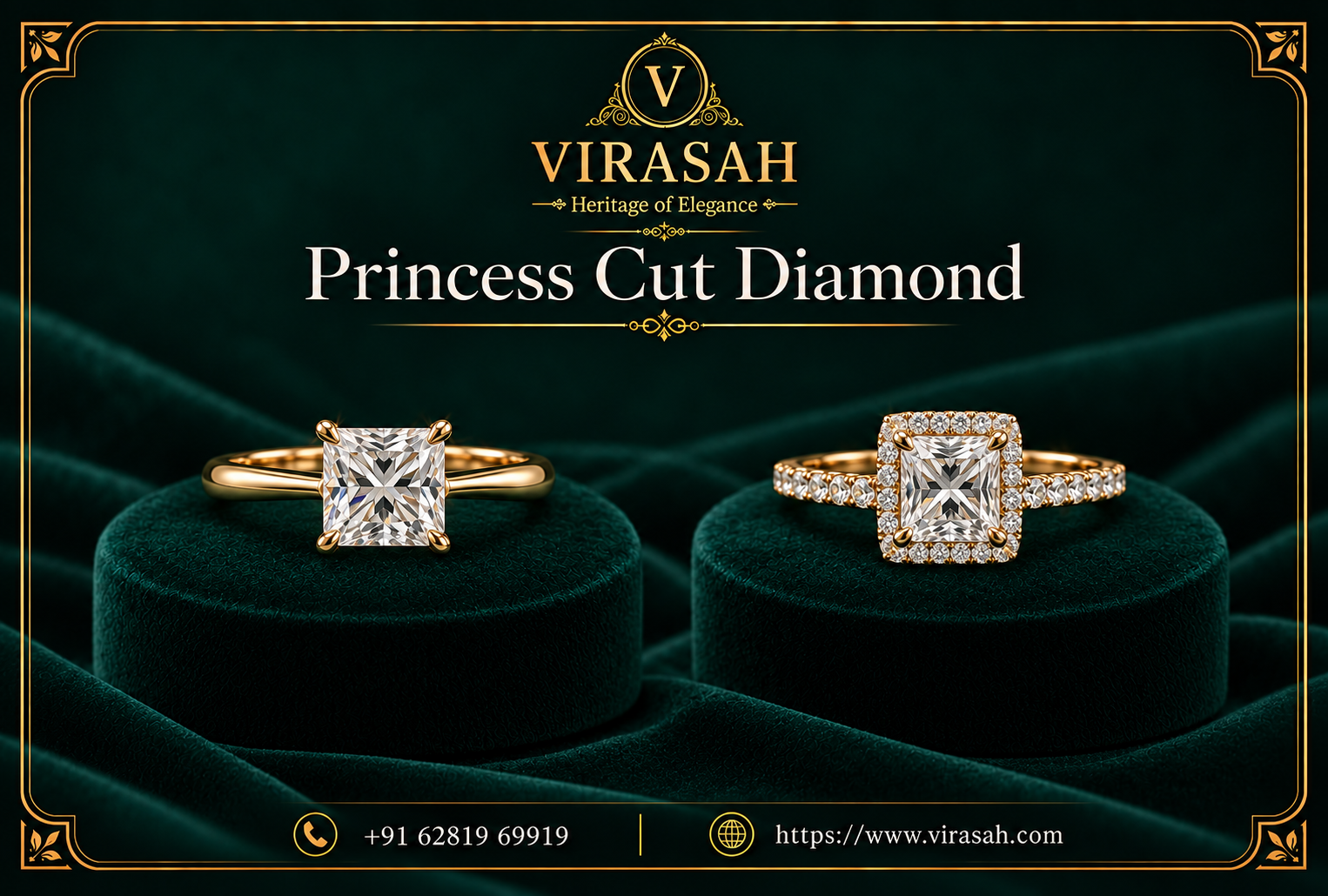
For buyers exploring fine jewellery in India, a Princess Cut Diamond also fits naturally into both contemporary and traditional styling. It can look minimal in a clean solitaire, dramatic in a halo, refined beside tapered baguettes, or richly detailed in a bridal design. If you want to explore the broader design context first, Virasah's guide to diamond cuts for engagement rings is a useful companion because it shows how square, round, oval, pear, emerald, cushion, and other shapes create different visual impressions.
What Is a Princess Cut Diamond?
A Princess Cut Diamond is generally a square or slightly rectangular modified brilliant-cut diamond with pointed corners and a faceting pattern designed to produce strong brightness and scintillation. GIA describes the shape as a square modified brilliant rather than a step cut, which helps explain why its visual personality is very different from an emerald or Asscher shape. Instead of long mirrored steps, the stone displays many smaller reflections that turn on and off as the ring moves.
Viewed from the top, a well-proportioned Princess Cut Diamond can look like a crisp square filled with a mosaic of light, shadow, and flashes of spectral color. Viewed from the side, much of the weight sits below the girdle in the pavilion. That depth is one reason shoppers should compare millimetre measurements as well as carat weight: two one-carat stones can present different face-up sizes depending on how their weight is distributed.
The Princess Cut Diamond became popular because it offers a distinct alternative to the round brilliant while still delivering a dynamic sparkle. The outline feels clean and contemporary, and the straight sides can align beautifully with ring shoulders, channel-set accents, geometric halos, and modern wedding bands. It can also serve as a visual bridge between classic diamond tradition and a more design-led aesthetic.
Why the Shape Looks So Bright
The beauty of a Princess Cut Diamond is created by the interaction of proportions, facet arrangement, polish, symmetry, transparency, and the way the stone is observed under changing light. A diamond does not generate light; it redirects light. When facet angles work together effectively, more useful light returns toward the viewer and the face-up pattern appears lively rather than dull, watery, or excessively dark.
A Princess Cut Diamond can also show a different style of scintillation depending on its pavilion construction. Some stones break reflections into many small flashes, while others display broader flashes and larger contrast zones. Neither visual style is automatically better for every person. A buyer who loves a glittery, high-frequency sparkle may prefer one facet arrangement, while another buyer may prefer stronger, broader flashes that remain easy to see at a distance.
This is why video and in-person observation matter when choosing a Princess Cut Diamond. Rotate the stone slowly under diffused light, brighter spot lighting, and ordinary room lighting if possible. Look for a balanced pattern that remains interesting across different angles rather than a stone that only looks impressive under intense jewellery-store spotlights. Consistent liveliness is often more meaningful to the eye than a single proportion number.
The 4Cs Still Matter, but They Need Shape-Specific Interpretation
The familiar 4Cs—cut, color, clarity, and carat weight—provide a disciplined way to evaluate a Princess Cut Diamond, but they should not be treated as four independent boxes. Beauty comes from their combined effect. A slightly lower color grade can look excellent in a well-chosen setting, an eye-clean clarity grade may be more practical than paying for microscopic perfection, and a slightly smaller stone with stronger light performance can look more impressive than a heavier stone that hides weight in its depth.
When comparing a Princess Cut Diamond, start with appearance, then use laboratory information to understand what you are seeing. A grading report is valuable because it documents key characteristics, but it does not replace visual inspection. In particular, buyers should remember that grading approaches for fancy shapes differ from the standardized overall cut grading used for many round brilliants, so symmetry, measurements, table, depth, and actual light behaviour deserve careful attention.
Cut Quality: The First Place to Spend Your Attention
Cut quality strongly influences how a Princess Cut Diamond handles light. For this shape, do not chase a single "ideal" table or depth percentage as though it guarantees beauty. Proportions interact. A table that works beautifully with one pavilion configuration may not perform the same way with another. Use measurements as screening tools, then judge brightness, contrast, scintillation, symmetry, and face-up spread together.
Begin by looking directly at the Princess Cut Diamond from the top. The outline should appear balanced, the corners should be even, and the left and right halves should feel visually matched. Imagine vertical and horizontal lines through the centre. Major facet shapes and contrast patterns should look reasonably coherent across those axes. Perfect mathematical mirroring is not the only sign of beauty, but obvious imbalance can make a stone feel lopsided or less refined.
Then tilt the Princess Cut Diamond. Watch whether bright and dark areas exchange positions as the angle changes. Healthy contrast gives the eye something to read and is part of scintillation; a uniformly white face can look flat, while large persistent dark zones can make the centre seem sleepy. The goal is an appealing pattern that responds to motion rather than static brightness in only one viewing position.
Length-to-Width Ratio and the Meaning of “Square”
A square Princess Cut Diamond is usually selected for an outline that looks close to 1.00 in length-to-width ratio. GIA's educational guidance notes that a square princess has a ratio not exceeding roughly 1.05:1. In real shopping, personal perception matters: some buyers will notice a slight rectangle immediately, while others will not see a meaningful difference once the stone is mounted.
To calculate the ratio for a Princess Cut Diamond, divide the longer face-up measurement by the shorter one. A stone measuring 6.00 x 5.90 mm has a ratio of about 1.02, for example. The number helps you compare shape consistency, but it should not override your eyes. Slight variations can be attractive, especially when a ring design intentionally uses a more rectangular silhouette.
If you prefer strong geometric precision, ask to see the Princess Cut Diamond loose before setting. Prongs can visually disguise or exaggerate differences at the corners, and halos can make a slightly rectangular centre appear squarer. Looking at the loose stone gives you the clearest idea of its natural outline and whether its facet pattern aligns with that outline.
Table, Depth and Face-Up Spread
Table percentage describes the width of the large top facet relative to the stone, while depth percentage describes the total depth relative to width. These figures are useful when comparing a Princess Cut Diamond, but they are not a complete beauty score. Two stones with similar table and depth can show different pavilion patterns, different levels of leakage, different contrast, and different face-up sizes.
A very deep Princess Cut Diamond may carry weight where it is not visible from the top. That does not automatically make it unattractive, but it can mean you pay for carat weight that does not translate into apparent size. A shallower stone may spread wider, but shallow alone is not a guarantee of better light return. The better purchase balances spread, optical life, and structural suitability.
For a Princess Cut Diamond that will be worn as a centre stone, compare the laboratory measurements with other diamonds in the same weight range. If one stone is noticeably smaller face-up, ask where the weight is being retained. Also inspect the side profile for a smooth pavilion rather than an unusually bulged shape. This simple comparison can prevent a carat number from dominating a decision that should ultimately be visual.
Color: How Much Warmth Can You Accept?
Color preference in a Princess Cut Diamond depends on the stone, the metal, the size, and the viewer. The D-to-Z scale used for diamonds measures the relative absence of body color in the normal color range. Higher grades are more colorless, but "higher" does not always mean the best value for your design. A near-colorless stone can look beautifully white to many observers, especially when its setting and overall brightness are well chosen.
A Princess Cut Diamond can show warmth differently around its corners and body than a round stone. Larger stones may make subtle body color easier to notice. White metals such as platinum or white gold can create more visual contrast with warmth, while yellow or rose gold may make a slightly warmer diamond feel harmonious. If the head or prongs are white and the band is yellow, you can combine a bright visual frame with a warmer overall jewellery look.
Compare color by viewing the Princess Cut Diamond in neutral lighting, ideally against a white background and from more than one angle. Do not judge color only under warm store lamps. If you are choosing a halo or side stones, make sure their color appearance is compatible with the centre; an obvious mismatch can make the centre appear warmer or cooler than it does on its own.
Clarity: Pay for What You Can See and What Affects Durability
Clarity describes inclusions and blemishes, their visibility, and their significance. In a Princess Cut Diamond, the best-value clarity is often the grade at which inclusions are not distracting to your unaided eye at normal viewing distance. Paying for a much higher grade can be worthwhile for collectors or for personal preference, but it does not automatically create more sparkle if the lower-clarity stone is already transparent and visually clean.
Location matters. An inclusion near the pointed corner of a Princess Cut Diamond deserves careful attention because corners are already more exposed to mechanical stress. Not every corner inclusion is dangerous, and only a qualified professional who examines the individual stone can assess risk, but buyers should at least know where major clarity features are positioned. A grading plot, magnified video, and physical inspection can help.
Also watch for haziness. A Princess Cut Diamond can have a respectable clarity grade yet appear less crisp if numerous features affect transparency or if other characteristics reduce contrast. Look at the whole stone rather than treating the grade as a guarantee. The best comparison is to place two similarly graded diamonds beside each other and observe which one looks cleaner, sharper, and more energetic to your eye.
Carat Weight Versus Visible Size
Carat is a measure of weight, not diameter or visual area. This distinction is especially important with a Princess Cut Diamond because pavilion depth and outline proportions can change how large the stone looks from above. A well-spread 0.90-carat stone may appear surprisingly close in size to a deeper 1.00-carat alternative, while costing less because it sits below a psychologically important weight mark.
When comparing a Princess Cut Diamond by carat, write down its length and width in millimetres. Those dimensions tell you much more about face-up presence. Then compare how the stone performs next to others of similar measurements. A large-looking diamond with weak light return may not be a better purchase than a slightly smaller diamond that looks brighter and more balanced in daily lighting.
For a ring, finger coverage also depends on the setting. A halo can make a Princess Cut Diamond appear larger, while a delicate solitaire emphasizes the centre stone itself. Side stones, split shanks, bezel borders, and corner prongs all change apparent scale. Decide whether you want the visual focus to come from the diamond's own spread or from the complete ring architecture.
Symmetry, Polish and Craftsmanship
Symmetry describes the precision and alignment of facets and the overall shape, while polish refers to the quality of the facet surfaces. A Princess Cut Diamond with strong symmetry tends to present a cleaner, more intentional pattern. You can often notice poor symmetry before you understand the technical reason: the stone may look skewed, the centre pattern may feel off-balance, or one side may reflect light differently from the other.
Polish on a Princess Cut Diamond affects how cleanly light can interact with the facet surfaces. Fine polishing supports crisp reflections, while obvious surface-finish issues can interfere with appearance. Laboratory grades for polish and symmetry are helpful screening information, but once again they work best as part of a larger assessment that includes magnified inspection, face-up beauty, and how the stone behaves in motion.
Corner Durability: The Most Important Practical Detail
The pointed corners that define a Princess Cut Diamond are also its most vulnerable areas. GIA specifically notes that the corners can chip if they are left exposed or struck. This does not make the shape unsuitable for regular wear, but it does make setting design more important than it is for a round stone. Secure protection at all four corners should be treated as a functional requirement, not merely a style choice.
V-prongs are a common solution because they wrap around the corners of a Princess Cut Diamond instead of pressing a tiny point of metal against a tiny point of diamond. Split prongs can also protect corners when engineered correctly, and a bezel can provide an even more enclosed edge. The right choice depends on the ring's aesthetic, the size of the centre, the metal, and how active the wearer is.
Ask the jeweller to inspect a Princess Cut Diamond before and after setting. The stone should sit level, the prongs should be secure, and there should be no visible corner damage caused during mounting. Regular maintenance matters too: a loose prong can turn a safe setting into a risk. Periodic professional checks are simple insurance for an engagement ring worn every day.
Choosing a Setting That Shows the Stone at Its Best
A four-prong solitaire keeps a Princess Cut Diamond visually open and allows its square outline to dominate. This is an excellent choice for someone who likes clean design, but the prongs must protect the corners properly. A cathedral setting can raise the centre and add architectural support, while a lower-profile basket can feel more practical for daily wear and reduce snagging.
A halo surrounding a Princess Cut Diamond can increase visual presence and add a more glamorous frame. The shape of the halo matters: a square halo reinforces geometry, clipped or softened corners can reduce sharpness, and a hidden halo adds sparkle from the side without changing the face-up outline as dramatically. Make sure the halo is aligned accurately, because asymmetry becomes obvious around a square centre.
Three-stone designs can pair a Princess Cut Diamond with trapezoids, tapered baguettes, triangles, or smaller square stones. These combinations can create a strong architectural composition. For a softer contrast, round brilliant side stones bring curves and extra scintillation. The best side stones support the centre instead of competing with it in color, brightness, or proportion.
Princess Shape in Engagement and Bridal Jewellery
A Princess Cut Diamond works particularly well for an engagement ring because its shape feels distinctive without being difficult to style. Straight edges can sit neatly beside many wedding bands, although the basket or prongs may create a gap depending on construction. If a flush-fitting band is important, discuss the complete ring stack before finalizing the engagement-ring setting.
For Indian bridal styling, a Princess Cut Diamond can move between western-style solitaires and more elaborate diamond jewellery. It can be repeated in geometric necklace links, used as a centre in statement earrings, or combined with colored gemstones for contrast. Brides planning a coordinated set may also find the broader wedding jewellery checklist for Indian brides useful when balancing rings, necklaces, earrings, bangles, and other pieces.
If your jewellery wardrobe includes color, a Princess Cut Diamond can act as a neutral bright counterpoint. For example, square diamonds can frame emeralds or sapphires without visually competing with their hue. Virasah's guides to emerald jewellery for weddings and sapphire jewellery offer additional context for combining diamonds with colored stones.
How It Compares With Other Popular Diamond Shapes
A Princess Cut Diamond is often compared with round, radiant, cushion, and emerald shapes because shoppers may want either maximum sparkle, a square outline, or both. The princess shape is distinguished by its sharp corners and geometric profile. A round brilliant has no vulnerable points and offers a classic circular outline, while a radiant generally has cropped corners that can provide a softer rectangular or square look.
| Shape | Visual Character | Light Style | Practical Consideration |
|---|---|---|---|
| Princess | A Princess Cut Diamond has a crisp square outline and pointed corners. | Brilliant-style sparkle with lively contrast and many flashes. | Protect all four corners with a secure setting. |
| Round Brilliant | Classic circular silhouette. | Highly standardized brilliant performance when well cut. | Easy to pair with many settings and bands. |
| Radiant | Square or rectangular with clipped corners. | Brilliant-style sparkle, often with a different facet texture. | Cropped corners can be less exposed than sharp points. |
| Emerald | Rectangular or square-ish with stepped facets and clipped corners. | Broad flashes and a hall-of-mirrors effect rather than glittery scintillation. | Clarity characteristics may be easier to notice. |
| Cushion | Square or rectangular with rounded corners. | Ranges from chunky flashes to more splintery modified patterns. | Softer outline creates a romantic, less angular feel. |
If your priority is a strong square silhouette, compare a Princess Cut Diamond directly with a square radiant and cushion. The princess will usually look more angular because its corners come to points. A radiant's clipped corners can make it feel slightly more octagonal, while a cushion has visibly rounded corners. Seeing all three beside one another is much more useful than relying on product names alone.
Compared with an emerald cut, a Princess Cut Diamond is usually chosen for more active scintillation. Emerald cuts emphasize long step facets, transparency, and broad flashes, so inclusions and color can read differently. There is no universally superior shape; the right choice depends on whether you respond more strongly to crisp brilliance, mirrored depth, soft romance, or traditional round symmetry.
Grading Reports: What They Tell You and What They Do Not
A reputable grading report can help you verify the identity and documented quality characteristics of a Princess Cut Diamond. Depending on the laboratory and report type, it can include measurements, carat weight, color grade, clarity grade, polish, symmetry, fluorescence, proportions, comments, and a plotted clarity diagram or inscription information. Match the report number to the stone whenever verification is available.
Do not treat a report as a beauty certificate. A Princess Cut Diamond can share similar grades with another stone and still look different because of facet architecture, contrast pattern, spread, inclusion placement, or overall craftsmanship. Use the report to establish facts; use your eyes, magnified media, and trusted professional guidance to judge whether those facts come together in a diamond you actually love.
GIA's published information on the 4Cs of diamond quality is a useful foundation, while its dedicated guide on how to select a princess-cut stone explains shape, symmetry, scintillation, pavilion form, and corner protection in more detail. For a Princess Cut Diamond, this combination of general grading knowledge and shape-specific observation is especially valuable.
IGI also publishes educational material on princess facet structures and virtual facets. Its princess-cut faceting explanation can help a technically curious buyer understand why one Princess Cut Diamond may show many smaller flashes while another shows broader reflections. You do not need to become a gemologist to buy well, but understanding why diamonds look different makes comparison much easier.
Natural and Laboratory-Grown: Insist on Clear Disclosure
A Princess Cut Diamond may be natural or laboratory-grown. These categories can share the same basic crystal material and can both be cut into attractive princess shapes, but origin and market positioning are different and should be clearly disclosed. Decide which category you want before comparing prices so that you are evaluating like with like rather than assuming a low price has only one explanation.
For any Princess Cut Diamond, ask for written disclosure, the grading report where applicable, and a clear sales invoice. The U.S. Federal Trade Commission's Jewelry Guides are a useful example of consumer-protection principles around truthful representation of jewellery materials and characteristics. In India, your purchase should likewise be documented clearly by the seller and matched to the item delivered.
Terms such as natural, laboratory-grown, treated, or simulated should never be blurred when describing a Princess Cut Diamond or any diamond-like product. A simulant may resemble a diamond visually but is a different material. If a listing is unclear, ask direct questions before payment. Transparent terminology protects both the buyer's expectations and the long-term story attached to the jewellery.
How to Build a Smart Budget
Start with the total jewellery budget, not only the centre-stone budget. A Princess Cut Diamond can require a setting that protects its corners, and the cost of a high-quality mount, metal, side stones, customization, taxes, and after-sales service should all be considered. Setting aside money for craftsmanship is sensible because a beautiful stone deserves a secure and well-finished home.
Within the diamond budget, decide which visual qualities matter most. If sparkle is your priority, give strong attention to light performance and symmetry before paying for an ultra-high clarity grade you cannot appreciate without magnification. If you are highly color-sensitive, allocate more toward color. If size matters, compare near-threshold carat weights and actual millimetre spread. A Princess Cut Diamond rewards this personalized approach.
For many shoppers, an eye-clean Princess Cut Diamond in a near-colorless range can provide an attractive balance, but no single combination is correct for everyone. The surrounding metal and side stones influence how color reads, and the location of inclusions influences how clarity feels. Instead of buying a grade chart, buy the appearance you prefer with documentation that supports what the seller represents.
Do not forget lifetime ownership costs. A Princess Cut Diamond ring may need periodic prong inspection, professional cleaning, occasional refinishing of the metal, resizing, or insurance. These are ordinary maintenance considerations for fine jewellery. A slightly more expensive setting with strong corner protection and good construction can be better value than a cheaper mount that requires frequent repair or creates avoidable risk.
A Step-by-Step Buying Process
- Choose the outline first. Decide whether you want a square Princess Cut Diamond or a slightly rectangular version.
- Set a complete budget. Include the diamond, setting, metal, side stones, customization, and ongoing care.
- Shortlist by documentation. Compare measurements, carat, color, clarity, polish, symmetry, fluorescence, and report details.
- Compare face-up beauty. Evaluate brightness, contrast, symmetry, scintillation, and apparent size under more than one lighting condition.
- Inspect clarity features. Pay special attention to inclusions near corners and to any haziness that affects transparency.
- Confirm corner protection. Select V-prongs, split prongs, a bezel, or another secure design appropriate to the stone.
- Check the finished ring. Make sure the centre is level, the prongs are secure, the band is comfortable, and the workmanship is clean.
The best way to buy a Princess Cut Diamond is to reduce the decision into a sequence rather than comparing dozens of variables at once. First eliminate stones whose outline or measurements do not suit you. Then eliminate those with distracting inclusions or poor visual balance. Finally compare the strongest candidates side by side and choose the one whose appearance remains compelling after the initial store-lighting impression has passed.
When two candidates seem close, record a short video of each Princess Cut Diamond in the same lighting if the seller permits it. Look again after a few hours. Buyers often discover that one stone has a more pleasing pattern, cleaner corners, or stronger spread once the excitement of the first viewing settles. A deliberate process protects you from choosing solely because one specification looked better on paper.
Buying Online: What to Request Before You Pay
Online shopping can offer a wide selection, but a Princess Cut Diamond should be represented with enough information for meaningful comparison. Request the grading report, exact measurements, high-resolution photographs, and a rotating video that keeps the stone centred and in focus. Images should not be so heavily edited that contrast, inclusions, or color become impossible to judge.
Ask whether the Princess Cut Diamond shown in the video is the exact stone being sold. Confirm the return window, whether resizing affects returns, who pays insured return shipping, and what happens if the stone does not match the listing. A clear policy is especially important for a shape where subtle differences in symmetry and light pattern can strongly influence personal preference.
For a custom ring, request a design drawing or CAD preview showing how the Princess Cut Diamond will be protected at each corner. Confirm the metal, dimensions, ring size, side-stone specifications, engraving, finish, and estimated final weight where relevant. Good documentation reduces misunderstandings and creates a reference for approving the finished piece.
Buying Diamond Jewellery in India: Metal Hallmarking and Documentation
If a Princess Cut Diamond is mounted in gold or silver jewellery sold in India, check the relevant precious-metal hallmarking information rather than assuming a diamond grading report also verifies the metal. The Bureau of Indian Standards explains hallmarking as the official determination and recording of precious-metal fineness. Its hallmarking overview is a useful consumer reference for understanding the role of BIS marks.
Keep the invoice for a Princess Cut Diamond ring and make sure the document describes the jewellery clearly enough to identify what you purchased. Depending on the transaction, that may include the metal purity, diamond details, gross and net weights, making charges, taxes, report number, and other relevant specifications. Written records are useful for service, insurance, future valuation, and ownership history.
For terminology and broader industry standards, the World Jewellery Confederation provides its CIBJO Blue Books and industry resources. A Princess Cut Diamond buyer does not need to read technical standards cover to cover, but knowing that recognized nomenclature and disclosure frameworks exist can help you ask better questions and recognize vague or misleading descriptions.
Understanding Price Without Chasing the Lowest Number
The price of a Princess Cut Diamond reflects a combination of weight, color, clarity, craftsmanship, market conditions, origin category, documentation, and commercial factors. Two stones with matching headline grades can be priced differently because one has a better face-up appearance, more desirable measurements, a cleaner inclusion pattern, or a different supply history. Price comparison is useful only when the stones are genuinely comparable.
Value is personal as well as numerical. If a Princess Cut Diamond with a slightly lower clarity grade looks identical to your eye and has no durability concern, paying more for a higher grade may add little visual benefit. Conversely, if a small improvement in cut precision produces a noticeably brighter stone, that upgrade may be worth more to you than extra carat weight.
Styling the Shape With Colored Gemstones
A Princess Cut Diamond pairs especially well with strong gemstone colors because its neutral brilliance creates contrast. Deep blue sapphire side stones can make the square centre look bright and graphic; ruby accents add warmth and richness; emeralds can create a vivid green-and-white composition. When combining materials, match the setting design to the durability and care requirements of every gemstone, not only the diamond.
If you are researching colored stones for a custom piece, Virasah's ruby jewellery guide, Burmese ruby guide, and Kashmir sapphire guide provide background on quality and rarity. A Princess Cut Diamond can act as a bright supporting stone or the main centre, depending on the desired balance.
For collectors who enjoy exploring beyond the familiar precious stones, Virasah's articles on tanzanite jewellery and rare gemstones in India broaden the design conversation. A Princess Cut Diamond is versatile enough to sit within a collection that includes vivid color, unusual gems, or classic all-diamond jewellery.
Common Buying Mistakes to Avoid
Mistake 1: buying only by carat. A Princess Cut Diamond can hide significant weight in depth, so carat alone does not tell you how large the stone will look. Always compare length and width measurements, then confirm that the larger-looking stone still has appealing brightness and contrast.
Mistake 2: ignoring corner protection. A Princess Cut Diamond has pointed corners that deserve a setting designed around them. Choosing an extremely open mount because it looks delicate can create unnecessary exposure. Ask how each corner is supported and protected before approving the ring.
Mistake 3: paying for invisible clarity. A Princess Cut Diamond with an extremely high clarity grade may command a premium even when a lower grade looks identical without magnification. Use clarity strategically: avoid distracting or risky inclusions, but do not assume the highest label automatically produces the most beautiful face-up result.
Mistake 4: treating proportions as a recipe. A Princess Cut Diamond cannot be judged from table and depth figures alone. Facet arrangement and interaction determine the pattern you actually see. Use numbers to narrow a shortlist, then compare the stones visually in consistent lighting.
Mistake 5: skipping documentation. A Princess Cut Diamond is a significant purchase for many households. Keep the grading report, invoice, warranty or service terms, customization details, and photographs. Documentation protects clarity about what was bought and makes future servicing or insurance easier.
Care and Cleaning for Long-Term Beauty
Everyday oils, lotion, soap film, and dust can reduce apparent brilliance because they interfere with light at the surface. Clean a Princess Cut Diamond regularly using a method recommended for the complete piece, not just the diamond. Warm water, a small amount of mild detergent, and a very soft brush are commonly used for sturdy diamond jewellery, followed by careful rinsing and drying with a lint-free cloth.
Before cleaning a Princess Cut Diamond ring at home, check that no prong looks lifted, bent, or unusually thin. If the centre stone moves, stop wearing the ring and have it inspected professionally. Aggressive scrubbing or ultrasonic cleaning is not appropriate for every jewellery construction or every combination of gemstones, so ask your jeweller what is suitable for your specific piece.
Store a Princess Cut Diamond ring separately so the diamond does not scratch other jewellery and other pieces do not strike its pointed corners. A soft-lined compartment or pouch is useful. Remove the ring for activities that involve strong impact, heavy gripping, chemicals, or machinery. Diamonds are highly resistant to scratching, but hardness does not make pointed corners immune to chipping.
A Practical Quality Checklist Before Final Approval
- Does the Princess Cut Diamond look square enough for your preference when viewed face-up?
- Are all four corners intact, even, and protected by the intended setting?
- Does the stone show lively brightness and contrast in ordinary room light, not only spot lighting?
- Do the length and width measurements make sense for the carat weight?
- Are inclusions acceptable to your eye, and are significant features safely positioned?
- Does the color look pleasing beside the chosen metal and side stones?
- Do the grading report number and physical stone match where verification is available?
- Is the final setting level, comfortable, secure, and finished cleanly under magnification?
A checklist keeps a Princess Cut Diamond purchase grounded in observable qualities. It also makes conversations with a jeweller more productive because you can describe what concerns you instead of saying only that one stone "feels better." Good professionals should be comfortable showing you the corners, measurements, report details, magnified inclusions, and setting structure.
Frequently Asked Questions
1. Is a Princess Cut Diamond a good choice for an engagement ring?
Yes. A Princess Cut Diamond can be an excellent engagement-ring centre because it combines a modern square outline with brilliant-style sparkle. The important practical requirement is corner protection. Choose a setting that shields all four points and have the prongs checked periodically if the ring will be worn every day.
2. What length-to-width ratio should I look for?
For a square Princess Cut Diamond, many buyers prefer a ratio close to 1.00, and GIA educational guidance describes square princess shapes as not exceeding roughly 1.05:1. A slightly rectangular stone can also be beautiful, so treat the ratio as a shape preference rather than a rigid beauty grade.
3. What color grade is best for a princess shape?
The best color grade for a Princess Cut Diamond depends on your sensitivity to warmth, stone size, metal color, side stones, and budget. Compare several grades face-up in the intended metal. Many buyers prefer to allocate budget to visible beauty rather than automatically paying for the highest colorless grade.
4. What clarity should I choose?
Choose a Princess Cut Diamond that is eye-clean to your satisfaction and free from clarity features that create a durability concern. The grade alone is not enough; inclusion type, size, position, and effect on transparency all matter. Features near pointed corners deserve extra attention from a qualified professional.
5. Does GIA give an overall cut grade to every princess-shaped stone?
Do not assume a Princess Cut Diamond will carry the same standardized overall cut-grade framework used for a standard round brilliant. Fancy-shape evaluation relies heavily on measurements, polish, symmetry, facet appearance, and visual light performance. Read the actual report and compare the stone rather than inventing a grade that is not shown.
6. Why can two diamonds with the same carat weight look different in size?
A Princess Cut Diamond can distribute weight differently through its depth, pavilion, girdle, and face-up dimensions. Carat measures mass, not visible area. Compare the millimetre length and width of similarly weighted stones to understand how large each one is likely to appear from the top.
7. Are princess corners easy to chip?
The pointed corners of a Princess Cut Diamond are more vulnerable than a rounded outline if they receive a hard impact or are left exposed. Secure V-prongs, split prongs, or a well-designed bezel can reduce risk. Avoid wearing the ring during activities that put the stone in contact with hard surfaces or heavy force.
8. Is a princess shape cheaper than a round diamond?
A Princess Cut Diamond can sometimes cost less per carat than a broadly comparable round brilliant because of differences in cutting yield and market pricing, but there is no guaranteed fixed discount. Compare actual stones with similar quality, origin category, documentation, and retailer terms rather than relying on a generic percentage.
9. What setting is safest?
A secure setting for a Princess Cut Diamond protects each pointed corner. V-prongs are widely used, while split prongs and bezel designs can also work well when properly engineered. Safety depends on execution, metal condition, stone size, and wear habits, so setting quality matters as much as setting name.
10. How do I know whether a princess diamond sparkles well?
Move the Princess Cut Diamond under several lighting conditions and look for balanced brightness, contrast, and flashes that change as the stone moves. Avoid judging only from a static photograph or intense spotlight. Side-by-side comparison with another stone of similar size is one of the easiest ways to recognize stronger optical life.
11. Should I buy the highest clarity I can afford?
Not necessarily. If a lower-clarity Princess Cut Diamond is eye-clean, transparent, attractive, and structurally sound, paying for a much higher grade may not create a visible improvement. Some buyers still value rarity or high grades for personal reasons, but the decision should be intentional rather than automatic.
12. Can a princess shape work with a wedding band?
Yes. A Princess Cut Diamond can pair beautifully with plain, pavé, channel-set, curved, or contoured wedding bands. Whether the band sits flush depends mostly on the engagement-ring basket and prong structure. If a no-gap stack matters, design or test both rings together before purchase.
13. How often should the ring be inspected?
A Princess Cut Diamond ring worn frequently should be checked whenever you notice movement, a snagging prong, impact damage, or a change in alignment. Many owners also choose periodic professional inspections as preventive maintenance. Your jeweller can recommend an interval based on the setting style, metal, and how the ring is worn.
Final Thoughts
A Princess Cut Diamond is at its best when geometry, brilliance, proportion, documentation, and craftsmanship work together. The square outline may be the first thing you notice, but the most satisfying purchase usually comes from looking beyond shape: compare face-up measurements, observe light performance in real conditions, understand where inclusions are located, and insist on a setting that protects the corners.
There is no single specification sheet that can choose a Princess Cut Diamond for every buyer. Personal sensitivity to color, preferred sparkle pattern, ring design, finger size, lifestyle, and budget all change the answer. Use grades to narrow the field, then let side-by-side observation decide which stone looks most balanced, lively, and beautiful to you.
When you are ready to select a Princess Cut Diamond, prioritize transparent information and careful craftsmanship over marketing shortcuts. A final viewing of the Princess Cut Diamond in ordinary lighting can confirm that your choice still feels right beyond the showroom presentation. A well-chosen stone does not need exaggerated claims: its symmetry, sparkle, secure setting, and documented quality should speak clearly for themselves. With thoughtful comparison and proper care, the finished jewellery can remain both visually distinctive and practical for years of meaningful wear.
Contact Virasah
Explore elegant natural diamond and fine jewellery designs with guidance tailored to your preferred style, occasion, and budget.
Phone: +91 62819 69919
Website: www.virasah.com