Cushion Cut Diamond Guide: Everything You Need to Know Before Buying
A Cushion Cut Diamond combines a softly rounded outline with the brilliance of a faceted diamond, giving it a look that can feel vintage, romantic, contemporary, or all three at once. That versatility is exactly why shopping for one deserves more attention than simply choosing a carat weight and a certificate. Two stones with the same laboratory grades can look remarkably different because cushion shapes vary in length-to-width ratio, corner shape, depth, faceting pattern, brightness, and the way they hold color.
This guide explains how to evaluate a Cushion Cut Diamond with the eye of a careful buyer rather than relying on a single number. You will learn how square and elongated cushions differ, what “crushed ice” means, why clarity and color can behave differently in this shape, how settings change apparent size, which certificate details matter, and where buyers commonly overspend. If you are comparing fine jewelry before making a long-term purchase, you can also explore the wider collections and guidance available at Virasah.
- What is a cushion cut?
- History and character
- Brilliant vs modified cushions
- Square vs elongated cushions
- How to judge the 4Cs
- Length-to-width ratio
- Light performance and dark areas
- Best settings
- Shape comparison
- Budget strategy
- Certification and verification
- Responsible sourcing
- Buying checklist
- FAQs
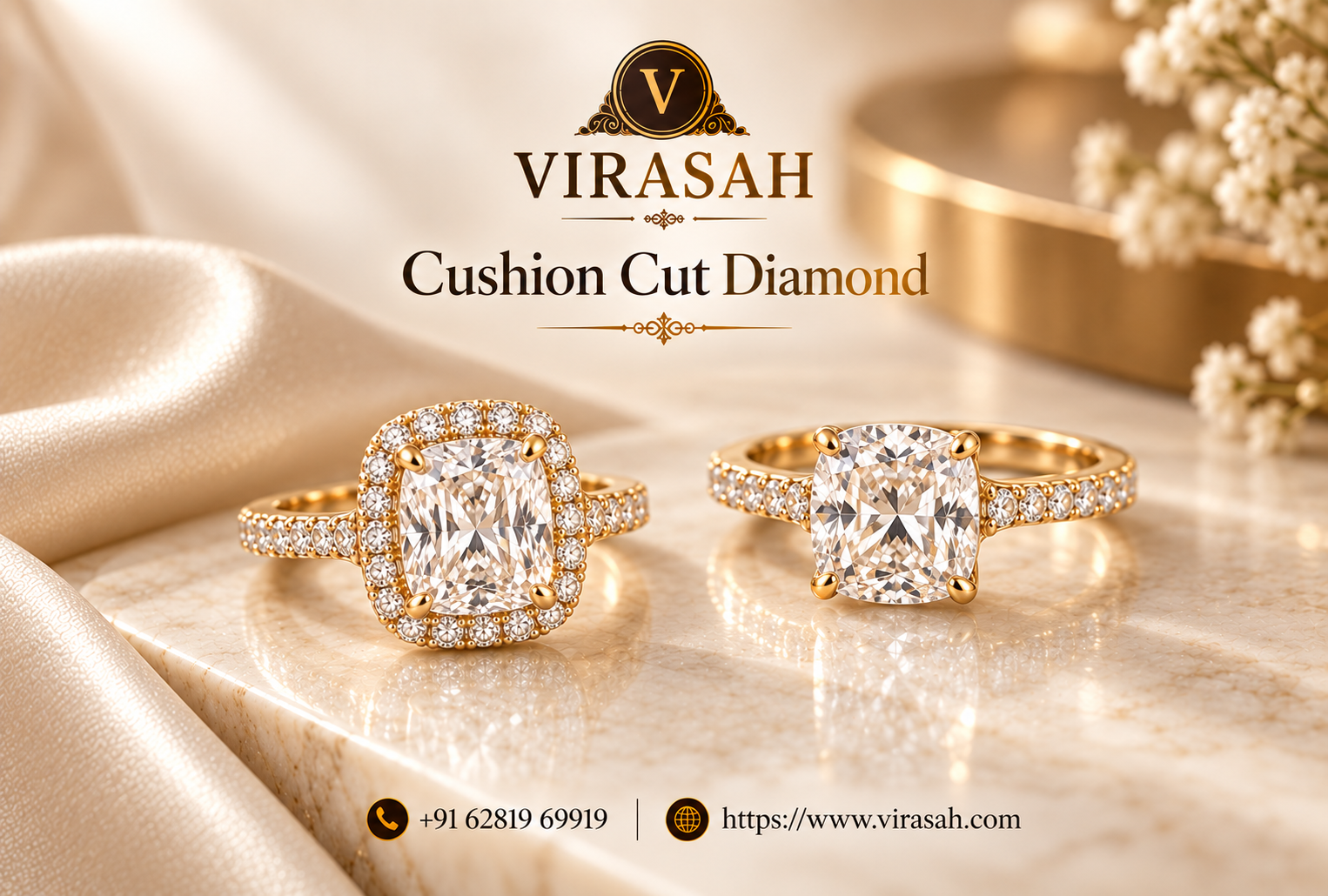
What Is a Cushion Cut Diamond?
A Cushion Cut Diamond is a diamond shape with a square or rectangular outline and rounded corners. The silhouette resembles a pillow, which is where the “cushion” name comes from. Unlike a round brilliant, which follows a more standardized outline and cut framework, cushion-shaped stones can vary widely. Some are nearly square, some are noticeably elongated, some have broad, chunky flashes of light, and others show a fine, glittering pattern that buyers often describe as crushed ice.
The important distinction is that “cushion” describes a family of shapes, not one single visual formula. A Cushion Cut Diamond may have gently curved sides or a more structured perimeter. Its corners may be subtle and rounded or more pronounced. Its pavilion—the lower portion of the diamond—can use different facet arrangements, creating different patterns of brightness and contrast. This is why photographs, videos, and direct comparison matter so much when buying this shape.
For a buyer, that variety is an advantage. You can choose a Cushion Cut Diamond that feels antique and soft, highly brilliant and modern, or long and elegant. The trade-off is that laboratory specifications alone cannot fully tell you whether the stone will look lively and balanced. A careful purchase combines grading information with visual evaluation.
Why the Cushion Shape Has Endured for Generations
The modern Cushion Cut Diamond has historical roots in earlier cushion-like diamonds, particularly the old mine cut. Older stones were shaped by hand and often had high crowns, deeper bodies, larger facets, and small tables. Their sparkle was broad and romantic rather than extremely precise. As cutting technology developed, diamond cutters refined the cushion outline while keeping its rounded, softly geometric character.
That history helps explain why a Cushion Cut Diamond works so well in both antique-inspired and contemporary jewelry. In a milgrain halo or detailed vintage setting, it looks naturally at home. In a clean solitaire or a thin pavé band, the same basic outline feels modern. This adaptability is one reason buyers who want a distinctive engagement ring without choosing an unconventional gemstone often consider a cushion.
The shape also bridges two visual ideas: the orderliness of a square or rectangle and the gentleness of rounded edges. A Cushion Cut Diamond can therefore feel structured without appearing severe. Compared with a princess cut, its corners are less sharp; compared with a round, its outline appears more architectural. That balance can be flattering on many hand shapes and can coordinate easily with wedding bands and side stones.
For shoppers interested in the broader language of diamond shape, Virasah’s guide to the best diamond cuts for engagement rings is a useful companion. It helps place the Cushion Cut Diamond in context alongside other popular silhouettes before you commit to one look.
Understanding Cushion Brilliant, Modified Brilliant, and “Crushed Ice”
Not every Cushion Cut Diamond returns light in the same way. The internal facet pattern can create a major difference in appearance even when two diamonds share similar color, clarity, and carat grades. This is one of the most important topics to understand before buying.
Cushion Brilliant Appearance
A classic brilliant-style Cushion Cut Diamond often shows larger, more defined flashes of light. Buyers sometimes call this a “chunky” pattern because the reflections appear broader and easier to distinguish. The stone can look crisp, open, and lively, especially when the facets are well aligned and the proportions support strong light return. People who love antique diamonds or visible facet architecture often prefer this style.
Modified Brilliant Appearance
A modified brilliant Cushion Cut Diamond uses additional or altered facets in the pavilion. Many examples produce smaller, splintery reflections that resemble crushed ice. This is not automatically good or bad. A beautiful crushed-ice cushion can sparkle intensely, particularly in motion, while a poorly performing one can look watery or dull in the center. The label on a grading report does not tell you whether the pattern is attractive; the actual stone must be inspected.
Hybrid and Mixed Appearances
Some cushions sit between the two visual extremes. A Cushion Cut Diamond may have clear, broad flashes in one area and finer scintillation in another. For many buyers, these mixed patterns are appealing because they combine definition with abundant sparkle. There is no universal “best” pattern. The better question is whether the stone looks bright across its face, maintains attractive contrast, and avoids large dead or glassy areas.
Square vs Elongated: Choosing the Outline You Prefer
A square Cushion Cut Diamond has a length-to-width ratio close to 1.00, giving it a compact, balanced presence. It is a classic choice for halos, three-stone rings, and vintage-inspired designs because the symmetry feels calm and centered. A square outline can also make the rounded corners more noticeable, emphasizing the pillow shape.
An elongated Cushion Cut Diamond is longer than it is wide. This creates a rectangular impression with softened corners. Elongated cushions have become especially popular because they can look larger across the finger and can visually lengthen the hand. They also work beautifully in north-south solitaires, hidden halos, and delicate pavé bands.
Neither version is inherently superior. A Cushion Cut Diamond with a slightly elongated ratio may offer the most noticeable compromise between square symmetry and rectangular elegance. More dramatic elongation creates a fashion-forward look, but it also makes outline consistency more important. Check that the shoulders are balanced, the corners have similar curves, and the stone does not appear pinched or overly bulged on one side.
When choosing between the two, consider more than trend. A Cushion Cut Diamond is likely to be worn for years, so look at the shape from arm’s length as well as close up. A ratio that feels exciting in a magnified product video can appear very different once set on the hand.
Length-to-Width Ratio: A Simple Number With a Big Visual Effect
The length-to-width ratio of a Cushion Cut Diamond is calculated by dividing its length by its width. A ratio of 1.00 is square. As the number rises, the outline becomes more elongated. The ratio is not a quality grade; it is a shape preference. Still, it is one of the quickest ways to filter stones when shopping online.
| Approximate Ratio | General Look | Who May Prefer It |
|---|---|---|
| 1.00–1.05 | Square and balanced | Buyers who want a traditional pillow-like silhouette |
| 1.06–1.10 | Subtly elongated | Buyers who want a gentle rectangular effect |
| 1.11–1.20 | Clearly elongated | Buyers who like a longer look and greater finger coverage |
| Above 1.20 | Distinctly rectangular | Buyers who prefer a modern and dramatic outline |
These ranges are not rules. Two stones with the same ratio can still look different because the curvature of the sides and corners changes the outline. A Cushion Cut Diamond with straighter sides can look more rectangular than another with strongly bowed sides even if the measurements are similar. That is why dimensions and face-up images should always be reviewed together.
If you are unsure, compare a square and an elongated Cushion Cut Diamond at the same carat weight. The elongated stone may give more visual spread in one direction, while the square stone may look fuller and more compact. The best choice is the one that looks harmonious in the setting you intend to use.
How the 4Cs Apply to a Cushion Cut Diamond
The 4Cs—cut, color, clarity, and carat weight—provide a useful framework for evaluating diamonds, but a Cushion Cut Diamond requires some shape-specific interpretation. Cushion shapes are generally classified as fancy shapes, and their visual performance can vary considerably. That means buyers should understand the grades without assuming that a higher grade in every category always produces the most beautiful or best-value stone.
Cut: Look Beyond a Single Label
For a Cushion Cut Diamond, cut quality should be judged through proportions, symmetry, polish, facet pattern, and actual light performance. Pay attention to whether the center remains bright, whether dark areas move attractively as the diamond moves, and whether the outline is symmetrical. Very deep stones can hide weight below the girdle, while unusually shallow stones can lose light or appear less lively.
Because cushion shapes vary, a Cushion Cut Diamond should not be purchased simply because its table and depth fall inside an internet “ideal range.” Those ranges can be useful for screening, but they cannot replace visual review. A diamond just outside a popular range may outperform one that fits the numbers perfectly.
Color: Cushions Can Reveal Warmth
A Cushion Cut Diamond can show body color more readily than some round brilliant diamonds, especially in larger sizes or certain faceting patterns. If you want an icy white appearance in platinum or white gold, you may prefer a higher color grade. If you enjoy a little warmth—or plan to use yellow or rose gold—you may be comfortable choosing a lower grade and allocating more of the budget to size or clarity.
Color sensitivity is personal. Some people easily distinguish adjacent grades; others see very little difference once a Cushion Cut Diamond is face-up and set. Compare diamonds in similar settings whenever possible because metal color can influence perception.
Clarity: Position Matters as Much as Grade
The clarity grade of a Cushion Cut Diamond describes inclusions and blemishes evaluated under standardized conditions, but the practical buying question is whether inclusions are visible without magnification and whether they create durability concerns. A small inclusion near the edge may be less noticeable than a dark inclusion under the table. Conversely, an inclusion located near a corner or girdle can deserve extra attention from a jeweler because of setting and wear considerations.
Many buyers aim for an eye-clean Cushion Cut Diamond rather than paying a premium for microscopic perfection. A well-selected VS or SI stone may appear completely clean in normal viewing, depending on its size, inclusion type, and placement. Always request magnified images and, when possible, a normal-scale video.
Carat: Weight Is Not the Same as Visible Size
Carat measures weight, not diameter or surface area. A deeply cut Cushion Cut Diamond may carry more of its weight below the top of the stone and therefore look smaller than another diamond of the same carat. Compare millimeter dimensions, not just carat numbers. Face-up spread is particularly important when comparing a square cushion with an elongated one.
A smart strategy is to choose a Cushion Cut Diamond with balanced dimensions rather than chasing a psychologically appealing carat threshold. A well-spread 0.90-carat diamond can look remarkably similar to a 1.00-carat stone in some settings, while the price difference may be meaningful. The same principle can apply around other popular weight milestones.
Light Performance: Brightness, Fire, Scintillation, and Contrast
When people say a diamond “sparkles,” they are usually combining several visual effects. Brightness is the return of white light. Fire is the separation of light into spectral colors. Scintillation is the pattern of flashes that appears as the diamond, the viewer, or the light source moves. A well-chosen Cushion Cut Diamond should feel active rather than flat: bright areas and darker contrast zones should alternate in a pleasing way as the stone moves.
Contrast is important because a diamond that is uniformly white can look less dimensional than one with a balanced pattern of light and dark. The goal is not to eliminate every dark reflection. Instead, look for movement. If a dark region remains fixed and dominant through several viewing angles, the Cushion Cut Diamond may have an undesirable dead area. If the contrast shifts and breaks into bright flashes, it can add character and definition.
Elongated shapes sometimes show a bow-tie-like shadow through the middle. A mild bow tie can be part of the stone’s pattern, but a strong, persistent dark band may distract from the overall appearance. Evaluate an elongated Cushion Cut Diamond in video and, ideally, in person rather than judging one static photograph. Studio lighting can hide problems or exaggerate sparkle, while ordinary lighting often gives a more realistic impression.
Also check the center for a watery or transparent look. In some modified cushions, very fine facets can create a glittery effect that appeals to many buyers, but the Cushion Cut Diamond should still return enough light to feel vibrant. If large areas look mushy, gray, or see-through, compare another stone. The best-performing option is the one whose pattern remains attractive under several lighting conditions rather than only under intense jewelry-store spotlights.
Table, Depth, Girdle, and Other Proportions to Check
Numbers on a grading report can help narrow a shortlist, but they should be treated as screening tools rather than rigid pass-or-fail rules. The table is the large facet on the top of the diamond, while depth is the total height expressed as a percentage of average width. In a Cushion Cut Diamond, different combinations of table and depth can produce attractive results because there is no single standardized cushion architecture.
A very deep Cushion Cut Diamond can concentrate weight below the girdle, reducing face-up size. A very shallow one may show leakage or an unbalanced reflection pattern. Buyers often prefer moderate proportions, but the actual outline and facet arrangement should guide the decision. If two stones have similar grades and prices, compare their millimeter dimensions and videos to see which offers a better balance of spread and light return.
The girdle deserves attention as well. Cushion corners can naturally have greater thickness than the spaces between them. Extremely thin areas may be more vulnerable during setting or impact, while an excessively thick girdle can hide weight. For a Cushion Cut Diamond, look at the full girdle description and ask a jeweler whether any localized extremes create a practical concern.
Polish and symmetry grades also matter. Good finishing helps facets meet cleanly and supports an orderly appearance. Still, a Cushion Cut Diamond can have high symmetry on paper yet show an outline you personally dislike. Inspect the way the four sides balance, how evenly the corners are shaped, and whether the culet appears centered when you look straight down at the stone.
Choosing a Color Grade Without Overspending
Color is one of the easiest areas in which buyers can overspend if they purchase a laboratory grade rather than a visual result. A Cushion Cut Diamond may show warmth differently depending on carat weight, facet pattern, setting metal, and the viewer’s sensitivity. The practical target is not necessarily the highest grade you can afford; it is the lowest grade that still looks the way you want in the finished ring.
For a white-metal setting, many shoppers prefer the near-colorless range because it can offer a bright appearance without the premium attached to the top colorless grades. In yellow or rose gold, a slightly warmer Cushion Cut Diamond can harmonize beautifully with the metal. If the prongs holding the center stone are white metal while the band is yellow gold, that combination can also help maintain a crisp face-up look.
Size matters because color can be more apparent in a larger Cushion Cut Diamond. A grade that appears sufficiently white in a smaller diamond may show more warmth when the stone is significantly larger. Elongated cushions can also concentrate color differently near their ends or corners, so inspect face-up and side views rather than relying on the grade alone.
When comparing adjacent grades, ask to see them under neutral light and without being told which is “better” first. If you cannot reliably distinguish the more expensive Cushion Cut Diamond, the lower grade may be the smarter allocation of budget. Put the savings toward a more attractive facet pattern, greater visible size, a stronger setting, or a design detail you will notice every day.
Choosing Clarity: Aim for Eye-Clean, Not Automatically Flawless
Clarity grades are important, but their visual effect depends heavily on inclusion type and location. A Cushion Cut Diamond with a small feather or crystal near the edge can look cleaner to the unaided eye than another stone with a dark inclusion directly beneath the table, even if their laboratory clarity grades are the same. This is why the inclusion plot and magnified imagery should be read together.
An eye-clean Cushion Cut Diamond has no inclusions that are distracting at normal viewing distance under ordinary conditions. “Eye-clean” is a practical description rather than an official universal grade, so ask the seller exactly how they define it. For example, is the diamond viewed from the top only, or also from the side? At what distance? Under what lighting? Those details matter when comparing stones online.
Do not assume that every lower-clarity Cushion Cut Diamond is a bargain. Some inclusions can affect transparency, making the diamond appear hazy even when individual marks are hard to see. Others may be positioned near vulnerable areas. Request a jeweler’s assessment if the grading report lists features such as large feathers, cavities, knots, or extensive clouds, particularly when comments indicate additional clarity characteristics not shown on the plot.
At the other end of the spectrum, paying for a very high clarity grade can make sense when rarity itself is part of the purchase objective. For most everyday engagement rings, however, the visual difference between a clean-looking VS-grade Cushion Cut Diamond and a much higher grade may be invisible without magnification. Decide whether your priority is rarity on paper or appearance on the hand.
Carat Weight vs Face-Up Size: What Buyers Often Miss
A carat is a unit of weight, not a measurement of visual diameter. This distinction is especially important for a Cushion Cut Diamond because cushions can be cut at noticeably different depths. Two one-carat cushions may carry the same weight but present different lengths and widths from the top. The stone with better spread may look larger even though the certificate shows the same carat number.
Always compare the three measurements on the grading report. For a square Cushion Cut Diamond, length and width should be reasonably close if you want a balanced outline. For an elongated stone, the relationship between those measurements tells you the ratio. The third measurement—the depth in millimeters—helps explain where some of the weight is distributed.
Setting design can further change apparent size. A halo around a Cushion Cut Diamond can make the entire center presentation look substantially larger. A fine bezel traces the perimeter and can create a bold outline. A thin solitaire band makes the center stone visually dominant, while a very wide band can make the same diamond appear smaller by comparison. Think of visible size as a combination of diamond dimensions and design, not carat alone.
If budget matters, consider weights just below common milestones. A well-cut 0.95-carat Cushion Cut Diamond may deliver nearly the same visual presence as a 1.00-carat example, depending on dimensions. Likewise, a 1.80-carat stone with generous spread can sometimes compete visually with a deeper two-carat option. Never sacrifice beauty purely to reach a round number on the certificate.
Best Ring Settings for a Cushion Cut Diamond
The rounded corners of a Cushion Cut Diamond make it versatile in jewelry design. The right setting should protect the diamond, complement its outline, and match the wearer’s lifestyle. Because cushions range from antique-looking to sleek and elongated, there is no single setting that works for every stone.
Solitaire Setting
A solitaire gives the Cushion Cut Diamond maximum visual attention. Four prongs can keep the outline open and airy, while a six- or eight-prong arrangement may create a more vintage impression. A delicate band emphasizes the center stone and works particularly well with elongated cushions. Ask the jeweler to keep prongs neat and symmetrical so they do not visually distort the corners.
Halo Setting
A halo frames the Cushion Cut Diamond with smaller stones and increases overall presence. It can also reinforce a vintage aesthetic. The most refined halos follow the contour of the center closely rather than leaving an awkward gap. For a square cushion, a gently rounded square halo looks cohesive; for an elongated cushion, the halo should echo the exact length-to-width proportions.
Hidden Halo Setting
A hidden halo places small diamonds beneath the center rather than around its face. This lets the Cushion Cut Diamond remain the main top-view feature while adding sparkle from the side. It is popular in contemporary designs and pairs well with simple bands. The engineering is important: the hidden halo should not interfere with a wedding band or create exposed areas that catch on clothing.
Bezel Setting
A bezel surrounds the perimeter with metal, offering excellent edge protection and a clean modern outline. For someone with an active lifestyle, a bezel-set Cushion Cut Diamond can be practical because there are fewer exposed prongs. The trade-off is that the metal frame changes the visual profile, so the craftsmanship must be precise and the bezel should follow the stone evenly.
Three-Stone Setting
Side stones can make a Cushion Cut Diamond feel more substantial and ceremonial. Tapered baguettes create an elegant architectural look; half-moons soften the transition; smaller cushions create continuity. The center should remain visually dominant, so proportion the side stones carefully. An elongated center with tapered sides can create particularly graceful finger coverage.
Pavé Band
A pavé band adds sparkle without changing the outline of the center. It suits both square and elongated cushions and can make a moderate-size Cushion Cut Diamond feel more luxurious. Very fine pavé requires careful workmanship and periodic inspection because the small stones rely on tiny beads or shared prongs. If durability is a priority, discuss band width and maintenance with the jeweler.
Cushion Cut Diamond vs Other Popular Diamond Shapes
Shape preference is emotional, but comparison is still useful because each silhouette distributes weight and light differently. A Cushion Cut Diamond is especially attractive to buyers who want softened geometry and a balance between vintage character and contemporary sparkle. The table below summarizes the practical differences you are likely to notice while shopping.
| Shape | Outline | Sparkle Character | Visible Size Tendency | Style Impression |
|---|---|---|---|---|
| Cushion Cut Diamond | Square or rectangular with rounded corners | Ranges from broad flashes to crushed-ice scintillation | Varies substantially with depth and ratio | Romantic, soft, and versatile |
| Round Brilliant | Circular | Highly standardized brilliant pattern | Predictable for a given weight | Classic and timeless |
| Princess | Square with pointed corners | Sharp and lively brilliance | Often efficient for square coverage | Modern and geometric |
| Radiant | Square or rectangular with cut corners | Often energetic, splintery brilliance | Can offer strong rectangular spread | Bold and contemporary |
| Oval | Elongated and rounded | Bright with possible bow-tie contrast | Often appears large for weight | Elegant and lengthening |
Compared with a round, a Cushion Cut Diamond tends to offer more individuality because the outline and faceting vary. Compared with a princess, it removes sharp corners and feels softer. Compared with a radiant, it usually has more rounded edges and can show chunkier facet patterns. Compared with an oval, it keeps a stronger geometric identity while still offering an elongated option.
If you are building a wider bridal jewelry plan rather than choosing the center stone in isolation, Virasah’s wedding jewelry checklist for Indian brides can help you think about coordination between engagement rings, necklaces, earrings, bangles, and other pieces.
How Cushion Diamonds Fit Into a Broader Fine-Jewelry Collection
A diamond purchase often sits within a larger jewelry wardrobe. The neutral brilliance of a Cushion Cut Diamond makes it easy to pair with colored gemstones, but balance matters. If the ring is elaborate, simpler gemstone earrings may be enough. If the cushion ring is a restrained solitaire, richly colored pieces can add personality without creating visual competition.
For buyers comparing different precious stones, it helps to understand how rarity and quality work outside diamonds. Explore Virasah’s guides to tanzanite jewelry, Burmese ruby, and Kashmir sapphire. Each category has its own grading language, treatment considerations, and rarity factors, which is a useful reminder not to apply diamond-buying rules to every gemstone.
A Cushion Cut Diamond can also serve as a calm centerpiece when other jewelry uses saturated color. A ruby, sapphire, emerald, or tanzanite may become the accent while the diamond supplies neutral light. If you enjoy collecting unusual stones, the guide to rare gemstones in India offers additional context on building a varied collection.
For more specific gemstone shopping, Virasah also covers how to choose sapphire jewelry, ruby jewelry quality and buying tips, and emerald jewelry designs for weddings and special occasions. These resources can help you coordinate a Cushion Cut Diamond ring with heirloom pieces or wedding jewelry while keeping each gemstone’s character distinct.
How to Build a Smart Budget for a Cushion Cut Diamond
A strong budget strategy starts by deciding which qualities you can actually see. With a Cushion Cut Diamond, the most important visual priorities are usually an attractive outline, lively light return, a color level you enjoy, and clarity that looks clean in normal wear. Carat weight comes after those considerations because extra weight does not help if the diamond looks dull, overly deep, or visibly included.
Begin with a total ring budget rather than a center-stone budget alone. The setting, side stones, metal, craftsmanship, taxes, resizing, and future maintenance all contribute to the final cost. If the design includes a halo or pavé, a slightly smaller Cushion Cut Diamond may still achieve the visual presence you want. If the setting is a simple solitaire, you may prefer to devote more of the budget to the center stone itself.
Price jumps often occur around familiar carat milestones. Comparing a Cushion Cut Diamond slightly below those thresholds can reveal strong value, especially when its face-up dimensions are generous. Likewise, moving down one color or clarity grade can sometimes produce substantial savings with little visible difference. The key is to compare actual stones rather than deciding that a particular letter or clarity abbreviation is mandatory.
Do not treat the lowest-priced Cushion Cut Diamond in a filtered search as automatically good value. A low price can reflect weaker light performance, unattractive proportions, a distracting inclusion, fluorescence concerns in a particular stone, or simply an unpopular outline. Value means getting the combination of beauty, verification, durability, and design you want—not just minimizing the purchase price.
Natural and Laboratory-Grown Options: Know What You Are Comparing
Both natural and laboratory-grown diamonds can be fashioned into a Cushion Cut Diamond, and both can be evaluated for color, clarity, carat weight, and finish. The essential buying step is clear disclosure. You should know exactly what material you are purchasing and receive documentation that matches the stone. The visual choice of cushion outline and faceting can be considered separately from the origin choice.
A natural Cushion Cut Diamond forms through geological processes and is valued partly for natural origin and rarity. A laboratory-grown diamond is created through technological processes that produce diamond material and can offer a different price structure. Personal priorities vary: some buyers place importance on natural rarity and long-standing jewelry traditions, while others prioritize size, specifications, or budget efficiency.
Do not assume future resale or appreciation outcomes for either category. Jewelry should be purchased primarily because you understand the product, price, documentation, and terms of sale. If long-term monetary value is an important concern, request written policies regarding trade-ins, upgrades, buybacks, and returns rather than relying on verbal predictions about what a Cushion Cut Diamond may be worth later.
Truthful terminology is especially important when shopping online. The U.S. Federal Trade Commission’s Jewelry Guides discuss accurate representation and disclosures for diamonds, gemstones, and jewelry products. Wherever you purchase, insist that descriptions of a Cushion Cut Diamond clearly state whether it is natural or laboratory-grown and disclose relevant treatments.
Certification and Grading Reports: What to Verify
A grading report provides an independent record of measurable and observable characteristics. For a Cushion Cut Diamond, verify the report number, carat weight, color grade, clarity grade, measurements, polish, symmetry, fluorescence, and plotted or listed clarity characteristics. The shape and cutting style should also match the stone you are viewing.
Use the report as verification, not as a beauty certificate. A laboratory may document two diamonds with very similar grades even though one Cushion Cut Diamond has a more appealing outline or sparkle pattern. Fancy-shape beauty requires visual judgment. If purchasing remotely, request high-resolution video, a face-up image, and ideally footage in more than one lighting environment.
The Gemological Institute of America provides an overview of the diamond buying process and the 4Cs, as well as a specific discussion of the cushion shape and what to look for. Its resources on diamond color and its diamond clarity education materials are also useful when interpreting a Cushion Cut Diamond grading report.
If a seller provides a report lookup function, confirm the report details directly before finalizing the purchase. Check that the measurements and identifying features correspond to the Cushion Cut Diamond you receive. For higher-value purchases, you can also discuss independent appraisal, insurance documentation, and secure shipping procedures.
Responsible Sourcing Questions Worth Asking
Responsible sourcing is broader than simply asking whether a Cushion Cut Diamond is “conflict free.” Buyers can ask how suppliers are selected, what documentation is retained, which standards the jeweler follows, and how origin or sourcing claims are substantiated. A transparent seller should be able to explain its policies clearly rather than relying on vague ethical language.
The Kimberley Process is an international initiative focused on excluding conflict diamonds from legitimate trade in rough diamonds. It is useful context, but an individual polished Cushion Cut Diamond may involve additional supply-chain questions beyond the scope of the rough-diamond certification scheme. Buyers interested in broader responsible-jewelry practices can also review the Responsible Jewellery Council standards.
Ask for specificity whenever a claim matters to you. If a Cushion Cut Diamond is described as traceable to a country, mine, or program, request the documentation supporting that statement. If recycled metal or certified precious metal is part of the ring design, ask what standard or supplier documentation supports that claim as well.
Common Mistakes to Avoid When Buying a Cushion Cut Diamond
1. Buying by Carat Number Alone
A heavy but deep Cushion Cut Diamond can look smaller than a lighter stone with better spread. Always compare millimeter dimensions and face-up appearance. Carat is important, but it is only one part of the value equation.
2. Treating a Ratio as a Quality Grade
Length-to-width ratio describes shape preference, not beauty. A 1.15 Cushion Cut Diamond is not inherently better than a 1.02 stone. The sides, corners, symmetry, and faceting must work together.
3. Ignoring the Sparkle Pattern
Some buyers discover after purchase that they prefer broad flashes to crushed ice, or the reverse. Compare different facet personalities before choosing your Cushion Cut Diamond so you know which type of scintillation you enjoy.
4. Paying for Invisible Clarity
A very high clarity grade can be valuable for rarity, but it may not change what you see. If an eye-clean Cushion Cut Diamond at a lower grade is equally beautiful, the savings can be redirected to size or craftsmanship.
5. Choosing Color Without Considering Metal
The setting influences perceived warmth. A Cushion Cut Diamond that looks slightly warm loose may appear harmonious in yellow or rose gold. Evaluate the intended metal before paying for a higher color grade.
6. Relying Only on Magnified Photography
Extreme magnification can make harmless inclusions look alarming and can also make the diamond seem larger than it is. View the Cushion Cut Diamond both magnified and at realistic scale. Video showing movement is particularly valuable.
7. Forgetting Return and Resize Policies
Even careful online evaluation cannot perfectly predict how a Cushion Cut Diamond will feel on the hand. Read the return window, condition requirements, resizing policy, warranty, and custom-order terms before payment.
Final Cushion Cut Diamond Buying Checklist
- Confirm whether you prefer a square or elongated Cushion Cut Diamond and note the approximate ratio that looks best to you.
- Compare facet patterns and decide whether you like chunky flashes, crushed-ice scintillation, or a hybrid appearance.
- Check face-up brightness and make sure there are no distracting persistent dark or watery zones.
- Compare millimeter dimensions in addition to carat weight so you understand visible spread.
- Select a color grade based on the finished setting and your own sensitivity to warmth.
- Choose clarity by actual visibility and inclusion position, not just by chasing a high grade.
- Review girdle condition, polish, symmetry, fluorescence, and report comments.
- Match the setting to lifestyle, protection needs, wedding-band fit, and maintenance tolerance.
- Verify the grading report and make sure it matches the exact Cushion Cut Diamond being sold.
- Read written return, resize, warranty, upgrade, and shipping terms before purchase.
- Ask for transparent natural or laboratory-grown disclosure and any sourcing documentation important to you.
- Compare the final Cushion Cut Diamond under more than one lighting condition whenever possible.
Frequently Asked Questions About Cushion-Shaped Diamonds
1. Is a cushion-shaped diamond a good choice for an engagement ring?
Yes. Its rounded corners, varied proportions, and mix of vintage and modern character make it highly versatile. The most important step is selecting an individual stone with a balanced outline and attractive light performance, then placing it in a setting suited to the wearer’s lifestyle.
2. Does a cushion-shaped diamond look bigger than a round diamond?
It depends on proportions. Some elongated cushions provide generous finger coverage, while deeper cushions can look smaller than their carat weight suggests. Compare face-up millimeter dimensions rather than assuming one shape will always look larger.
3. What length-to-width ratio is best for a cushion-shaped diamond?
There is no single best ratio. Around 1.00 looks square, while higher ratios create increasing elongation. Choose the outline that appeals to you, then inspect the side curves and corner symmetry because two stones with the same ratio can still look different.
4. What is the difference between cushion brilliant and cushion modified brilliant?
The terms describe different facet arrangements. A brilliant-style cushion-shaped diamond often shows broader, more defined flashes, while modified versions may produce finer, crushed-ice scintillation. Actual appearance varies, so the report description should be paired with video or in-person inspection.
5. What color grade should I choose for a cushion-shaped diamond?
Your ideal grade depends on size, setting metal, budget, and personal color sensitivity. Near-colorless grades can offer strong value for many buyers, while larger stones or white-metal settings may make some shoppers prefer a higher grade. Compare adjacent grades visually before paying a premium.
6. What clarity grade is best for a cushion-shaped diamond?
For many buyers, the practical goal is eye-clean clarity rather than the highest possible grade. Inclusion location and type matter. A lower-grade cushion-shaped diamond can be an excellent choice if it looks clean at normal distance and does not contain durability-relevant features.
7. Is a crushed-ice cushion-shaped diamond lower quality?
No. “Crushed ice” describes a visual pattern, not an official quality grade. Some buyers love its fine scintillation; others prefer large, chunky flashes. Quality depends on whether the diamond is bright, attractive, balanced, and suited to your taste.
8. Can a cushion-shaped diamond have a bow tie?
Yes, particularly elongated examples can display darker contrast through the center. A small moving contrast area can be normal, but a strong stationary band may be distracting. Review the stone in motion and in several lighting conditions.
9. Which setting protects a cushion-shaped diamond best?
A well-made bezel provides excellent perimeter protection, while secure prong settings can also be suitable. The best option depends on the wearer’s activity level, design preference, and the specific girdle. Have a qualified jeweler inspect the stone before setting.
10. How can I tell whether a cushion-shaped diamond is fairly priced?
Compare stones with similar origin, grading laboratory, carat, color, clarity, dimensions, fluorescence, and overall visual quality. Then factor in craftsmanship, setting quality, service, return terms, and warranty. Price comparison is meaningful only when the products being compared are genuinely similar.
Conclusion: Buy the Stone You Love, Not Just the Report
The appeal of a cushion-shaped diamond lies in its individuality. Unlike a shape that follows one tightly standardized visual formula, cushions offer a spectrum of outlines and facet personalities. That means the buying process rewards careful comparison. Start with the report, but do not stop there. Look at dimensions, ratio, corners, side curvature, brightness, contrast, color, clarity, and the way the diamond moves in real light.
A thoughtfully selected cushion-shaped diamond should make sense from three distances: under magnification, at normal viewing distance, and on the hand as part of the finished ring. If it only looks impressive in a certificate table or a highly controlled video, keep comparing. The best purchase is one whose beauty remains convincing after the technical details have been checked.
Use your budget where it creates a visible or meaningful benefit. A beautiful outline and lively faceting often matter more day to day than microscopic perfection. Choose a cushion-shaped diamond that works with your preferred metal, setting, lifestyle, and long-term jewelry wardrobe, and insist on clear grading and product disclosure before you buy.
Contact Virasah Jewellery:
For jewelry guidance, design enquiries, and purchase assistance, contact Virasah.
Phone: +91 62819 69919