Custom Diamond Jewellery in Hyderabad: From Concept to Final Design
Discover how a personalised diamond jewellery idea becomes a finished piece through consultation, stone selection, design development, CAD planning, craftsmanship, setting, finishing and final quality inspection.
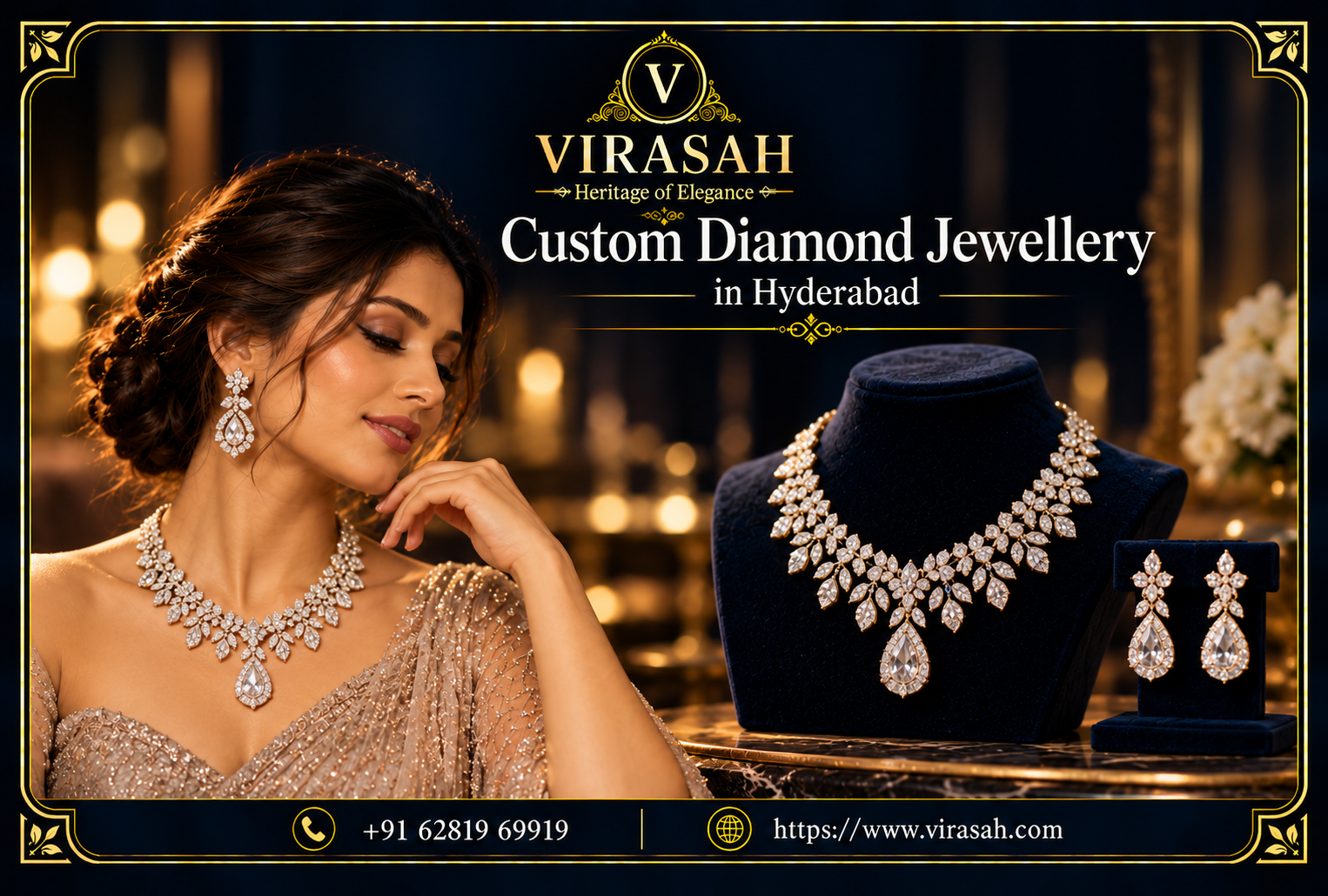
Introduction: Turning a Jewellery Idea Into a Personal Design
Jewellery becomes especially meaningful when it is created around a person rather than selected only from a display. A custom piece can reflect a proposal, wedding milestone, family tradition, anniversary, personal style, or simply a desire for something that does not look mass-produced. In Hyderabad, clients can combine traditional Indian jewellery aesthetics with contemporary silhouettes, choosing the metal, diamond arrangement, proportions, finish, and small design details that make a piece feel personal.
The journey from an idea to a finished jewel is not one single step. It is a sequence of design conversations, sketches, stone selection, technical planning, modelling, setting, finishing, inspection, and final approval. Understanding this sequence makes the experience easier because you know what questions to ask before production begins. Custom Diamond Jewellery in Hyderabad can range from a delicate everyday ring to a statement bridal necklace, and the process should be adjusted to the complexity of the design.
A strong custom process begins with listening. The jeweller needs to understand the occasion, preferred jewellery style, expected budget, metal preference, desired diamond appearance, wearing frequency, and practical requirements. From there, the concept can be translated into proportions that can actually be manufactured and worn comfortably. The most beautiful concept is useful only when it can be engineered into a durable finished piece.
What Is Custom Diamond Jewellery?
Custom diamond jewellery is jewellery designed specifically for a client instead of being selected as a finished standard model. The custom approach may involve creating a completely new design or modifying an existing concept. The client can have input into the overall shape, stone layout, metal colour, dimensions, engraving, setting style, and finishing details.
For Custom Diamond Jewellery in Hyderabad, the design process can be particularly interesting because Hyderabad has a long jewellery culture alongside a growing interest in modern luxury design. A custom piece can combine classic motifs such as floral forms, paisley-inspired curves, geometric patterns, or traditional bridal proportions with cleaner contemporary lines.
Customisation does not necessarily mean that every component must be invented from zero. A practical custom order may begin with a reference image, an inspiration board, or an existing design language. The designer then changes the proportions and details so that the final piece becomes distinctive and suitable for the intended wearer.
Why More Buyers Choose a Custom Approach
One major reason people choose custom jewellery is personal meaning. A ready-made design may be beautiful, but a custom piece can incorporate a meaningful motif, initials, a date, a family stone, or a specific diamond arrangement. The result can become associated with a particular memory rather than simply being another item in a jewellery box.
Another benefit is control. With Custom Diamond Jewellery in Hyderabad, buyers can discuss the relationship between design, diamond size, metal weight, comfort, and budget before production. This can be useful when a customer wants a visually substantial piece without increasing the centre diamond size, or when a minimalist look is preferred even with higher-quality stones.
Customisation can also solve fit and lifestyle problems. Ring proportions can be adapted to the wearer’s finger, earrings can be balanced for comfortable use, and necklace lengths can be selected according to neckline and occasion. The goal is not only visual beauty but also a piece that behaves well in everyday use.
Step 1: Understanding the Client’s Vision
The first stage is a design consultation. The conversation should establish what the client wants the jewellery to communicate. Is it romantic, traditional, minimal, glamorous, architectural, vintage-inspired, or contemporary? What jewellery does the client already wear? What shapes are usually preferred? Are there pieces that should be avoided? These answers give the designer a starting direction.
A consultation for Custom Diamond Jewellery in Hyderabad may also include references from photographs, sketches, previous jewellery, clothing, wedding outfits, or architecture. A reference is best treated as inspiration rather than something to copy blindly. The designer can identify the useful elements—perhaps the outline of a halo, the spacing of diamonds, or a particular curve—and translate those ideas into an original composition.
Budget should be discussed at the beginning rather than at the end. The cost of a custom piece can be affected by diamond characteristics, total carat weight, metal type, metal weight, craftsmanship, setting complexity, finishing, and certification or documentation. Early budget alignment allows the design to be engineered realistically.
Step 2: Defining the Occasion and Wearing Style
A jewellery piece designed for a wedding can have different priorities from one intended for everyday use. Bridal jewellery may emphasise visual presence, layered styling, traditional motifs, and coordination with an outfit. Everyday jewellery may prioritise low profiles, secure settings, lighter weight, and easy maintenance.
When planning Custom Diamond Jewellery in Hyderabad, the intended frequency of wear should influence the design. A ring that will be worn daily may need a practical setting and a profile that is less likely to catch on clothing. A ceremonial necklace can be more elaborate because it may be worn for shorter periods and stored carefully between occasions.
The wearer’s personal style matters as much as the occasion. Two brides may both want diamond jewellery while choosing completely different designs. One may prefer a delicate cluster of stones, while another may prefer bold geometric panels. Custom design allows those preferences to become part of the brief.
Step 3: Choosing the Diamond
Diamond selection is one of the most important technical stages. GIA describes the familiar 4Cs as color, clarity, cut, and carat weight. These characteristics provide a common framework for communicating diamond quality. However, a custom jewellery decision should not be reduced to a single grade because appearance, shape, setting, budget, and the design itself all matter.
For Custom Diamond Jewellery in Hyderabad, the designer and client can decide whether the visual priority is brilliance, size appearance, colour, matching between multiple stones, or a particular fancy shape. Round brilliant diamonds have a different visual character from oval, pear, emerald, marquise, cushion, or princess-style shapes. The right choice depends on the design concept and the wearer’s preferences.
For a significant purchase, buyers should ask for appropriate documentation and should understand what the report covers. GIA and IGI provide diamond and jewellery identification or assessment services, with the exact format depending on the stone and service. A report should be considered alongside the physical appearance and the jeweller’s documentation rather than as a substitute for understanding the complete purchase.
Step 4: Natural or Laboratory-Grown Diamond?
Modern buyers may encounter both natural and laboratory-grown diamonds. A laboratory-grown diamond is a diamond produced through a technological process rather than recovered from a natural geological deposit. It is important that the origin is clearly disclosed so the customer knows what is being purchased.
GIA currently provides separate services for laboratory-grown diamonds, and its current service descriptions distinguish laboratory-grown assessments from natural-diamond reports. IGI also provides laboratory-grown diamond reports. Because grading systems and terminology can change, buyers should check the current report format and the issuing laboratory’s own guidance at the time of purchase.
When Custom Diamond Jewellery in Hyderabad is being designed around a specific budget, discussing both options can help the client understand how the choice affects the design brief. The decision should be based on the buyer’s preferences, disclosure, documentation, budget, and intended use—not on assumptions about one category being automatically suitable for every customer.
Step 5: Selecting the Diamond Shape and Cut
Shape is one of the first visual decisions. Round diamonds offer a classic look, while oval and pear shapes can create an elongated appearance. Emerald cuts have broad step facets and a different optical character. Marquise shapes can feel dramatic, and cushion shapes often provide a softer outline. Fancy shapes can be used as centre stones, side stones, or repeating design elements.
Cut quality affects how a diamond interacts with light. GIA notes that cut involves complex factors related to proportions, facets, symmetry, and finish. In Custom Diamond Jewellery in Hyderabad, the selected stone should work with the architecture of the setting. A highly detailed setting cannot compensate for a centre stone that does not suit the intended visual effect.
For multi-stone designs, matching becomes important. The stones may need to be consistent in shape, visual appearance, and selected quality parameters so the finished arrangement looks balanced. A designer or gemologist can help establish a practical matching range.
Step 6: Choosing Metal and Colour
Gold remains a versatile choice for diamond jewellery, and the metal colour can change the overall character of a design. Yellow gold creates a warm traditional appearance, white gold can provide a brighter contemporary frame, and rose gold adds a softer colour contrast. The final choice should consider skin preference, wardrobe, existing jewellery, and the visual effect desired.
For Custom Diamond Jewellery in Hyderabad, the metal selection should also be discussed in relation to the construction. The karat, alloy composition, thickness, and manufacturing method can influence the finished piece. A jeweller should explain the metal specification, making charges, and applicable hallmarking documentation where relevant.
In India, BIS explains that hallmarking is an official system for recording precious-metal fineness, and hallmarked gold jewellery carries prescribed marks including purity information and a HUID under the current framework. Customers can also use BIS consumer resources to understand verification options.
Step 7: From Sketch to Design Direction
Once the brief is clear, the designer begins translating ideas into a visual direction. The first sketches may be loose and exploratory. Several proportions can be tested before one direction is developed further. At this stage, it is normal for a design to change because a shape that looks attractive in a reference photograph may not translate directly to the wearer’s dimensions.
A good custom process separates aesthetic decisions from engineering decisions without ignoring either. The front view determines visual balance, while the side and back views reveal how the piece will sit, close, support stones, and interact with the body. Custom Diamond Jewellery in Hyderabad should therefore be evaluated as a three-dimensional object, not only as a flat sketch.
Design approval should be based on clear information. The client should understand the intended dimensions, major stones, approximate metal specification, and notable construction features before production begins.
Step 8: CAD Design and 3D Visualisation
Computer-aided design can turn an approved concept into a detailed digital model. CAD allows the designer to examine proportions, stone placement, prong positions, wall thickness, openings, and other construction features before the piece is physically made. This can reduce uncertainty and make communication easier between the client, designer, and manufacturing team.
For Custom Diamond Jewellery in Hyderabad, a 3D model can be especially useful when the design includes complex curves, repeated motifs, hidden settings, or multiple stones. The client can review different views and request changes before production. A professional workflow should distinguish a visual rendering from the final manufactured dimensions because the two are not always identical.
At this stage, questions about comfort should be considered. A ring may look elegant from above but feel too tall from the side. Earrings may look balanced in a rendering but need weight distribution adjustments. CAD review gives the team an opportunity to identify such issues early.
Step 9: Prototype and Production Planning
Depending on the design, a prototype may be produced or a detailed production model may be used directly. The purpose is to verify that the design can be manufactured with the intended dimensions and stone arrangement. Complex pieces may require more planning because several components must fit together precisely.
A custom piece should have a clear production specification. This can include metal, stone quantities, approximate sizes, setting style, dimensions, finish, engraving, and any special requirements. Custom Diamond Jewellery in Hyderabad benefits from written specifications because they reduce ambiguity between the approved concept and the manufacturing stage.
The client should also ask about the approval point. Some jewellers allow final confirmation of the CAD model before production. If the design has significant sentimental or financial importance, retaining a copy of the approved design representation and order details can be useful for future reference.
Step 10: Stone Setting
Stone setting is where individual diamonds are secured into the jewellery. Common approaches include prong, bezel, pavé, channel, and other specialised setting styles. Each has a different visual and structural effect. The setting should be selected according to the stone shape, design, wear conditions, and desired appearance.
For Custom Diamond Jewellery in Hyderabad, precision matters because small differences in alignment can affect the way a group of stones appears. Pavé-style surfaces, for example, require consistent spacing and secure setting. Centre stones need a setting that provides appropriate support while maintaining the intended visual openness.
A finished piece should be inspected for stone security, alignment, symmetry, and finishing quality. Buyers should understand the jeweller’s care and maintenance recommendations because even a well-made piece requires appropriate handling.
Step 11: Polishing and Final Finishing
After construction and setting, the piece moves through finishing. Surfaces can be polished, textured, brushed, or given a combination of finishes. The choice can be subtle but important. A highly polished surface reflects light strongly, while a satin or brushed surface creates a quieter contrast against diamonds.
In Custom Diamond Jewellery in Hyderabad, finishing should support the design rather than distract from it. Edges should feel intentional, surfaces should meet cleanly, and decorative elements should have consistent proportions. The final finish can also influence how the jewellery photographs and how it appears under different lighting conditions.
If the design includes engraving, the engraving should be checked for spelling, spacing, and placement before final approval. Personalisation is often small in physical size but large in emotional importance.
Step 12: Quality Inspection Before Delivery
The final inspection is a critical step. The jewellery should be checked against the approved design and order details. The team can verify stone count, visible setting, symmetry, finish, dimensions, metal details, and documentation. Any requested engraving or personalisation should also be checked.
For Custom Diamond Jewellery in Hyderabad, buyers should ask what documentation accompanies the final piece. Depending on the product, this may include a diamond report, invoice, metal purity or hallmarking information, warranty terms, care instructions, and service details. The exact documents vary by product and jeweller.
BIS provides consumer information about hallmarking and HUID verification for hallmarked gold jewellery in India. Buyers can consult the official BIS resources rather than relying solely on informal explanations.
How to Plan a Custom Diamond Jewellery Budget
A custom jewellery budget should begin with the total amount the buyer is comfortable spending. The design can then be developed within that boundary. Instead of selecting a large centre stone first and trying to make the rest fit, it can be useful to allocate the budget across the major components: diamonds, metal, craftsmanship, design, and applicable documentation or services.
Custom Diamond Jewellery in Hyderabad can be adjusted in many ways without completely changing the design. The number of accent diamonds can be changed, the metal weight can be optimised, the centre-stone shape can be reconsidered, or a different setting can be used. A professional designer should explain how each change affects the visual result.
Buyers should request a clear quotation and understand what is included. Ask whether the quoted amount includes taxes, making or manufacturing charges, diamond certification, engraving, resizing, after-sales service, and any other applicable fees. Written clarity helps prevent surprises at delivery.
Design Ideas for Custom Diamond Rings
Custom rings can range from solitaire designs to halo compositions, three-stone layouts, cluster arrangements, hidden details, and modern geometric forms. A solitaire focuses attention on the centre stone, while a halo can visually frame it with smaller diamonds. Three-stone designs can represent a personal story or milestone, while cluster designs can create a broader surface of sparkle.
For Custom Diamond Jewellery in Hyderabad, ring design should also consider lifestyle. A daily-wear ring may benefit from a lower profile and secure setting. A statement ring intended for occasional wear can use more elaborate architecture. The ring should fit comfortably and leave enough practical clearance for neighbouring jewellery if it is intended to be stacked.
The best ring concept is one that looks distinctive while remaining wearable. Customisation gives the designer room to solve this balance rather than forcing the client into a fixed catalogue proportion.
Design Ideas for Custom Diamond Earrings
Earrings can be customised around face shape, hairstyle, outfit, and preferred level of movement. Studs can be designed for daily wear, while drops and chandeliers can create a more formal effect. Hoops can incorporate diamonds along the front, outer edge, or a combination of surfaces.
In Custom Diamond Jewellery in Hyderabad, earring weight and balance deserve attention. A visually large design is not automatically comfortable. The back mechanism, post position, centre of gravity, and overall weight can influence how an earring sits on the ear.
For bridal earrings, designers can coordinate the diamond arrangement with a necklace, maang tikka, or other pieces without making every component identical. Repeating a shape or motif can create visual continuity while allowing each piece to remain distinct.
Design Ideas for Custom Diamond Necklaces
A custom necklace can be developed around the neckline of an outfit, the intended occasion, and the desired scale. A delicate pendant may be designed for daily use, while a layered or statement necklace can be built for weddings and formal celebrations.
Custom Diamond Jewellery in Hyderabad can include necklaces that combine diamonds with coloured gemstones, pearls, or traditional motifs. If multiple materials are used, the designer should consider colour balance, stone durability, setting security, and maintenance requirements.
Necklace length and clasp design are also important. A beautiful front design can become inconvenient if the clasp is difficult to operate or if the necklace does not sit correctly. These functional elements should be included in the design conversation from the start.
Design Ideas for Custom Diamond Bracelets
Bracelets can be designed as flexible linked pieces, structured bangles, tennis-style arrangements, charm-based designs, or statement cuffs. The choice depends on how much movement and flexibility the wearer wants.
For Custom Diamond Jewellery in Hyderabad, bracelet sizing should be measured carefully because an overly tight piece can be uncomfortable while an overly loose piece can move excessively. The closure should be secure and appropriate for the design.
A custom bracelet can also coordinate with an existing watch or bangle stack. Designers can use repeated diamond shapes or metal finishes to create a cohesive look without making the pieces identical.
Combining Diamonds With Rare and Coloured Gemstones
Diamonds can work with emeralds, rubies, sapphires, and other coloured gemstones. The contrast can make a design more expressive, especially when the coloured stone has personal or cultural significance.
When Custom Diamond Jewellery in Hyderabad includes coloured gemstones, the buyer should understand that gemstone quality is evaluated differently from diamond quality. Colour, transparency, treatment, origin claims, durability, and laboratory documentation can all matter depending on the gemstone.
For deeper reading about gemstones, readers can explore our guides on Tanzanite, Burmese Ruby, Kashmir Sapphire, rare gemstones, sapphire jewellery, ruby jewellery, and emerald wedding designs. These resources can help buyers understand gemstone characteristics before incorporating them into a custom concept.
Related Reading and Internal Resources
If you are researching diamond and gemstone jewellery before starting a custom project, our related guides can help you build a more informed design brief. You can read our Tanzanite Jewelry: Meaning, Rarity and Buying Guide, Burmese Ruby: Why It Is One of the World's Most Valuable Gemstones, and Kashmir Sapphire: Why This Rare Gemstone Is So Valuable.
You can also explore our Rare Gemstones in India: Complete Guide for Jewelry Lovers, Sapphire Jewelry Guide, and Ruby Jewelry Guide. These articles provide additional background when a custom design includes coloured gemstones.
For wedding planning, our guides on Emerald Jewelry Designs for Weddings, Diamond Cuts for Engagement Rings, and Wedding Jewelry for Indian Brides can help with coordinating a complete jewellery collection.
How to Evaluate a Custom Jewellery Proposal
Before approving production, ask the jeweller to explain the design in plain language. What are the centre stone specifications? What is the metal purity? Which parts are handmade or machine-assisted? What is the expected finished weight? What are the dimensions? What type of setting is planned? How will the piece be finished? What documentation will be provided?
A good proposal should connect the design to the budget. If the price changes after design approval, the buyer should understand why. Changes can occur when stone specifications change, metal weight changes, or the construction becomes more complex. Clear communication is particularly important for Custom Diamond Jewellery in Hyderabad because custom orders are built for a specific client rather than taken from standard inventory.
It is also sensible to ask about resizing, repairs, polishing, stone checking, and warranty terms. These services can matter years after the purchase, especially for rings and frequently worn jewellery.
Questions to Ask Before Placing an Order
Ask whether the diamonds are natural or laboratory-grown and how that origin will be documented. Ask whether the centre diamond has an independent report and which laboratory issued it. Ask how matching stones are selected. Ask what metal purity is being used and what hallmarking documentation applies.
Ask for a detailed quotation and payment schedule. Confirm the design approval stage, expected production timeline, and what happens if a change is requested after approval. Also ask how the finished jewellery will be inspected before delivery.
For Custom Diamond Jewellery in Hyderabad, these questions can make the process more transparent and help the buyer compare proposals based on the same information rather than comparing only headline prices.
Custom Jewellery for Engagements and Proposals
An engagement ring is one of the clearest examples of why custom design can be meaningful. The design can reflect the recipient’s style instead of relying on a standard setting. A hidden engraving, unusual side-stone layout, or personalised basket can add meaning without changing the overall elegance of the ring.
When designing Custom Diamond Jewellery in Hyderabad for an engagement, confidentiality may also matter. The buyer can plan the design privately and coordinate the ring size, preferred shape, and lifestyle requirements before final production.
A practical engagement ring should balance symbolism with everyday wear. The setting should protect the stone appropriately, the profile should suit the wearer, and the ring should coordinate with any wedding band that may be added later.
Custom Jewellery for Hyderabad Weddings
Hyderabad weddings can include several jewellery moments, from engagement ceremonies to wedding-day dressing and reception styling. A custom collection can be planned so that each piece has its own purpose while still sharing a common design language.
Custom Diamond Jewellery in Hyderabad can be paired with traditional gold pieces, diamond sets, coloured gemstone jewellery, or contemporary accessories. A designer can repeat a motif, diamond shape, or metal finish across multiple pieces to create cohesion.
Instead of designing every piece at the same scale, consider a hierarchy. One major necklace or statement piece can become the focal point, while earrings, bracelets, or rings support it. This often creates a more organised overall appearance.
Modern Minimalism vs Traditional Detail
Minimal jewellery focuses on clean lines, controlled proportions, and visual restraint. Traditional designs may use more decorative detail, layered forms, motifs, and a stronger sense of ornamentation. Neither approach has to be rigid. A custom design can combine a traditional motif with a minimalist outline, or a modern diamond arrangement with a classic gold finish.
For Custom Diamond Jewellery in Hyderabad, the key is to define what should be visually dominant. If the diamonds are the focus, the metal architecture can be quieter. If the metalwork is intricate, the diamond arrangement may be simplified so that the piece does not become visually crowded.
A designer can also create two-sided character: a classic front with a personal detail on the back, such as engraving or a hidden gemstone. This gives the jewellery a private story without changing its overall appearance.
Caring for Custom Diamond Jewellery
Care begins with regular observation. Check whether prongs appear secure, whether a clasp closes correctly, and whether the piece has developed unusual movement. Jewellery that is worn frequently should receive periodic professional inspection according to the jeweller’s guidance.
GIA recommends simple care practices for diamond jewellery, including gentle cleaning with warm water, mild soap, and a soft toothbrush, while noting that some treatments and jewellery materials can require additional care. Always follow the specific care instructions for the complete jewellery piece, particularly when coloured gemstones are included.
For Custom Diamond Jewellery in Hyderabad, storage also matters. Store pieces separately when possible to reduce scratching and tangling. Keep jewellery away from harsh chemicals, and remove delicate pieces when performing activities that could expose them to impact or abrasion.
The Importance of Transparency and Documentation
A custom purchase should leave the buyer with a clear record of what was ordered. The invoice should identify the jewellery and relevant charges. Where applicable, diamond reports should correspond to the stone being supplied, and metal documentation should match the jewellery specifications.
Documentation is particularly useful when Custom Diamond Jewellery in Hyderabad is insured, resold, resized, repaired, or passed to another family member. Keeping reports, invoices, photographs, and service records together creates a useful ownership history.
BIS consumer resources explain hallmarking and HUID verification for hallmarked gold jewellery. GIA and IGI provide their own systems for diamond and jewellery documentation. Buyers should use the issuing organisation’s current verification tools where available.
Why the Final Design Is More Than a Sketch
A successful custom piece is the result of multiple decisions working together. The final appearance depends on the original concept, stone selection, proportions, setting, metal, manufacturing accuracy, finishing, and quality control. A sketch is only the beginning because jewellery must work as a physical object.
This is why Custom Diamond Jewellery in Hyderabad should be approached as a collaborative process. The client brings the story and aesthetic direction. The designer interprets that direction. Gemological and sourcing teams help with stone selection. Craftspeople and setters translate the approved concept into a finished object. Inspection confirms that the result meets the agreed specification.
When each stage is documented and communicated clearly, the client can move from inspiration to ownership with greater confidence.
Choosing a Custom Jewellery Partner in Hyderabad
When selecting a jewellery studio or jeweller, look beyond photographs alone. Ask about design consultation, stone documentation, metal specifications, CAD approval, craftsmanship, quality inspection, and after-sales service. A professional process should make these stages understandable.
For Custom Diamond Jewellery in Hyderabad, communication is particularly important because the finished item is being created around the client’s individual requirements. The jeweller should be able to explain trade-offs clearly rather than presenting every decision as a fixed rule.
Look for a process where the design is approved before production, important specifications are recorded, and the final jewellery is checked against those specifications. The right process is one that gives the client a clear understanding of what is being made and why.
The Virasah Approach to Custom Design
At Virasah, the concept of custom jewellery can be approached as a journey from personal inspiration to a carefully developed finished design. The emphasis is on understanding the wearer, defining the visual direction, selecting appropriate stones and materials, and translating the concept into a wearable piece.
A consultation for Custom Diamond Jewellery in Hyderabad can begin with a simple conversation about the occasion and the type of jewellery you imagine. Reference images, sketches, existing pieces, or outfit details can help communicate the desired direction. From there, the design can be refined around proportion, stone arrangement, metal, comfort, and budget.
The objective is not simply to make a different-looking piece. It is to create jewellery that feels connected to the person who will wear it. That can mean a subtle personal detail, a distinctive silhouette, a meaningful gemstone combination, or a carefully balanced diamond arrangement.
Frequently Asked Questions
1. What is the first step in Custom Diamond Jewellery in Hyderabad?
Start with a consultation. Discuss the occasion, style, budget, metal preference, diamond preference, and how often the piece will be worn. A clear brief gives the designer a practical starting point.
2. Can I bring my own design reference?
Yes. Reference images can communicate style, proportion, setting, or motif ideas. The designer can then adapt those elements into a custom concept suitable for manufacturing and the wearer.
3. Can I choose the diamond shape?
Yes. Common options include round, oval, pear, emerald, marquise, cushion, and other shapes. The choice should fit the design, desired appearance, budget, and setting.
4. What are the 4Cs?
The 4Cs are color, clarity, cut, and carat weight. GIA uses these characteristics as a framework for describing diamond quality. Buyers should consider them together with shape, appearance, documentation, and design requirements.
5. Can I choose between natural and laboratory-grown diamonds?
Discuss both options with the jeweller and ask for clear disclosure and documentation. GIA and IGI provide distinct services for laboratory-grown diamonds, and the exact report format can change over time.
6. Is hallmarking important for gold jewellery in India?
BIS operates the hallmarking framework for covered precious-metal articles in India. Buyers of hallmarked gold jewellery can review purity and HUID information and use BIS consumer resources for verification guidance.
7. Can custom jewellery be made for everyday wear?
Yes. The design should be engineered around daily activities, comfort, setting security, profile, and maintenance. Everyday jewellery may need different construction priorities from ceremonial pieces.
8. How long does custom jewellery take?
The timeline depends on design complexity, stone availability, approvals, manufacturing, setting, and finishing. Ask for an estimated timeline before placing the order and confirm when the production clock starts.
9. Can I engrave a custom diamond ring?
Many designs can accommodate engraving. The available space and lettering size depend on the jewellery dimensions. Confirm the wording and placement before final production.
10. Can coloured gemstones be added to a diamond design?
Yes. Rubies, emeralds, sapphires, and other gemstones can be combined with diamonds. The design should account for gemstone properties, colour balance, setting, durability, and care.
11. What should I check before accepting the finished piece?
Compare the piece with the approved design and invoice. Check stone count, visible alignment, setting security, finish, engraving, metal details, and accompanying documentation.
12. How should I maintain custom diamond jewellery?
Follow the jeweller’s care instructions and have frequently worn jewellery inspected periodically. Use gentle cleaning methods appropriate to the complete piece and avoid exposing jewellery to unnecessary chemicals or impacts.
Conclusion
Creating custom diamond jewellery is a process of translating an idea into an object that can be worn, enjoyed, and remembered. The journey begins with a conversation, continues through diamond and metal selection, design development, CAD or technical planning, craftsmanship, stone setting, finishing, and inspection, and ends with a piece created for a specific person.
For buyers searching for Custom Diamond Jewellery in Hyderabad, the most useful approach is to focus on clarity at every stage. Know the design brief, understand the diamond information, ask how natural or laboratory-grown origin is disclosed, confirm metal specifications, review the design before production, and keep the final documentation.
Whether the final piece is an engagement ring, bridal necklace, earrings, bracelet, pendant, or a completely original creation, custom design gives you the opportunity to shape details around your own story. With careful planning and transparent communication, the finished jewellery can become more than an accessory—it can become a personal keepsake designed to last.
Define the centrepiece
Decide which element should attract attention first. In Custom Diamond Jewellery in Hyderabad, this may be a centre diamond, a gemstone, a motif, or an architectural silhouette. Once the focal point is clear, supporting details can be sized so they enhance rather than compete with the main feature.
Bring reference images
Save several reference images instead of relying on one photograph. Custom Diamond Jewellery in Hyderabad can be developed faster when the designer knows which details you actually like. Mention whether you prefer the shape, setting, metal colour, proportions, or overall mood of each reference.
Separate inspiration from specification
A reference photograph communicates inspiration, not an exact manufacturing specification. For Custom Diamond Jewellery in Hyderabad, the final dimensions, diamond sizes, metal weight, and setting method must be established separately. This prevents a visual reference from being mistaken for a guaranteed copy of a finished piece.
Set a practical budget
A realistic budget helps the designer make decisions early. Custom Diamond Jewellery in Hyderabad can be adjusted through stone size, accent count, metal weight, setting complexity, and design scale. Discuss the budget before detailed production work so the design can be developed around a clear financial boundary.
Think about daily movement
Consider how the jewellery behaves when you walk, work, travel, or attend events. Custom Diamond Jewellery in Hyderabad should be designed around real wearing conditions. Rings may need a practical profile, earrings need balanced weight, and bracelets need secure closures that match their intended level of activity.
Consider existing jewellery
If the new piece will be worn with jewellery you already own, show those pieces during consultation. Custom Diamond Jewellery in Hyderabad can then be coordinated through metal colour, motif, diamond shape, scale, or finishing. Coordination does not require every piece to look identical.
Choose the diamond shape early
Diamond shape influences the silhouette of the jewellery. Custom Diamond Jewellery in Hyderabad can use round, oval, pear, emerald, marquise, cushion, or other shapes. Selecting the shape early allows the setting and surrounding elements to be proportioned around the actual centrepiece.
Compare stones visually
Two diamonds with similar headline specifications may appear different when viewed in person because proportions, cutting, and individual characteristics affect appearance. Custom Diamond Jewellery in Hyderabad should therefore consider the physical stone as well as its report. Ask to see the stone or an appropriate visual representation before approval.
Plan matching stones
Multi-stone jewellery requires consistency. Custom Diamond Jewellery in Hyderabad may involve matching several accent diamonds by shape, apparent colour, clarity characteristics, and size. A professional sourcing process should establish a reasonable matching range rather than selecting each small stone independently.
Ask about the setting
The setting is both a design element and a structural system. Custom Diamond Jewellery in Hyderabad should use a setting appropriate to the stone and expected wear. Ask how the stone is secured, how it can be inspected later, and what maintenance the setting may require.
Review the side profile
Do not approve a design only from the front view. Custom Diamond Jewellery in Hyderabad should be reviewed from multiple angles. Side height, under-gallery construction, back surfaces, clasp placement, and comfort can change the practical experience of wearing the finished jewellery.
Confirm measurements
Measurements should be documented before production. Custom Diamond Jewellery in Hyderabad can include ring size, necklace length, bracelet circumference, earring dimensions, stone measurements, and overall proportions. Written measurements reduce uncertainty when the piece moves from design into manufacturing.
Check engraving carefully
Personal engraving is small but permanent in character. For Custom Diamond Jewellery in Hyderabad, confirm spelling, punctuation, date format, font style, placement, and available space before production. A short message often works better than a long sentence when the engraving area is limited.
Ask about revisions
Understand how many design revisions are included before production and when changes may create additional charges. Custom Diamond Jewellery in Hyderabad benefits from an approval process that clearly separates concept revisions from manufacturing changes. This makes expectations easier for both the client and the design team.
Understand the quotation
Read the quotation line by line. Custom Diamond Jewellery in Hyderabad may include separate components for diamonds, gemstones, metal, labour, design, certification, taxes, engraving, or other services. Ask for clarification whenever an amount or abbreviation is not immediately understandable.
Keep the paperwork
Store the invoice, diamond documentation, design approval, warranty information, and service records together. Custom Diamond Jewellery in Hyderabad can remain valuable for many years, and good records help with maintenance, insurance, resizing, repair, and future family ownership.
Plan after-sales care
Ask how the jeweller handles inspection, cleaning, resizing, polishing, repairs, and stone security checks. Custom Diamond Jewellery in Hyderabad is not finished from a service perspective on the delivery date. Long-term care can help preserve both appearance and function.
Think about insurance
For high-value jewellery, ask your insurer what documentation is needed before coverage begins. Custom Diamond Jewellery in Hyderabad may require an invoice, laboratory report, photographs, or valuation depending on the insurance provider. Keep copies of important records in a secure place.
Design for photographs and real life
A piece can look different in a studio photograph, natural daylight, warm indoor lighting, and direct sunlight. Custom Diamond Jewellery in Hyderabad should be evaluated in realistic conditions when possible. Ask how the diamonds and metal are expected to appear across the environments where you will wear them.
Plan future pairing
Think beyond the first wearing occasion. Custom Diamond Jewellery in Hyderabad can be designed so a ring pairs with a future wedding band, a necklace works with multiple necklines, or earrings coordinate with existing pieces. Future compatibility can be built into the design without making the jewellery generic.
Review the final inspection
Before accepting the finished piece, compare it with the approved design and invoice. Custom Diamond Jewellery in Hyderabad should be checked for stone placement, finish, proportions, engraving, closures, and visible construction. Ask the jeweller to explain any difference between the original concept and final product.
Celebrate the personal detail
The strongest custom designs often include one detail that belongs specifically to the wearer. Custom Diamond Jewellery in Hyderabad may incorporate an initial, meaningful date, distinctive motif, hidden stone, unusual setting, or personal proportion. Such details can remain subtle while giving the jewellery a lasting identity.
Contact Virasah:
Ready to discuss a personalised diamond jewellery concept in Hyderabad?
Call: +91 62819 69919
Website: www.virasah.com