Traditional Jewelry vs Contemporary Jewelry: Which Style Suits You?
Choosing between heritage-inspired ornaments and modern designs is not simply a question of fashion. It is about personality, lifestyle, occasion, craftsmanship, comfort, and the story you want your jewelry to tell. Traditional vs Contemporary Jewelry is a useful way to understand these two design worlds, but the best choice often lies in knowing how each style fits your wardrobe and your life.
At Virasah, jewelry can be appreciated both as an expression of Indian heritage and as a modern design statement. This guide explores Traditional vs Contemporary Jewelry through design, materials, occasions, styling, investment value, gemstones, and personal taste so that you can make a more confident choice.
What Does Traditional Jewelry Mean?
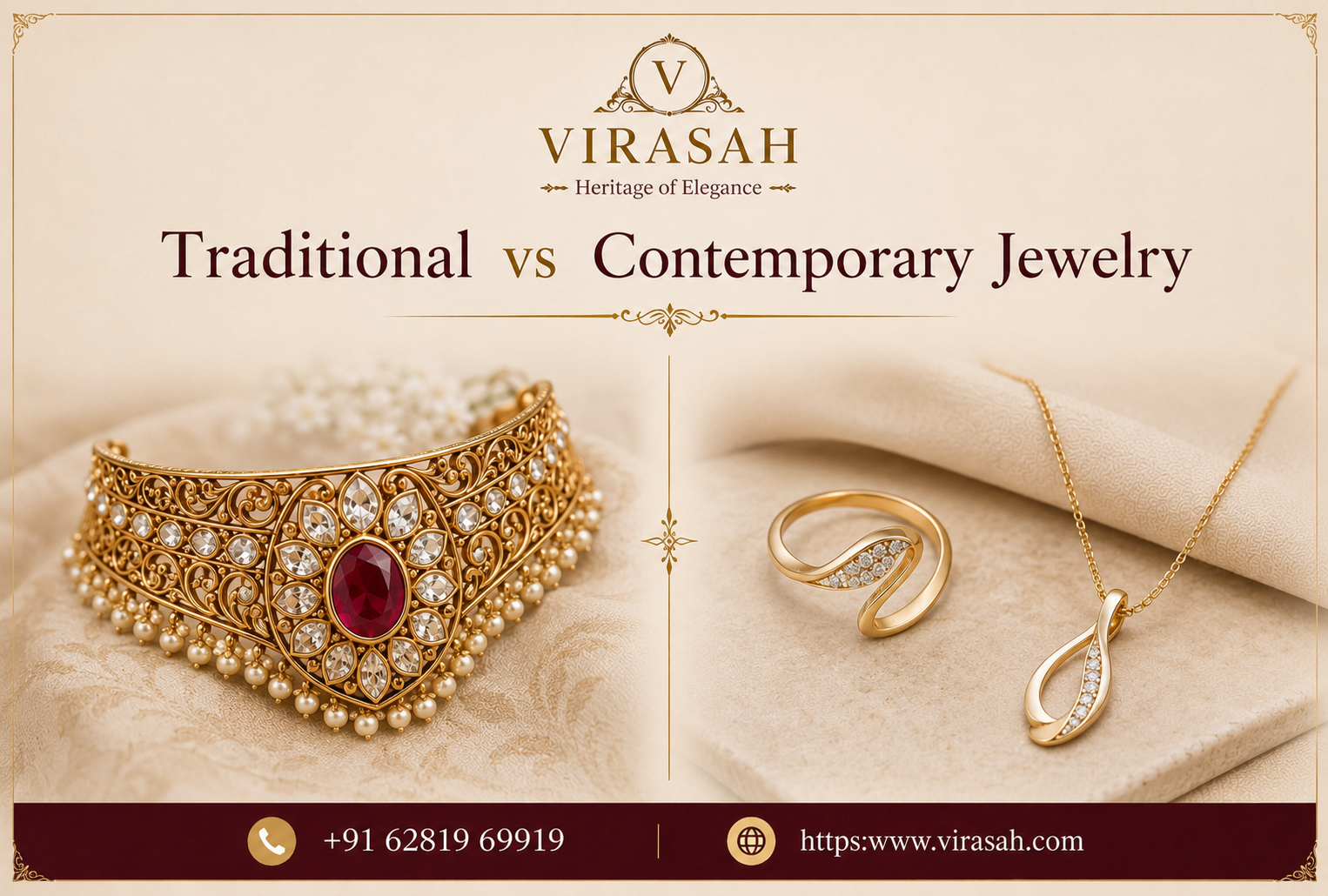
Traditional jewelry is closely connected with regional culture, family customs, ceremonial dressing, and time-honored craftsmanship. In the discussion of Traditional vs Contemporary Jewelry, traditional pieces are usually richer in symbolism, detail, and visual presence. Kundan, polki, temple jewelry, jadau, antique gold, meenakari, bridal necklaces, elaborate bangles, statement earrings, and gemstone-centered heirloom designs are common examples.
The appeal of Traditional vs Contemporary Jewelry becomes especially clear during weddings, religious ceremonies, festive celebrations, and family occasions. Traditional designs often work beautifully with sarees, lehengas, anarkalis, silk ensembles, and bridal wear because their scale and detailing complement ornate fabrics.
What Is Contemporary Jewelry?
Contemporary jewelry reflects current lifestyles, changing fashion preferences, minimalist aesthetics, experimental forms, and versatile styling. When comparing Traditional vs Contemporary Jewelry, contemporary pieces often feature cleaner lines, lighter proportions, geometric arrangements, open settings, mixed metals, modern gemstone cuts, asymmetry, and designs created for repeat wear.
For office wear, dinners, travel, formal events, western clothing, fusion outfits, and understated celebrations, Traditional vs Contemporary Jewelry can feel very different in practice. Contemporary pieces are usually easier to layer, repeat, and style across different outfits without looking overly ceremonial.
Traditional vs Contemporary Jewelry: Key Differences
| Factor | Traditional Jewelry | Contemporary Jewelry |
|---|---|---|
| Design Language | Heritage motifs, cultural references and intricate detailing | Minimal, geometric, experimental and versatile forms |
| Occasion | Weddings, festivals, ceremonies and family events | Work, parties, travel, daily wear and modern celebrations |
| Styling | Pairs strongly with Indian and ceremonial clothing | Pairs easily with western, fusion and minimalist clothing |
| Visual Impact | Rich, layered, elaborate and statement-making | Refined, sleek, subtle and fashion-forward |
| Wearability | Often occasion-led | Often created for frequent wear |
This comparison makes Traditional vs Contemporary Jewelry easier to understand, but there is no rule saying that your jewelry collection must belong exclusively to one category. Some of the most sophisticated wardrobes combine both.
Which Style Works Better for Weddings?
For Indian weddings, Traditional vs Contemporary Jewelry usually depends on the ceremony and the outfit. A heavily embroidered bridal lehenga may need a substantial necklace, classic earrings, bangles, and traditional gemstone work. A reception gown, cocktail saree, or modern bridal silhouette may work better with a sculptural diamond necklace, sleek emerald earrings, or a refined statement ring.
If you are preparing a bridal jewelry plan, explore Virasah’s best wedding jewelry for Indian brides checklist. It helps place Traditional vs Contemporary Jewelry in the practical context of different wedding functions.
Gemstones Change the Entire Look
Gemstones can move a design toward either heritage richness or modern sophistication. In Traditional vs Contemporary Jewelry, ruby, sapphire, emerald, diamond, tanzanite, and other rare stones can all be used in very different ways depending on the setting, scale, cut, metal, and design language.
A ruby surrounded by intricate gold work can look deeply traditional, while the same ruby in a clean bezel or architectural setting can feel contemporary. Learn more through Virasah’s ruby jewelry guide and the guide to Burmese ruby.
Likewise, sapphire can suit both sides of Traditional vs Contemporary Jewelry. A richly detailed sapphire necklace may feel regal, while a sharp-cut sapphire ring can look exceptionally modern. For deeper guidance, see the sapphire jewelry guide and Virasah’s article about Kashmir sapphire.
How Diamonds Influence the Style
Diamonds are especially versatile in the Traditional vs Contemporary Jewelry conversation. Traditional diamond jewelry may use elaborate clusters, floral compositions, polki-inspired layouts, or ornate gold settings. Contemporary diamond jewelry often relies on precise cuts, negative space, slim bands, asymmetry, and refined proportions.
If you are choosing a center stone, Virasah’s guide to the best diamond cuts for engagement rings can help you understand how shape influences personality and overall style.
Emerald Jewelry: Heritage and Modernity Together
Emeralds are a perfect example of why Traditional vs Contemporary Jewelry should not always be treated as an either-or decision. Deep green emeralds have a royal, historic presence, yet they also look striking in clean, modern settings.
For wedding inspiration, explore emerald jewelry designs for weddings and special occasions. In many wardrobes, emerald pieces become the bridge between Traditional vs Contemporary Jewelry.
Rare Gemstones for a More Individual Look
If you prefer jewelry that feels distinctive, rare gemstones can give both heritage and modern designs a stronger identity. The choice between Traditional vs Contemporary Jewelry becomes more personal when the gemstone itself carries rarity, unusual color, and a memorable story.
Explore Virasah’s guide to rare gemstones in India and the tanzanite jewelry meaning, rarity and buying guide for ideas beyond the most familiar stones.
Traditional vs Contemporary Jewelry for Everyday Wear
For daily use, Traditional vs Contemporary Jewelry usually favors lighter contemporary pieces because comfort and repeat styling matter. Small diamond studs, sleek rings, delicate gemstone pendants, slim bracelets, and minimal earrings fit naturally into professional and casual wardrobes.
However, Traditional vs Contemporary Jewelry does not mean traditional pieces must remain reserved for celebrations. Small jhumkas, a slim antique-gold bangle, a heritage-inspired pendant, or a delicate meenakari accent can make everyday outfits more personal without feeling heavy.
Traditional vs Contemporary Jewelry for Festive Dressing
Festivals are where Traditional vs Contemporary Jewelry becomes especially flexible. You can wear a completely traditional set with a silk saree or pair a modern necklace with a classic kurta. Combining a contemporary ring with traditional bangles can also create a more individual look.
For festive dressing, Traditional vs Contemporary Jewelry should be decided through balance. When the outfit is heavily embellished, quieter jewelry can prevent visual overload. When the outfit is minimal, jewelry can become the primary statement.
How to Know Which Style Suits Your Personality
- If you love heritage, ceremony, intricate detailing, and heirloom character, the traditional side of Traditional vs Contemporary Jewelry may suit you.
- If you prefer simplicity, repeat wear, clean lines, and flexible styling, the contemporary side of Traditional vs Contemporary Jewelry may feel more natural.
- If you enjoy fusion dressing, your ideal answer to Traditional vs Contemporary Jewelry may be a carefully selected combination of both.
- If you buy fewer but more meaningful pieces, choose designs within Traditional vs Contemporary Jewelry that can transition between different occasions.
Can You Mix Traditional and Contemporary Jewelry?
Yes. In fact, mixing is one of the most interesting approaches to Traditional vs Contemporary Jewelry. A traditional choker with a modern gown, a sleek diamond bracelet with a silk saree, or an antique-inspired pendant with a crisp shirt can produce contrast that feels intentional rather than mismatched.
The key to mixing Traditional vs Contemporary Jewelry is keeping one element dominant. If the necklace is ornate, keep the earrings simpler. If the outfit is very modern, use one heritage piece as the focal point. If the outfit is traditional, introduce a contemporary ring or bracelet for freshness.
Investment and Long-Term Value
When considering Traditional vs Contemporary Jewelry as a long-term purchase, focus less on trend labels and more on craftsmanship, gemstone quality, metal purity, wearability, provenance, and design integrity. A beautifully made contemporary piece can remain elegant for decades, while an heirloom-quality traditional piece may become part of a family legacy.
Independent gemological education can improve buying confidence. Useful authoritative resources include Gemological Institute of America, International Gemological Institute, CIBJO – The World Jewellery Confederation, World Gold Council, De Beers Group, and Responsible Jewellery Council.
Traditional vs Contemporary Jewelry: Styling by Outfit
With a saree, Traditional vs Contemporary Jewelry can move successfully in either direction. A Kanjeevaram saree naturally supports temple or antique jewelry, while a chiffon or organza saree may look polished with minimal diamonds or a single gemstone statement.
With lehengas, Traditional vs Contemporary Jewelry depends on embroidery and neckline. Heavier bridal embroidery often supports layered traditional pieces, while modern monotone lehengas work well with sculptural earrings or one prominent necklace.
With western clothing, Traditional vs Contemporary Jewelry often favors contemporary pieces, but one heritage accent can make the entire look memorable. A traditional cuff, gemstone ring, or pair of small jhumkas with a structured dress can create elegant contrast.
Traditional vs Contemporary Jewelry: Styling by Age
Age should not determine your choice in Traditional vs Contemporary Jewelry. Personal comfort, confidence, and lifestyle are more relevant. Younger buyers increasingly choose heritage pieces for weddings and festivals, while mature buyers frequently enjoy sleek modern jewelry for work and social events.
The better question in Traditional vs Contemporary Jewelry is not, “What should someone my age wear?” but rather, “What will I genuinely enjoy wearing repeatedly?”
Traditional vs Contemporary Jewelry for Gifting
When gifting, Traditional vs Contemporary Jewelry should be chosen according to the recipient’s lifestyle. For someone who attends many cultural events, a traditional gemstone piece may feel meaningful. For someone who works in a corporate environment or prefers minimal dressing, a contemporary design may be more useful.
A thoughtful gift within Traditional vs Contemporary Jewelry balances emotional meaning with practical wearability. Pieces that can move from family events to formal dinners often provide greater long-term appeal.
Traditional vs Contemporary Jewelry and Custom Design
Custom design makes Traditional vs Contemporary Jewelry far more flexible. You can preserve a family motif while simplifying the silhouette, reset an heirloom gemstone into a modern structure, or create a contemporary piece using traditional craftsmanship.
This approach to Traditional vs Contemporary Jewelry is ideal for buyers who appreciate heritage but prefer lighter styling, or who want modernity without losing emotional depth.
Traditional vs Contemporary Jewelry: What Should You Buy First?
If you are building a jewelry wardrobe from the beginning, start with pieces that solve real styling needs. In Traditional vs Contemporary Jewelry, a sensible foundation could include one versatile pair of earrings, one gemstone or diamond ring, one necklace for important occasions, and one piece with strong cultural or emotional meaning.
As your collection grows, Traditional vs Contemporary Jewelry can become more experimental. Add statement pieces after understanding which jewelry you actually wear most frequently.
Virasah Tip: The most useful way to think about Traditional vs Contemporary Jewelry is not as a competition between old and new. Think of it as a spectrum. The strongest jewelry collection reflects your heritage, your present lifestyle, and the occasions you genuinely want to dress for.
Traditional vs Contemporary Jewelry: Final Decision Guide
Choose traditional jewelry if you value craftsmanship rooted in culture, substantial visual presence, ceremonial relevance, and heirloom character. Choose contemporary jewelry if you prioritize versatility, comfort, modern proportions, and repeat wear. Choose both if your wardrobe moves between Indian, western, formal, festive, and fusion dressing.
Ultimately, Traditional vs Contemporary Jewelry is personal. The right style is the one that feels natural when you wear it, works with your real wardrobe, and continues to feel meaningful after the event is over.
FAQs About Traditional vs Contemporary Jewelry
1. What is the main difference between traditional and contemporary jewelry?
The key difference in Traditional vs Contemporary Jewelry is design language. Traditional jewelry usually draws from cultural motifs, regional craftsmanship, and ceremonial dressing, while contemporary jewelry focuses more on modern forms, simplicity, experimentation, and everyday versatility.
2. Which is better for Indian weddings?
For most major wedding ceremonies, Traditional vs Contemporary Jewelry often leans traditional because ornate bridal outfits can support heavier necklaces, earrings, bangles, and gemstone work. Contemporary jewelry can be ideal for receptions, cocktail events, or minimalist bridal looks.
3. Can contemporary jewelry be worn with sarees?
Yes. Traditional vs Contemporary Jewelry does not restrict contemporary designs to western outfits. Minimal diamonds, modern emerald earrings, sleek necklaces, and sculptural rings can look excellent with organza, chiffon, satin, and modern silk sarees.
4. Is traditional jewelry a better investment?
Not automatically. In Traditional vs Contemporary Jewelry, value depends on metal purity, gemstone quality, craftsmanship, rarity, condition, and market demand. Both traditional and contemporary pieces can offer long-term value when well made.
5. Which style is better for everyday wear?
For daily use, Traditional vs Contemporary Jewelry often favors contemporary designs because they are lighter and easier to repeat. Small heritage-inspired pieces can still be excellent everyday choices.
6. Can I mix both styles in one outfit?
Absolutely. One of the best approaches to Traditional vs Contemporary Jewelry is mixing a single heritage statement piece with cleaner modern elements. The contrast can look sophisticated when the overall styling remains balanced.
7. Which gemstones work with both traditional and contemporary jewelry?
Ruby, sapphire, emerald, diamond, and tanzanite all work beautifully across Traditional vs Contemporary Jewelry. The setting, cut, scale, and metal often determine whether the finished piece feels traditional or modern.
8. How do I choose between the two styles?
Use your wardrobe, lifestyle, comfort, and occasions as the deciding factors. The strongest choice in Traditional vs Contemporary Jewelry is the one you will wear with confidence and frequency.
9. Is contemporary jewelry suitable for bridal wear?
Yes. Modern brides increasingly use contemporary pieces for receptions, engagement events, cocktail nights, and minimalist ceremonies. Traditional vs Contemporary Jewelry can even be combined within the same bridal wardrobe across different functions.
10. Where can I explore jewelry inspiration and gemstone education?
You can explore Virasah’s gemstone and bridal guides linked throughout this article, along with gemological resources such as GIA, IGI, and CIBJO. These references make the Traditional vs Contemporary Jewelry decision more informed and personal.
Quick Styling Principles
- Traditional vs Contemporary Jewelry works best when your lifestyle guides the final choice.
- Traditional vs Contemporary Jewelry should be judged by comfort as well as appearance.
- Traditional vs Contemporary Jewelry becomes easier when you start with the occasion.
- Traditional vs Contemporary Jewelry can be balanced by choosing one dominant design language.
- Traditional vs Contemporary Jewelry is more flexible when gemstone quality is prioritized.
- Traditional vs Contemporary Jewelry can reflect both cultural identity and personal taste.
- Traditional vs Contemporary Jewelry should consider how often each piece will actually be worn.
- Traditional vs Contemporary Jewelry can help you create a more versatile jewelry wardrobe.
- Traditional vs Contemporary Jewelry works beautifully when proportions suit your outfit.
- Traditional vs Contemporary Jewelry is easier to style when your neckline is considered first.
- Traditional vs Contemporary Jewelry can be personalized through metal color and gemstone choice.
- Traditional vs Contemporary Jewelry should account for the visual weight of your clothing.
- Traditional vs Contemporary Jewelry can change completely with a different gemstone setting.
- Traditional vs Contemporary Jewelry does not require choosing heritage or modernity forever.
- Traditional vs Contemporary Jewelry is often solved by mixing one statement piece with simpler accents.
- Traditional vs Contemporary Jewelry becomes more practical when repeat wear matters.
- Traditional vs Contemporary Jewelry can guide gifting choices for different personalities.
- Traditional vs Contemporary Jewelry is useful when planning jewelry for multiple wedding functions.
- Traditional vs Contemporary Jewelry can help avoid buying pieces that remain unworn.
- Traditional vs Contemporary Jewelry becomes more meaningful when craftsmanship is part of the decision.
- Traditional vs Contemporary Jewelry can be explored through earrings before investing in larger pieces.
- Traditional vs Contemporary Jewelry is easier to test with rings, pendants, and bracelets.
- Traditional vs Contemporary Jewelry can be adapted to both Indian and western wardrobes.
- Traditional vs Contemporary Jewelry may depend on whether you prefer symmetry or experimentation.
- Traditional vs Contemporary Jewelry can look refined when scale and detailing are well controlled.
- Traditional vs Contemporary Jewelry is not determined by age.
- Traditional vs Contemporary Jewelry should be approached according to personal confidence.
- Traditional vs Contemporary Jewelry can evolve as your wardrobe and lifestyle change.
- Traditional vs Contemporary Jewelry is especially interesting in custom-designed jewelry.
- Traditional vs Contemporary Jewelry can preserve heritage while introducing cleaner modern proportions.
- Traditional vs Contemporary Jewelry works well when one piece becomes the focal point.
- Traditional vs Contemporary Jewelry can support both understated and statement dressing.
- Traditional vs Contemporary Jewelry is strongest when jewelry complements rather than competes with clothing.
- Traditional vs Contemporary Jewelry can help you plan a collection instead of making isolated purchases.
- Traditional vs Contemporary Jewelry is more rewarding when you understand gemstone quality.
- Traditional vs Contemporary Jewelry can be a starting point for discovering your signature style.
- Traditional vs Contemporary Jewelry ultimately comes down to what you enjoy wearing.
Conclusion
Traditional vs Contemporary Jewelry is ultimately about how you want jewelry to function in your life. Traditional designs connect strongly with heritage, ceremony, and heirloom value, while contemporary designs respond to modern dressing, comfort, and versatility. A well-curated collection can include both without conflict.
Whether you are shopping for a wedding, a meaningful gift, a signature gemstone, or a piece you can wear for years, use Traditional vs Contemporary Jewelry as a framework rather than a limitation. The best pieces are those that feel authentic to you and continue to bring value beyond a single occasion.
Contact Virasah
Explore distinctive jewelry, gemstone-led creations, and elegant designs.
Website: www.virasah.com.
Phone: +91 62819 69919