Kundan Jewellery vs Polki Jewellery: Which Is Better for Brides?
Choosing between two of India's most admired bridal jewellery traditions can feel confusing because the words are often used together, yet they do not describe exactly the same thing. This guide separates technique from material, explains the visual difference, and gives brides a practical framework for comparing craftsmanship, price, comfort, authenticity, styling and long-term value.
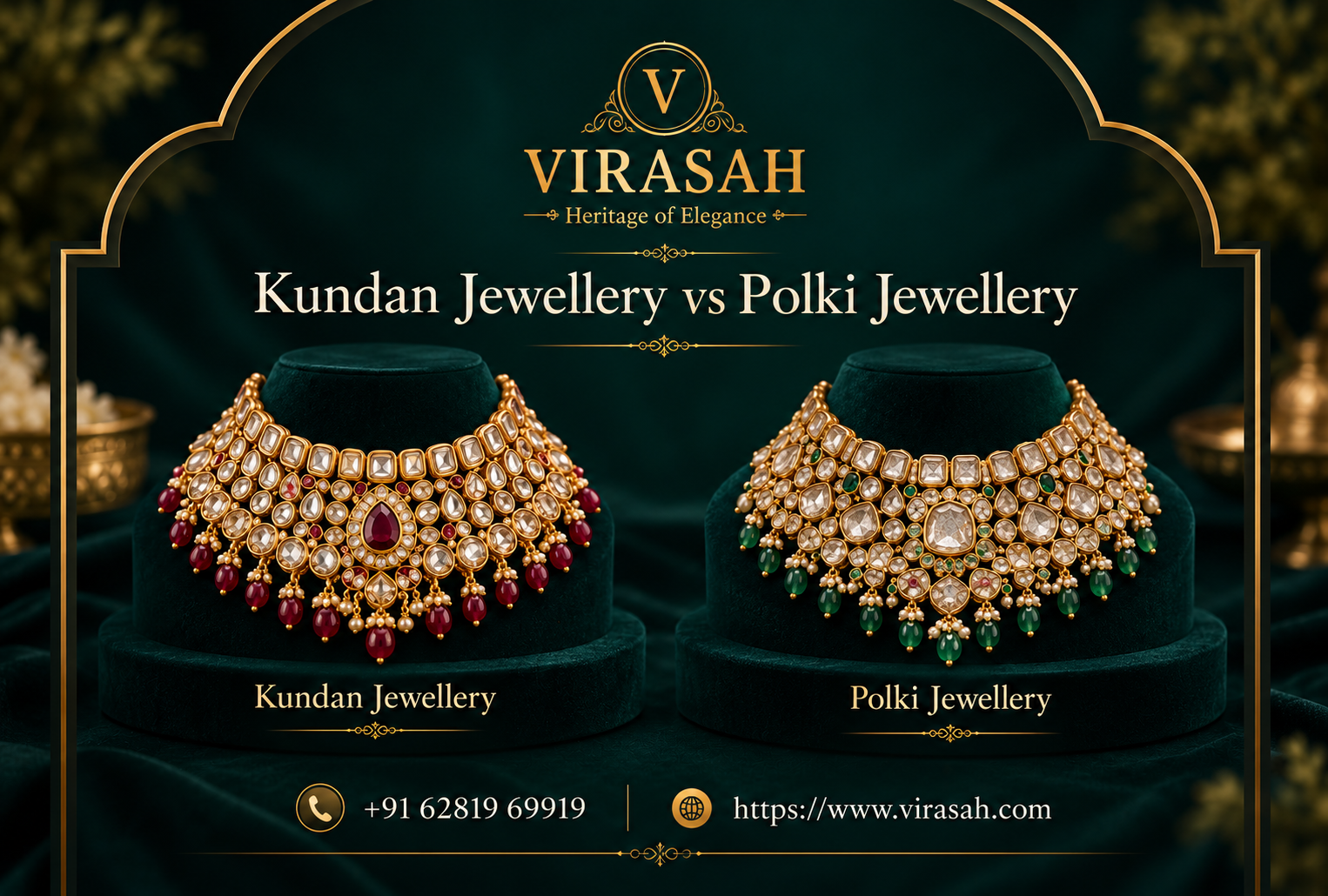
At-a-Glance Bridal Comparison
| Factor | Kundan | Polki |
|---|---|---|
| What the term primarily describes | A traditional setting technique and jewellery style | Uncut or minimally fashioned/flat-style diamonds used in traditional jewellery |
| Typical visual effect | Ornate, colourful, highly decorative and often paired with enamel | Soft diamond glow, irregular shapes, antique and royal character |
| Best for | Brides who love colour, craft detail and heritage motifs | Brides who want diamond-led heritage styling with organic character |
| Outfit pairing | Strong with red, jewel tones, traditional lehengas and silk sarees | Strong with ivory, pastel, neutral, red and classic bridal palettes |
| Price | Varies by gold, stones, enamel, craftsmanship and brand | Varies by diamond quality, gold, craftsmanship, size and brand |
| Buying priority | Check workmanship, metal, stones, enamel and construction | Check diamond disclosure, construction, gold, backing and workmanship |
| Future wear | Excellent when modular or medium scale | Excellent when the design is versatile and not overly ceremonial |
Understanding the Two Traditions
Kundan refers primarily to a traditional setting technique that uses highly refined gold around stones, while Polki refers to diamonds that are uncut or minimally fashioned and used for their natural, old-world character. In Kundan Jewellery vs Polki Jewellery, Begin by asking the jeweller what the stones are, what metal supports the setting, and whether enamel work is present on the reverse.
For the historical character, Kundan Jewellery vs Polki Jewellery should be judged by the actual piece. Both styles are strongly associated with royal and courtly jewellery traditions in India, but they describe different aspects of a piece: one emphasizes the setting craft and the other the diamond material. Treat origin stories as context rather than proof of quality; workmanship, materials, documentation, and condition still matter when you buy.
When the visual language matters, Kundan Jewellery vs Polki Jewellery becomes a practical bridal decision. Kundan pieces can appear colourful, ornate, and highly patterned because gemstones, glass, enamel, pearls, and decorative motifs may all be combined in a single composition. Choose it when the bridal outfit already carries traditional embroidery and you want the jewellery to echo those details without depending on diamond sparkle alone.
Consider the Polki look carefully in Kundan Jewellery vs Polki Jewellery. Polki diamonds tend to show irregular outlines, soft reflection, and a distinctly antique mood rather than the symmetrical brilliance expected from modern brilliant-cut diamonds. Look at the necklace in daylight and warm indoor lighting because the charm of Polki is often in texture and depth, not in uniform fire.
A close look at the relationship between terms helps clarify Kundan Jewellery vs Polki Jewellery. A bridal piece can be both Kundan-set and made with Polki diamonds, which is why shoppers sometimes hear the words used as though they are interchangeable. Ask for a written description of materials so you know whether you are comparing a technique, a diamond type, or two finished collections.
For brides thinking about the role of enamel, Kundan Jewellery vs Polki Jewellery is not only about appearance. Meenakari on the reverse can turn a necklace or pendant into a beautifully finished object from both sides and often adds colour that feels especially appropriate for wedding jewellery. Inspect the back for chips, uneven finishing, sharp edges, or areas where enamel may be vulnerable to impact and friction.
Traditional fine examples may use high-purity gold in parts of the setting because softer gold can be worked closely around irregular gemstones and diamonds. In Kundan Jewellery vs Polki Jewellery, Do not assume every modern commercial piece follows the same construction; request exact purity information for each metal component that materially affects value.
For why brides confuse them, Kundan Jewellery vs Polki Jewellery should be judged by the actual piece. Bridal showrooms often merchandise Kundan, Polki, Meena, jadau, gemstones, pearls, and antique-finish designs together, so the categories can overlap visually. Make your decision from a product specification and physical inspection rather than from the collection name printed on a display card.
How Each Style Looks on a Bride
When face-framing impact matters, Kundan Jewellery vs Polki Jewellery becomes a practical bridal decision. Large Kundan motifs can create a strong architectural frame around the face, especially in chokers, collars, chandbalis, and layered necklaces. Try the complete set with your hairstyle and dupatta placement, because earrings that look balanced alone can feel oversized once a matha patti or veil is added.
Consider soft diamond glow carefully in Kundan Jewellery vs Polki Jewellery. Polki offers a gentler, more organic diamond presence that suits brides who want richness without the highly engineered sparkle of modern faceted stones. View the piece from normal conversation distance; bridal jewellery should create a beautiful overall impression rather than requiring close-up perfection.
A close look at colour coordination helps clarify Kundan Jewellery vs Polki Jewellery. Kundan designs often make it easier to bring emerald green, ruby red, pearl white, or enamel accents into the jewellery story. Repeat only one or two colours from the lehenga so the overall styling looks intentional instead of matching every embroidery shade.
For brides thinking about ivory and pastel outfits, Kundan Jewellery vs Polki Jewellery is not only about appearance. Polki can look especially refined with ivory, champagne, blush, dusty rose, muted gold, and pastel bridal palettes because its surface reflection is softer and warmer. Use contrast through emeralds, rubies, or pearls when a completely neutral jewellery palette feels too flat against the outfit.
Classic red, maroon, wine, and rani-pink bridal clothing can support the visual weight of both ornate Kundan and substantial Polki necklaces. In Kundan Jewellery vs Polki Jewellery, Choose the hero element first—necklace, earrings, or headpiece—and let the other pieces support it instead of competing at equal scale.
For saree styling, Kundan Jewellery vs Polki Jewellery should be judged by the actual piece. On silk sarees and heirloom drapes, both traditions can feel authentic, but proportion becomes more important because the pallu, border, and blouse neckline already create strong lines. Try the jewellery with the actual blouse or a neckline mock-up to confirm that the necklace sits on skin or fabric exactly as intended.
When lehenga styling matters, Kundan Jewellery vs Polki Jewellery becomes a practical bridal decision. A heavily embroidered lehenga can carry elaborate jewellery, yet too many large motifs close to the neckline can visually merge with zari and stonework. Photograph the complete outfit from front, side, and seated positions before the wedding so you can remove one layer if the look becomes crowded.
Consider reception styling carefully in Kundan Jewellery vs Polki Jewellery. Brides who want a second look for the reception can use Polki as a bridge between traditional ceremony jewellery and a cleaner evening silhouette. A detachable pendant, convertible choker, or necklace that can later be worn at festive events may offer better post-wedding versatility.
Craftsmanship, Materials and Value
A close look at handcrafted character helps clarify Kundan Jewellery vs Polki Jewellery. Fine Kundan work depends on careful setting, proportion, edge finishing, and the relationship between the front decoration and the reverse construction. Look closely for secure stones, consistent borders, comfortable surfaces, and finishing that remains neat where the piece touches the neck.
For brides thinking about natural irregularity, Kundan Jewellery vs Polki Jewellery is not only about appearance. Polki diamonds are valued partly for their individual shape and old-world appearance, so perfect visual uniformity should not be expected in the same way as calibrated modern stones. Compare several pieces side by side and decide whether the variations look harmonious or simply inconsistent.
Even when a diamond is intentionally uncut or flat-cut, buyers should still ask about whether it is natural, how it has been processed, and how the seller describes its quality. In Kundan Jewellery vs Polki Jewellery, Request a detailed invoice that distinguishes natural diamonds from any simulants, composites, glass, or other decorative materials.
For backing and foil, Kundan Jewellery vs Polki Jewellery should be judged by the actual piece. Some traditional constructions use reflective backing or foil beneath flat stones to enhance their appearance, which can influence how the jewellery responds to moisture and wear. Ask the jeweller for care instructions that are specific to the construction rather than following generic advice for modern diamond jewellery.
When gold weight matters, Kundan Jewellery vs Polki Jewellery becomes a practical bridal decision. Heavy-looking bridal jewellery does not always mean the same thing as high net gold weight because lac, wax-like fillers, enamel, stones, pearls, and structural elements can contribute to total weight. Ask for gross weight, net precious-metal weight where available, purity, and stone weight so price comparisons are more meaningful.
Consider resale expectations carefully in Kundan Jewellery vs Polki Jewellery. Resale depends on the gold content, diamond or gemstone value, workmanship, brand policy, condition, and the jeweller's buyback terms rather than the style name alone. Get buyback or exchange conditions in writing before purchase if long-term liquidity is important to your family.
A close look at repair complexity helps clarify Kundan Jewellery vs Polki Jewellery. Traditional settings can require specialist repair skills, especially when foil, enamel, irregular stones, or delicate gold work are involved. Before buying a major bridal set, ask whether the seller provides in-house restoration and whether repairs may alter the appearance of the original setting.
For brides thinking about heirloom potential, Kundan Jewellery vs Polki Jewellery is not only about appearance. A well-made bridal piece can become a family heirloom when the design is timeless, materials are properly documented, and the piece can be maintained over decades. Store the invoice, photographs, certificates, service records, and any hallmark details together so future owners understand what they inherited.
Comfort and Wearability Through a Long Wedding Day
A spectacular choker can become uncomfortable after several hours if its weight is concentrated on a narrow edge or if the closure pulls unevenly. In Kundan Jewellery vs Polki Jewellery, Wear the sample for at least ten to fifteen minutes in the showroom and move your head normally before deciding.
For earring support, Kundan Jewellery vs Polki Jewellery should be judged by the actual piece. Large bridal earrings can cause fatigue regardless of whether the design is Kundan or Polki, especially when combined with a veil, hair accessories, or repeated outfit changes. Ask about ear chains, supportive backs, detachable drops, and lighter companion earrings for later functions.
When skin contact matters, Kundan Jewellery vs Polki Jewellery becomes a practical bridal decision. The back of the jewellery matters as much as the front because rough solder points, unfinished edges, protruding elements, or abrasive enamel borders can irritate during a long ceremony. Run a clean finger carefully over the contact surfaces and test the piece with the neckline you plan to wear.
Consider heat and humidity carefully in Kundan Jewellery vs Polki Jewellery. Indian weddings can involve bright stage lights, crowded venues, outdoor ceremonies, and warm weather, all of which can increase perspiration around necklaces and bangles. Plan gentle blotting with a soft cloth and avoid spraying perfume or hair products directly onto traditional jewellery.
A close look at dupattas and veils helps clarify Kundan Jewellery vs Polki Jewellery. Stone edges, prongs, beads, and hanging elements may catch on net, tulle, organza, or heavily embroidered dupattas. Bring a fabric swatch to the trial and check movement at the shoulders, hairline, and sides of the neck.
For brides thinking about sitting and rituals, Kundan Jewellery vs Polki Jewellery is not only about appearance. Brides spend significant time seated, bending, greeting relatives, and participating in rituals, so very long necklaces can collide with blouse embellishment or ceremonial items. Sit, lean, turn, and raise your arms during the jewellery trial rather than judging only from a standing mirror pose.
A choker plus a long haar can look grand, but two heavy pieces may overlap, twist, or push each other upward during movement. In Kundan Jewellery vs Polki Jewellery, Leave a visible gap between layers and make sure each necklace has its own stable resting line.
For function planning, Kundan Jewellery vs Polki Jewellery should be judged by the actual piece. Not every event needs the biggest set; a lighter mehendi or haldi look can preserve comfort while allowing the main bridal jewellery to feel special on the wedding day. Create a function-by-function jewellery plan before buying so you do not overspend on pieces that serve the same purpose.
Budgeting and Price Comparison
When setting a total budget matters, Kundan Jewellery vs Polki Jewellery becomes a practical bridal decision. Bridal jewellery budgets become easier to control when you separate must-have ceremony pieces from optional accessories and future-wear purchases. Reserve part of the budget for alterations, repair, secure storage, insurance if appropriate, and last-minute styling changes.
Consider comparing like with like carefully in Kundan Jewellery vs Polki Jewellery. Two necklaces that look similar can have very different values because of gold purity, net gold weight, diamond content, gemstone quality, enamel work, craftsmanship, and brand margin. Ask for itemized specifications before comparing prices across sellers.
A close look at making charges helps clarify Kundan Jewellery vs Polki Jewellery. Traditional handcrafted work may carry significant labour or making charges because many stages require specialist artisans and careful finishing. Ask how making charges are calculated and whether they are refundable or considered in any future exchange policy.
For brides thinking about stone pricing, Kundan Jewellery vs Polki Jewellery is not only about appearance. Polki pricing can vary widely depending on the diamonds used, their size, appearance, origin disclosure, and the overall quality of the finished piece. Do not use a per-carat comparison alone without understanding how the seller grades or describes the material.
A bride who loves a dramatic look but expects little post-wedding use may value a versatile medium-sized set more than an extremely heavy statement suite. In Kundan Jewellery vs Polki Jewellery, Think in terms of cost per future wear as well as wedding-day impact.
For custom work, Kundan Jewellery vs Polki Jewellery should be judged by the actual piece. Customisation can improve neckline fit, motif scale, colour balance, and sentimental value, but it may also extend timelines and reduce return flexibility. Approve a sketch, dimensions, material specification, expected weight range, and delivery date before production begins.
When family pieces matters, Kundan Jewellery vs Polki Jewellery becomes a practical bridal decision. Remodelling inherited jewellery can reduce the need to buy an entirely new set while preserving emotional value, but old pieces should be assessed before alterations. Document the original item with photographs and written specifications before any irreversible work.
Consider value beyond resale carefully in Kundan Jewellery vs Polki Jewellery. Bridal jewellery also carries emotional, aesthetic, and cultural value that is not captured by metal and stone calculations alone. Set a financial ceiling first, then choose within it based on beauty, comfort, craftsmanship, and future relevance.
Outfit, Neckline and Styling Decisions
A close look at high necklines helps clarify Kundan Jewellery vs Polki Jewellery. A high blouse neckline leaves limited skin space, so a broad choker may sit partly on fabric and lose definition. Consider statement earrings, a shorter collar designed for the garment, or a longer necklace that creates vertical separation.
For brides thinking about deep necklines, Kundan Jewellery vs Polki Jewellery is not only about appearance. A deeper neckline can accommodate a choker plus a longer necklace, but the spacing should look deliberate and the central pendant should not fall awkwardly into the blouse edge. Mark the exact necklace drop during the fitting.
Boat neck blouses already create a strong horizontal line, so another broad necklace at the same level can make the upper body look visually compressed. In Kundan Jewellery vs Polki Jewellery, Try a longer haar or a narrower collar to introduce vertical movement.
For V necks, Kundan Jewellery vs Polki Jewellery should be judged by the actual piece. V-shaped necklines often pair naturally with tapered necklace compositions or pendants that echo the line without touching the fabric edge. Check symmetry carefully because an off-centre pendant becomes more obvious against a V neckline.
When strapless or wide necks matters, Kundan Jewellery vs Polki Jewellery becomes a practical bridal decision. Open necklines create a clean canvas for substantial bridal jewellery and allow detailed Kundan work or Polki diamonds to be seen clearly. Keep the headpiece and earrings proportionate so the face remains the focal point.
Consider embroidered blouses carefully in Kundan Jewellery vs Polki Jewellery. Dense neckline embroidery can visually compete with stones, pearls, and enamel, especially when colours are similar. Create contrast through negative space, a different scale of motif, or a cleaner necklace border.
A close look at minimal outfits helps clarify Kundan Jewellery vs Polki Jewellery. A simpler silk, organza, tissue, or monochrome outfit can support a more complex necklace because there is less surface detail competing for attention. This is an effective strategy when the jewellery itself is intended to be the heirloom statement.
For brides thinking about colour balance, Kundan Jewellery vs Polki Jewellery is not only about appearance. Green, red, white, gold, and pastel accents can all work in traditional bridal jewellery, but too many repeated colours can feel overly coordinated. Choose one dominant metal tone, one principal stone colour, and one supporting accent for a controlled palette.
Wedding Functions: What Works Where
An engagement look often benefits from a refined necklace and earrings that photograph well without feeling as ceremonial as the wedding-day set. In Kundan Jewellery vs Polki Jewellery, A medium-scale Polki or Kundan design can later be reused for receptions, festive dinners, and family weddings.
For mehendi, Kundan Jewellery vs Polki Jewellery should be judged by the actual piece. Mehendi events involve movement, photographs, and close interaction, so bracelets and rings need special thought because hands remain central to the ceremony. Use lighter earrings or a necklace and avoid pieces likely to interfere with the application process.
When haldi matters, Kundan Jewellery vs Polki Jewellery becomes a practical bridal decision. Haldi can stain fabric and create a messy environment for fine jewellery, particularly pieces with delicate backing, pearls, enamel, or traditional settings. Many brides keep valuable jewellery away from direct contact and choose simpler accessories for this function.
Consider sangeet carefully in Kundan Jewellery vs Polki Jewellery. Dancing changes the comfort equation: long earrings swing, layered necklaces shift, and heavy chokers can feel restrictive after an hour. Choose secure closures and test the set while moving rather than only posing.
A close look at wedding ceremony helps clarify Kundan Jewellery vs Polki Jewellery. The main ceremony can justify the richest and most traditional composition because the jewellery is part of the overall bridal identity and is seen alongside sacred and family rituals. Prioritize secure fit and comfort before adding a final extra layer.
For brides thinking about reception, Kundan Jewellery vs Polki Jewellery is not only about appearance. Reception styling often moves toward cleaner lines, gowns, cocktail saris, or contemporary lehengas, making a single strong Polki necklace or streamlined Kundan set effective. You can remove the head jewellery and simplify bangles to change the mood.
Smaller family gatherings after the wedding are a good test of future wearability because oversized bridal suites may feel impractical. In Kundan Jewellery vs Polki Jewellery, Buy at least one component that can be separated and worn without the full set.
For destination weddings, Kundan Jewellery vs Polki Jewellery should be judged by the actual piece. Travel adds packaging, insurance, security, and climate considerations to jewellery planning. Carry valuables according to applicable travel rules, keep documentation accessible, and use a compact storage system that prevents pieces from rubbing together.
How to Inspect a Bridal Set Before You Buy
When front symmetry matters, Kundan Jewellery vs Polki Jewellery becomes a practical bridal decision. Handcrafted jewellery can show small variations, but the overall necklace should still sit evenly and the main motifs should feel intentionally balanced. Lay it flat, then wear it, because a piece that looks symmetrical on a tray may shift once curved around the neck.
Consider stone security carefully in Kundan Jewellery vs Polki Jewellery. Every visible stone should appear firmly seated without obvious movement, gaps that look unintended, or edges that can snag fabric. Ask the jeweller to inspect the piece again immediately before final delivery.
A close look at back finishing helps clarify Kundan Jewellery vs Polki Jewellery. A beautiful reverse is not merely decorative; smooth construction can make the piece more comfortable and reveal the care taken in manufacture. Inspect hinges, joints, clasps, thread work, and enamel under bright neutral light.
For brides thinking about closure quality, Kundan Jewellery vs Polki Jewellery is not only about appearance. A bridal necklace is too important to rely on a weak hook, worn thread, or improvised fastening. Ask whether the closure has a secondary safety element and how it should be replaced or serviced over time.
Necklace, earrings, maang tikka, bangles, and rings do not need to be identical, but their motif language and finish should feel related. In Kundan Jewellery vs Polki Jewellery, Place all components together before paying the balance so colour and scale differences are visible.
For documentation, Kundan Jewellery vs Polki Jewellery should be judged by the actual piece. A clear invoice should describe the item, metal purity, relevant weights, stones, charges, taxes, and any identification or hallmark information that applies. Keep a digital copy in addition to the paper bill.
When return and alteration policy matters, Kundan Jewellery vs Polki Jewellery becomes a practical bridal decision. Custom sizing, personalised enamel, changed stone colours, or modified necklace lengths may affect whether an item can be returned or exchanged. Read the policy before authorising modifications.
Consider final photography carefully in Kundan Jewellery vs Polki Jewellery. Detailed photographs are useful for insurance records, future repairs, styling reference, and confirming the original arrangement of detachable components. Photograph the front, back, clasp, hallmarks, and every accessory after delivery.
Authenticity, Hallmarking and Smart Questions
A close look at gold hallmarking helps clarify Kundan Jewellery vs Polki Jewellery. For gold components, hallmarking and purity documentation deserve attention because they help buyers understand what precious metal they are purchasing. Check the applicable BIS information and ask the seller to explain every mark that appears on the piece.
For brides thinking about diamond disclosure, Kundan Jewellery vs Polki Jewellery is not only about appearance. The word Polki should not replace a clear explanation of what kind of diamond material is present and whether any treatment, backing, composite construction, or substitute material is used. Get material descriptions in writing.
Emeralds, rubies, sapphires, pearls, and other accents can be natural, treated, cultured, synthetic, or imitation depending on the product. In Kundan Jewellery vs Polki Jewellery, Ask specific questions rather than assuming traditional styling guarantees natural stones.
For certificates, Kundan Jewellery vs Polki Jewellery should be judged by the actual piece. Not every small stone in an elaborate traditional necklace will have an individual laboratory report, so the seller's invoice and written disclosure become especially important. For major centre stones or unusually valuable diamonds, ask what independent documentation is available.
When seller reputation matters, Kundan Jewellery vs Polki Jewellery becomes a practical bridal decision. A trustworthy jeweller should be willing to explain construction, materials, service options, and pricing without pressuring you to decide immediately. Compare communication quality as carefully as visual design.
Consider service support carefully in Kundan Jewellery vs Polki Jewellery. Traditional bridal jewellery benefits from periodic inspection because threads, clasps, settings, enamel, and pearl strings can age differently. Ask whether the seller offers cleaning, restringing, stone tightening, enamel repair, and restoration.
A close look at buyback wording helps clarify Kundan Jewellery vs Polki Jewellery. Statements such as 'full value exchange' can mean different things depending on deductions, making charges, stone valuation, taxes, and current policies. Request the exact formula in writing and keep it with the invoice.
For brides thinking about ethical and sourcing questions, Kundan Jewellery vs Polki Jewellery is not only about appearance. Some buyers also want information about diamond sourcing, gemstone origin, recycled gold, artisan practices, or supply-chain policies. Ask for the level of traceability the jeweller can genuinely document rather than relying on vague marketing language.
Long-Term Care and Heirloom Planning
Traditional foil-backed, enamelled, pearl-set, or lac-supported jewellery may be more sensitive to moisture than a simple modern diamond ring. In Kundan Jewellery vs Polki Jewellery, Follow the maker's specific instructions and avoid soaking pieces unless the jeweller confirms that the construction is suitable.
For perfume and cosmetics, Kundan Jewellery vs Polki Jewellery should be judged by the actual piece. Perfume, hairspray, lotions, and makeup can leave residue on stones, pearls, enamel, threads, and metal surfaces. Put jewellery on after beauty products have dried and remove it before intensive cleansing.
When storage matters, Kundan Jewellery vs Polki Jewellery becomes a practical bridal decision. Large bridal necklaces should be supported in their natural shape rather than folded sharply or piled with other jewellery. Use separate padded compartments and keep detachable parts labelled so they are not lost.
Consider cleaning carefully in Kundan Jewellery vs Polki Jewellery. Aggressive ultrasonic or steam cleaning is not automatically appropriate for traditional mixed-material jewellery because the piece may contain foil, enamel, pearls, treated gems, adhesives, or fragile settings. Use the jeweller's recommended method.
A close look at inspection after the wedding helps clarify Kundan Jewellery vs Polki Jewellery. The week after the wedding is a useful time to check for loose threads, shifted stones, bent hooks, makeup residue, or moisture before long-term storage. Have any issue corrected before the piece spends months in a box.
For brides thinking about insurance and records, Kundan Jewellery vs Polki Jewellery is not only about appearance. For high-value sets, good photographs, invoices, valuations, certificates, and identification details make ownership records more complete. Update records after major repairs or remodelling so the documentation matches the current piece.
A bridal necklace may be worn more often if it has detachable elements, adjustable lengths, removable drops, or earrings that convert from chandbali to stud. In Kundan Jewellery vs Polki Jewellery, Discuss these options during design rather than modifying the structure later.
For passing it forward, Kundan Jewellery vs Polki Jewellery should be judged by the actual piece. Heirloom jewellery carries stories as well as materials, and future family members benefit from knowing when it was bought, who made it, what it contains, and how it should be cared for. Keep a short written note with the documentation so the history does not disappear.
How to Make the Final Bridal Choice
Start with the outfit neckline, then choose the jewellery silhouette, then confirm materials and documentation. After that, judge comfort and only then add secondary pieces such as a maang tikka, bangles or a second necklace. This order prevents the common mistake of buying several beautiful pieces that do not work together.
For more bridal and fine-jewellery inspiration, explore Virasah and compare designs with the same level of attention you would give to diamonds, gemstones and craftsmanship.
Bridal Jewellery Buying Checklist
- Take the blouse or a neckline reference to the jewellery trial.
- Confirm the exact metal purity and applicable hallmark information.
- Ask whether diamonds and gemstones are natural, treated, cultured, synthetic or imitation where relevant.
- Request gross weight and net precious-metal weight when available.
- Ask how making charges are calculated.
- Read the return, alteration, exchange and buyback policy.
- Test necklace and earrings for at least several minutes.
- Check front symmetry and back finishing.
- Inspect clasps, hooks, threads and safety attachments.
- Check whether delicate stones or foil-backed settings need special care.
- Photograph detachable components after delivery.
- Keep invoices, certificates, hallmark details and service records together.
- Plan jewellery separately for mehendi, sangeet, ceremony and reception.
- Choose at least one component that can be worn after the wedding.
- Ask about cleaning, restringing and restoration support.
- Store each major piece separately in a padded box.
Authoritative Resources for Further Research
The following external resources are standard do-follow links and can help readers understand traditional Indian jewellery, diamond materials, gold purity and buying terminology:
- Gemological Institute of America: Jaipur's gem and jewellery tradition
- Victoria and Albert Museum: Traditional Indian jewellery making
- The Metropolitan Museum of Art: Jeweled arts of Mughal India
- Bureau of Indian Standards: Hallmarking overview
- U.S. Federal Trade Commission: Buying platinum, gold and silver jewellery
- Gemological Institute of America: Diamond education
Frequently Asked Questions
Is Kundan the same as Polki?
No. Kundan is best understood as a traditional setting method and style of workmanship, while Polki usually refers to uncut or flat, minimally fashioned diamonds. A single necklace can therefore combine both. When evaluating Kundan Jewellery vs Polki Jewellery, ask the seller to specify the metal, setting method, diamond type, backing, enamel and other gemstones rather than relying on only one collection label.
Which option looks more traditional for an Indian bride?
Both can look deeply traditional, but the effect depends on the complete design. Ornate Kundan with meenakari, coloured stones and pearls can create a highly decorative royal look, while Polki diamonds often bring a softer antique character. For Kundan Jewellery vs Polki Jewellery, the better traditional look is the one that matches the bride's outfit, regional styling and preferred level of ornamentation.
Is Polki always more expensive than Kundan?
Not necessarily. Price depends on the actual diamonds, gold purity and weight, gemstones, craftsmanship, brand, labour, design complexity and commercial terms. Some Kundan pieces can be extremely valuable, and some Polki pieces can use different qualities of diamond material. Compare Kundan Jewellery vs Polki Jewellery only after you have an itemised specification for both products.
Can a Kundan set contain real diamonds?
Yes. Kundan is a setting tradition, so the stones can vary according to the design and price point. Fine pieces may include diamonds and precious coloured stones, while other commercial products may use different materials. In Kundan Jewellery vs Polki Jewellery, never assume the stone identity from the word Kundan alone; request written disclosure from the jeweller.
Are Polki diamonds certified?
Large or important diamonds may sometimes have independent documentation, but elaborate traditional jewellery can contain many small, irregular stones that are not individually graded like a modern solitaire. For Kundan Jewellery vs Polki Jewellery, a detailed invoice, seller disclosure and documentation for any major centre stone can be more realistic than expecting a separate report for every small component.
Which is better for a red bridal lehenga?
Both can work beautifully with red. Kundan can echo green, red, pearl and enamel accents, while Polki can create warm contrast with the richness of red, maroon or wine. When styling Kundan Jewellery vs Polki Jewellery, pay more attention to neckline, embroidery density, necklace scale and the colour of accent stones than to a rigid rule about the lehenga colour.
Which is better for a pastel bridal lehenga?
Polki often suits ivory, champagne and pastel palettes because its irregular diamond surfaces can create a soft glow, but delicate Kundan in pale enamel, pearls or light gemstones can be equally elegant. With Kundan Jewellery vs Polki Jewellery, choose the piece that gives enough contrast to be visible in photographs without overpowering a light-coloured outfit.
Can I wear both styles in the same wedding?
Yes, provided the looks are planned rather than randomly mixed. You could wear a colourful Kundan set for the ceremony and a more restrained Polki necklace for the reception, or combine compatible components if their gold tone, motif scale and finishing relate well. Kundan Jewellery vs Polki Jewellery can therefore be a function-by-function styling decision instead of an either-or purchase.
Which one is lighter and more comfortable?
There is no guaranteed winner because comfort depends on size, construction, metal weight, stones, backing, strings and how the piece distributes pressure. A large Kundan collar may be heavier than a smaller Polki necklace, and the reverse can also be true. Test Kundan Jewellery vs Polki Jewellery by wearing each candidate for several minutes and moving naturally.
How should I check gold purity?
Ask for the exact gold purity and applicable hallmarking information, and verify marks or HUID details where relevant to the product and current rules. Do not infer purity from colour or from traditional appearance. When comparing Kundan Jewellery vs Polki Jewellery, keep gross weight separate from net precious-metal weight because stones, enamel, threads and fillers may affect the total.
How do I know if the Polki is natural diamond?
Ask the seller to state in writing whether the diamonds are natural, lab-grown, treated, composite, simulated or another material, and request supporting documentation where appropriate. Do not rely on a visual guess. In Kundan Jewellery vs Polki Jewellery, material disclosure is essential because two pieces that look similar in photographs can differ significantly in composition and value.
Can traditional jewellery be cleaned with an ultrasonic machine?
Do not assume that it can. Traditional mixed-material pieces may contain foil, enamel, pearls, lac, delicate settings, treated gemstones or components that respond poorly to ultrasonic or steam cleaning. For Kundan Jewellery vs Polki Jewellery, follow the jeweller's care instructions for the exact construction and choose the least aggressive safe cleaning method.
Which style has better resale value?
Resale cannot be predicted from the style name alone. Gold purity and net weight, diamond and gemstone value, condition, brand policies, documentation and the jeweller's buyback formula all matter. If resale influences your Kundan Jewellery vs Polki Jewellery decision, obtain written exchange and buyback terms before paying and ask which charges or deductions will not be recovered.
How early should a bride buy her jewellery?
Start early enough to coordinate the necklace with the blouse neckline, allow for custom work, check comfort and make any alterations without last-minute pressure. Custom or artisan-made pieces may need additional time. A thoughtful Kundan Jewellery vs Polki Jewellery comparison is easier when the outfit, hairstyle and function plan are reasonably clear before the final purchase.
Can I reuse bridal Kundan or Polki after the wedding?
Yes, especially if you choose modular components. Detachable pendants, convertible earrings, removable drops, adjustable necklace lengths and medium-scale chokers usually offer more styling options than a single very heavy suite. In Kundan Jewellery vs Polki Jewellery, future wear should be part of the buying brief if you want the jewellery to serve beyond the wedding.
What should be written on the invoice?
Ask for a clear product description, metal purity, relevant weights, stone details, making charges, taxes, hallmark or identification information where applicable, and the seller's return, service and exchange terms. For Kundan Jewellery vs Polki Jewellery, an itemised invoice protects clarity because ornate pieces can combine many materials that are easy to misunderstand later.
Which style is better for an heirloom purchase?
Either can become an heirloom if the materials are genuine and documented, the workmanship is strong, the design remains meaningful to the family, and the piece can be serviced by skilled craftspeople. Rather than treating Kundan Jewellery vs Polki Jewellery as a contest, choose the piece your family will want to preserve, wear and maintain for decades.
So which one should a bride finally choose?
Choose according to the bride's preferred visual language, the outfit, comfort, budget, material specifications and expected future use. Pick Kundan when colourful setting craft and ornate detail are central to the look; pick Polki when naturalistic diamond character and an antique mood are the priority. Kundan Jewellery vs Polki Jewellery works best as a personal bridal decision supported by clear product information.
Conclusion
A bridal jewellery purchase should never be reduced to a fashionable label. Kundan can offer remarkable setting artistry, colour, enamel and decorative richness; Polki can bring the unmistakable character of irregular, old-world diamonds. In many of the most beautiful traditional pieces, the two ideas overlap rather than compete. The bride's outfit, comfort, material expectations, budget, documentation and future-wear plans should guide the decision.
Before paying the final balance, inspect the piece from both sides, confirm the written specification, understand care needs, and make sure the necklace and earrings remain comfortable in real movement. A thoughtful purchase will photograph beautifully on the wedding day and remain meaningful long after the ceremony.
Contact Virasah :
For bridal jewellery enquiries, design guidance and fine-jewellery assistance:
Phone: +91 62819 69919
Website: www.virasah.com