Diamond Jewellery vs Gold Jewellery: Which Is Better for Weddings?
A practical bridal guide to appearance, budget, durability, symbolism, certification, styling and long-term value.
Diamond Jewellery vs Gold Jewellery is one of the most common decisions couples and families face when planning wedding jewellery. Both choices can look magnificent, both have deep cultural relevance, and both can become heirlooms. The better option depends less on a universal rule and more on your outfit, ceremony style, budget, comfort, future wear and personal taste.
For many Indian weddings, Diamond Jewellery vs Gold Jewellery is not simply a question of sparkle versus tradition. Gold may carry family symbolism, religious importance and a familiar sense of permanence, while diamonds can bring refined brilliance, crisp detailing and a contemporary finish. Understanding how each behaves in real wedding settings makes the decision easier and far more practical.
A useful way to approach Diamond Jewellery vs Gold Jewellery is to think in layers. Start with the bridal outfit and neckline, then consider the number of functions, photography, lighting, weight, skin sensitivity, jewellery changes between ceremonies and the pieces you expect to wear after the wedding. A spectacular set is valuable only when it works comfortably with the entire celebration.
Budget also changes the Diamond Jewellery vs Gold Jewellery discussion. A heavy gold necklace and a finely made diamond necklace can sit in very different price structures because metal weight, stone quality, workmanship, setting technique and brand positioning all affect the final amount. Comparing only the sticker price can hide important differences in what you are actually purchasing.
From a styling perspective, Diamond Jewellery vs Gold Jewellery can produce very different visual moods. Yellow gold creates warmth and traditional richness; diamonds create brightness and a more light-reflective appearance. Rose gold, white gold and mixed-metal settings blur that distinction, which means modern brides are no longer limited to choosing one visual language for every wedding event.
Family traditions can strongly influence Diamond Jewellery vs Gold Jewellery, especially when existing heirloom pieces are part of the wedding. A bride may already have inherited bangles, a long gold haram or a traditional pendant. In that case, adding a diamond choker, studs or bracelet can create balance without replacing jewellery that carries emotional and cultural significance.
Practicality should be part of every Diamond Jewellery vs Gold Jewellery decision. Weddings often involve several hours of sitting, standing, dancing, greeting guests, changing outfits and being photographed under bright lights. Secure clasps, sensible weight distribution, smooth edges and comfortable earring backs can matter just as much as carat, karat, cut or design.
Most importantly, Diamond Jewellery vs Gold Jewellery should be treated as a personal wardrobe and value decision rather than a competition with one winner. This guide compares the two clearly, then shows where combining them can be smarter. If you are building a full bridal trousseau, the goal is a collection that looks beautiful on the wedding day and remains useful afterward.
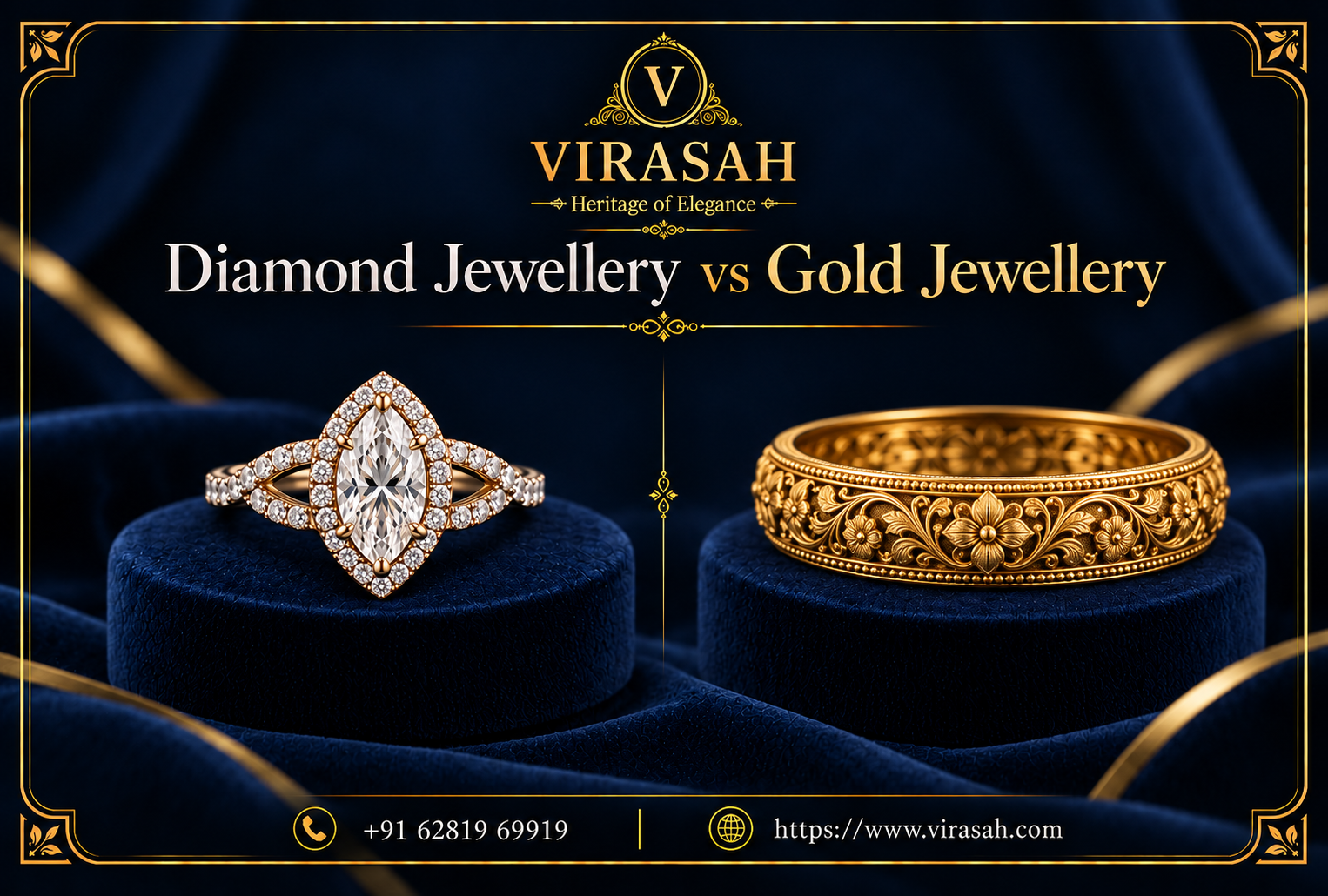
- Choose around your wedding wardrobe, not around a single product photograph.
- Ask for written specifications covering metal purity, stone details, weight and return or exchange terms.
- For diamonds, understand the 4Cs and grading documentation. For gold, check hallmarking and purity markings.
- Try the complete set with your blouse neckline, dupatta or veil before the event.
1. What Diamond Jewellery Brings to a Wedding Look
Diamond Jewellery vs Gold Jewellery often begins with the visual impact of light. Diamonds can create concentrated brilliance around the face, neckline and hands, especially under stage lighting and photography flashes. This makes diamond chokers, tennis necklaces, line bracelets and statement earrings particularly effective for receptions, cocktail evenings, sangeet functions and contemporary bridal outfits.
When considering Diamond Jewellery vs Gold Jewellery, remember that diamond appearance is affected by more than size. Cut quality influences how effectively a stone returns light, while colour and clarity affect its visual character and price. The Gemological Institute of America explains diamond quality through the 4Cs: colour, clarity, cut and carat weight, a useful framework for comparing stones consistently.
Another point in Diamond Jewellery vs Gold Jewellery is the setting metal. Many diamond pieces use 18K white gold, yellow gold, rose gold or other durable alloys because these materials provide practical strength for securing stones. The choice of metal tone can completely change how the same diamond design coordinates with embroidery, zari, sequins, pearls and other jewellery.
Brides who prefer a clean, tailored aesthetic often favour the diamond side of Diamond Jewellery vs Gold Jewellery. A well-proportioned diamond necklace can look polished without visually overpowering an embroidered lehenga or gown. It is also easier to repeat after the wedding with formal dresses, sarees, evening wear and milestone events, especially when the design avoids being excessively bridal.
Photography is another reason Diamond Jewellery vs Gold Jewellery may lean toward diamonds for certain functions. Faceted stones respond strongly to directional light, producing highlights that define the face and neckline in close shots. However, overly reflective pieces can compete with heavily embellished fabrics, so balance matters. The jewellery should frame the bride rather than become the only visible feature.
Comfort can be excellent in Diamond Jewellery vs Gold Jewellery when a diamond design uses an open framework instead of excessive metal mass. A broad necklace may look substantial while feeling lighter than a dense traditional gold piece. Still, stone-set edges, prongs and gallery work should be checked carefully so they do not catch on dupattas, lace, hair or delicate embroidery.
Certification adds an important buying layer to Diamond Jewellery vs Gold Jewellery. For significant natural diamonds, ask what grading documentation accompanies the stone and whether report numbers can be independently verified. GIA provides a public report-check service for GIA-graded diamonds, which helps buyers match a report number with recorded grading information before completing a high-value purchase.
A final advantage in Diamond Jewellery vs Gold Jewellery is design versatility. Diamond jewellery can range from restrained solitaires to elaborate necklaces combining diamonds with emeralds, rubies or sapphires. If you enjoy coloured stones, explore Virasah's guide to emerald jewellery for weddings for ideas on creating contrast without losing a refined bridal finish.
2. Why Gold Jewellery Remains Central to Wedding Traditions
Diamond Jewellery vs Gold Jewellery looks different when cultural meaning becomes the priority. Gold jewellery has long been woven into wedding customs across many Indian communities, appearing in necklaces, bangles, waist belts, earrings, nose rings, temple jewellery and family heirlooms. Its value is therefore often emotional and ceremonial as well as material and decorative.
Traditional styling gives gold an advantage in Diamond Jewellery vs Gold Jewellery when the bridal outfit includes warm zari, antique embroidery, red, maroon, green, mustard, orange or deep jewel tones. Yellow gold naturally echoes those colours, while antique, matte and temple finishes can create depth that highly polished surfaces do not.
Gold also changes the economics of Diamond Jewellery vs Gold Jewellery because the metal itself makes up a large and measurable part of the piece. Weight, purity, making charges, wastage policies, stones and taxes can all influence the invoice. Buyers should ask for a transparent breakup rather than judging value only by how large or intricate an ornament appears.
Purity is essential in Diamond Jewellery vs Gold Jewellery when purchasing gold in India. The Bureau of Indian Standards explains that hallmarking officially records precious-metal fineness, while the current hallmarking system includes purity information and a Hallmark Unique Identification number. Consumers can use BIS verification resources to check details connected with eligible hallmarked articles.
Gold performs especially well in Diamond Jewellery vs Gold Jewellery when families want jewellery that can potentially be reworked later. Depending on design, soldering, stones and condition, a gold piece may be remodelled into another necklace, bangles or smaller ornaments. That flexibility can appeal to buyers who want to preserve material while updating styling over the years.
Heirloom compatibility is another strength of gold in Diamond Jewellery vs Gold Jewellery. New earrings or bangles can be made to coordinate with a grandmother's necklace, while a traditional pendant can be reset on a more contemporary chain. The result can preserve family history without forcing the bride to wear an inherited set exactly as it was originally styled.
For ceremonial dressing, gold can also make Diamond Jewellery vs Gold Jewellery easier because it layers naturally. A short necklace, long necklace, waist belt and bangles can share a common tone even when their motifs differ. This creates the richly composed appearance many brides want for the main wedding ceremony, particularly with silk sarees, Banarasi weaves and traditional lehengas.
If you want more context before deciding Diamond Jewellery vs Gold Jewellery, read Virasah's complete wedding jewellery checklist for Indian brides. It can help identify which pieces are actually needed for each function before a large share of the jewellery budget is committed to a single statement set.
3. Diamond and Gold Wedding Jewellery Comparison
At a glance, the two options can be compared across appearance, symbolism, flexibility, maintenance and documentation. Diamonds often offer high sparkle and a contemporary finish, while gold provides warmth, strong cultural familiarity and metal-based value. Neither characteristic automatically makes one superior because bridal priorities vary by ceremony, wardrobe and family expectations.
| Factor | Diamond Jewellery | Gold Jewellery |
|---|---|---|
| Visual Effect | Bright, reflective, crisp and refined | Warm, rich, traditional and sculptural |
| Popular Wedding Use | Reception, cocktail, engagement and modern bridal styling | Main ceremony, traditional functions, temple and heritage looks |
| Important Quality Checks | Stone grading, setting quality, metal purity and stone disclosures | Purity, hallmark/HUID where applicable, weight, making charges and invoice details |
| Styling Flexibility | Excellent with gowns, lehengas and formal post-wedding wear | Excellent with sarees, lehengas and layered traditional looks |
| Maintenance | Periodic cleaning and setting inspection may be required | Cleaning, clasp checks and protection from dents or scratches |
| Heirloom Potential | Strong when the design is timeless and major stones are documented | Strong because of cultural continuity and possible remodelling |
In practical terms, Diamond Jewellery vs Gold Jewellery often comes down to the type of presence you want. A diamond necklace can create a luminous halo effect, while a gold necklace can create visible structure and warmth. If your blouse is heavily worked, a cleaner diamond design may help. If the fabric is simpler, sculptural gold can become the focal point.
Colour coordination adds another layer to Diamond Jewellery vs Gold Jewellery. White diamonds can work with almost any shade, but the metal underneath matters. Yellow gold warms the overall result, white gold cools it, and rose gold softens it. Traditional yellow-gold jewellery works particularly well with warm embroidery and can be balanced with coloured gemstones for contrast.
Scale should influence Diamond Jewellery vs Gold Jewellery as much as material. A petite bride may prefer a necklace with controlled width and a comfortable drop, while a taller frame may carry a longer or broader piece naturally. This is not a strict rule; the neckline, face shape, hairstyle and blouse construction are often more useful guides than height alone.
The event schedule can make Diamond Jewellery vs Gold Jewellery a multi-set decision rather than a single purchase. A lighter diamond set may suit the engagement or reception, while a traditional gold set works for the wedding ceremony. Planning jewellery function by function reduces the pressure to make one expensive set perform every role throughout the celebration.
Makeup and hairstyle also affect Diamond Jewellery vs Gold Jewellery. When hair is worn up, statement earrings and a defined necklace receive more attention; with long open hair, delicate details may disappear. Warm makeup and traditional flowers often complement gold, while clean makeup, cool shimmer and structured hairstyles can enhance the crisp brilliance of diamond jewellery.
Venue lighting can change Diamond Jewellery vs Gold Jewellery dramatically. Candlelight, warm chandeliers and mandap lighting can intensify gold tones, while reception stages with white or moving lights can make faceted diamonds appear especially lively. If possible, photograph the final jewellery under lighting similar to the venue rather than relying only on showroom lighting.
The most useful way to settle Diamond Jewellery vs Gold Jewellery is a full-dress trial. Wear the blouse or a neckline mock-up, pin the dupatta, style your hair approximately, then test necklace length and earring scale. A piece that looks perfect in a display case may sit too high, collide with embroidery or disappear once the complete outfit is assembled.
For brides drawn to gemstones as part of Diamond Jewellery vs Gold Jewellery, explore Virasah's ruby jewellery guide and sapphire jewellery guide. Coloured stones can bridge the visual gap between diamond sparkle and the strong colour presence traditionally associated with gold bridal jewellery.
4. Matching Jewellery to Bridal Outfits and Wedding Functions
Outfit architecture is one of the smartest ways to resolve Diamond Jewellery vs Gold Jewellery. Start with the neckline. Deep necklines can accommodate longer drops, sweetheart or square necklines can frame chokers beautifully, and heavily embroidered high necklines may need earrings instead of another dense visual layer. Jewellery should occupy open visual space rather than fight the garment.
For a red or maroon bridal lehenga, Diamond Jewellery vs Gold Jewellery can go either way. Traditional yellow gold reinforces richness and heritage, while diamonds introduce contrast and brightness. If the lehenga already contains heavy gold zari, a diamond necklace in yellow or rose gold can connect both worlds while keeping the face area visually fresh.
With pastel lehengas, champagne tones, ivory and contemporary gowns, Diamond Jewellery vs Gold Jewellery frequently shifts toward diamonds because clear stones and white or rose metals echo the lighter palette. Yet antique gold can create beautiful deliberate contrast, especially when the garment includes heritage motifs. The correct choice depends on whether you want harmony or a strong focal accent.
For silk sarees, Diamond Jewellery vs Gold Jewellery often favours gold because temple motifs, kasu designs, mango patterns, antique finishes and long layered necklaces naturally align with traditional drapes. Still, a diamond nose pin, bracelet or earrings can add light near the face without disturbing the saree's cultural character.
For the engagement, Diamond Jewellery vs Gold Jewellery often benefits from restraint. The ring is usually photographed closely, and a sophisticated necklace or earrings can support it without creating visual competition. If you are choosing a diamond ring, Virasah's guide to the best diamond cuts for engagement rings explains how shape and cut style affect appearance.
Sangeet and cocktail functions make Diamond Jewellery vs Gold Jewellery more performance-driven. Jewellery needs to survive movement, dancing and repeated hugs without snagging or shifting. Secure earrings, smooth necklace backs and flexible bracelets become important. A lighter diamond line necklace or compact gold choker may outperform a large ceremonial set simply because it remains comfortable for several hours.
The reception allows Diamond Jewellery vs Gold Jewellery to become more fashion-forward. Diamond necklaces, modern chandelier earrings and structured bracelets pair well with gowns, contemporary sarees and sleek lehengas. If you prefer gold, choose clean geometric surfaces, modern links or textured statement pieces rather than assuming gold must always look traditional or heavily ornamented.
Pre-wedding events make Diamond Jewellery vs Gold Jewellery easier to spread across the wardrobe. Use one hero set for the main ceremony, then support it with lighter pieces for mehendi, haldi, engagement and reception. This prevents unnecessary duplication and can leave more budget for pieces that will be worn after the wedding instead of remaining permanently stored.
5. Budget, Price Structure and What You Are Paying For
Budget planning is where Diamond Jewellery vs Gold Jewellery should become very specific. With gold jewellery, separate the value of the metal from making charges, stones, taxes and other listed components. With diamond jewellery, understand the stone specifications, total diamond weight, metal weight, craftsmanship and any certification or branding premium. A detailed invoice makes comparison more meaningful.
Large-looking jewellery can complicate Diamond Jewellery vs Gold Jewellery because visual size does not always equal material value. Openwork gold can cover a broad area with less weight, while a diamond necklace may use many small stones whose combined appearance is impressive but whose pricing differs from a single large graded diamond. Ask what drives the price before assuming.
In Diamond Jewellery vs Gold Jewellery, decide whether your budget should concentrate on one signature piece or a coordinated collection. A bride who wears necklaces often may benefit from one exceptional necklace, while another bride may get more utility from earrings, a bracelet, a ring and a smaller necklace. Post-wedding use should influence how the budget is divided.
Making charges deserve attention in Diamond Jewellery vs Gold Jewellery, especially for intricate handmade gold jewellery. Detailed filigree, engraving, enamel, stone setting and complex construction require labour, and that labour has value even though it is not recoverable like raw metal. Ask how charges are calculated and what happens if the piece is exchanged later.
Diamond pricing in Diamond Jewellery vs Gold Jewellery becomes clearer when you compare like with like. Two stones of equal carat weight may differ significantly in cut, colour, clarity and other characteristics. GIA's 4Cs framework exists precisely because carat alone cannot describe diamond quality. A lower-carat stone with stronger cut performance can appear more lively than a heavier poorly cut stone.
Gold pricing in Diamond Jewellery vs Gold Jewellery should also account for purity. A 22K piece contains a higher proportion of gold than an 18K piece, but 18K may be preferred for some stone-set designs because its alloy composition can provide added strength. Always compare the purity and metal weight actually listed, not merely the overall appearance.
A wedding budget for Diamond Jewellery vs Gold Jewellery should include after-sales costs as well. Diamond jewellery may need periodic setting inspection, professional cleaning or repair if a prong is damaged. Gold jewellery may need polishing, clasp repair or reshaping after wear. Ask the jeweller which routine services are included and whether future repairs are chargeable.
It is also sensible to reserve part of the Diamond Jewellery vs Gold Jewellery budget for pieces that complete the look: earrings, bangles, a ring, hair accessories or a smaller necklace for another function. Overspending on the first statement piece can force compromises later. A written allocation by function helps families compare alternatives without losing control of the total spend.
- Main ceremony statement set: approximately 35–45% of the planned jewellery budget.
- Reception or engagement set: approximately 20–30%.
- Earrings, bangles, rings and smaller pieces: approximately 20–25%.
- Alterations, insurance, storage, cleaning or contingencies: approximately 5–10%.
These are planning ranges rather than rules. Adjust them to family traditions, priorities and jewellery you already own.
6. Purity, Diamond Grading, Hallmarking and Documentation
Trust is central to Diamond Jewellery vs Gold Jewellery because wedding purchases can be high value and emotionally important. For gold, verify purity and hallmark details where applicable. BIS explains that the current gold hallmark includes the BIS Standard Mark, purity expressed through caratage and fineness, and a six-digit HUID. Keep the invoice and product details safely after purchase.
For diamonds, Diamond Jewellery vs Gold Jewellery requires a different type of documentation. Significant stones may be accompanied by grading reports describing characteristics such as colour, clarity, cut information and carat weight. A grading report is not the same as a jewellery valuation or guarantee of future resale price, so buyers should understand exactly what each document represents.
A strong Diamond Jewellery vs Gold Jewellery purchase process includes independent verification tools. The GIA 4Cs education resource explains the standard quality factors used to describe diamonds, and GIA Report Check can be used to retrieve grading information for a GIA report number. These resources help buyers ask better questions before approving a major diamond purchase.
On the gold side of Diamond Jewellery vs Gold Jewellery, BIS consumer information is particularly useful in India. The BIS CARE app supports HUID verification, and BIS publishes information about hallmarking, assaying and hallmarking centres, consumer testing and purity protections. Buyers should compare hallmark information with the invoice rather than treating a verbal assurance as sufficient.
Disclosure also matters in Diamond Jewellery vs Gold Jewellery when stones are laboratory-grown, treated or otherwise different from what a buyer may assume. Ask the seller to state important product characteristics in writing. A clear invoice should reduce ambiguity about the nature of stones, metal purity, weight and other specifications that materially affect value or care requirements.
Responsible sourcing is increasingly part of Diamond Jewellery vs Gold Jewellery for couples who care about supply-chain practices. The Responsible Jewellery Council publishes a Code of Practices covering ethical, social, human-rights and environmental expectations across the jewellery supply chain. Buyers can ask retailers what sourcing standards, supplier policies or traceability systems they follow rather than relying on vague sustainability language.
When buying coloured stones alongside diamonds in Diamond Jewellery vs Gold Jewellery, documentation becomes equally important. Treatments, origin claims and quality descriptions can affect pricing and care. Virasah's guides to Burmese ruby and Kashmir sapphire explain why origin terminology receives strong market interest and deserves careful evaluation.
Finally, keep records from Diamond Jewellery vs Gold Jewellery together: invoices, grading reports, warranties, repair policies, photographs and insurance valuation documents where relevant. Wedding jewellery often moves between homes, lockers and family storage during celebrations. A digital scan combined with a secure physical file makes future service, verification, insurance and inheritance discussions easier.
7. Durability, Comfort and Care During a Long Wedding Day
Real-world comfort can decide Diamond Jewellery vs Gold Jewellery more quickly than aesthetics. A necklace may be beautiful for ten minutes in a showroom but tiring after six hours. Check weight distribution, flexibility, back finish, edge smoothness and how the piece sits when you turn your head. The bride should be able to move naturally without constantly adjusting jewellery.
Earrings deserve special attention in Diamond Jewellery vs Gold Jewellery. Large diamond chandeliers and heavy gold jhumkas can both strain the earlobe. Support chains, ear patches or better-balanced designs may help, but they should be tested before the event. Wear the earrings at home for at least thirty minutes to identify pressure points before the wedding day.
Clothing interaction is another practical part of Diamond Jewellery vs Gold Jewellery. Prongs can catch fine net, lace and embroidered threads, while rough gold edges or protruding motifs can snag dupattas. Run a soft fabric gently around the outer surfaces during the trial. If it catches repeatedly, ask whether the setting or finish can be adjusted.
Sweat, makeup and hair products also affect Diamond Jewellery vs Gold Jewellery. Lotions and cosmetics can leave residue that reduces brilliance, particularly on diamonds and detailed settings. Put jewellery on after makeup, perfume and hairspray whenever possible. After the function, wipe pieces gently with an appropriate soft cloth and store them separately rather than piling them together.
Storage makes a difference in Diamond Jewellery vs Gold Jewellery because diamonds are very hard and can scratch other jewellery, including metal surfaces and softer gemstones. Separate compartments or soft pouches help avoid accidental contact. Gold pieces should also be supported so delicate links, chains or protruding motifs are not crushed beneath heavier ornaments.
Professional inspection is sensible in Diamond Jewellery vs Gold Jewellery for frequently worn stone-set jewellery. A loose prong may be difficult to notice until a stone moves or falls out. Before the wedding, have older diamond pieces and heirloom gold checked for clasps, hinges, solder joints and settings. Preventive inspection is usually easier than repairing a failure during an event.
Cleaning methods in Diamond Jewellery vs Gold Jewellery should match the actual materials present. A technique safe for plain gold may not suit a piece containing pearls, enamel, glued elements or treated gemstones. Do not assume one home-cleaning method works for every ornament. Ask the jeweller for care instructions specific to the complete construction of the piece.
For brides exploring unusual stones within Diamond Jewellery vs Gold Jewellery, Virasah's tanzanite jewellery guide is a useful reminder that gemstones have different durability and care needs. A bridal piece can combine several materials, so the most delicate component often determines how the entire item should be handled.
8. Heirloom Potential, Resale Thinking and Long-Term Use
Long-term value is often raised in Diamond Jewellery vs Gold Jewellery, but it should be discussed carefully. Jewellery is purchased at retail with craftsmanship, design, taxes, setting costs and commercial margins included. Future resale or exchange terms may not recover every component. Ask for the jeweller's written policy instead of assuming the original invoice amount can always be realised later.
Gold has an intuitive advantage in Diamond Jewellery vs Gold Jewellery because its metal content can be weighed and tested, and gold is widely traded. However, actual exchange outcomes depend on purity, deductions, current rates, condition and retailer policy. Stone weights, solder and non-gold parts may also affect how a piece is assessed during an exchange.
Diamonds make Diamond Jewellery vs Gold Jewellery more nuanced because resale depends on characteristics, documentation, market demand, size, shape and the buyer or jeweller evaluating the stone. Retail and secondary-market prices can differ substantially. Purchase diamonds primarily because you want to own and wear them, while treating future resale as a separate question requiring written clarification.
Heirloom value in Diamond Jewellery vs Gold Jewellery is not only financial. A necklace associated with the wedding ceremony, a ring worn daily for decades or bangles passed from one generation to another may become meaningful regardless of market price. Timeless design, comfortable proportions and proper maintenance generally support heirloom use better than an extremely trend-specific piece.
Remodelling can influence Diamond Jewellery vs Gold Jewellery over decades. Gold is frequently reworked into updated designs, although craftsmanship, purity and stone removal must be handled carefully. Diamond stones can also be reset into new rings, earrings or pendants. Choosing adaptable components today can make future redesign easier without losing the sentimental connection to the original wedding jewellery.
Insurance is worth considering in Diamond Jewellery vs Gold Jewellery when the collection is substantial. Keep detailed photographs, invoices and grading documents, and ask an insurer what evidence is required for coverage and claims. Wedding events involve travel, hotels, changing rooms and many people, so security planning should form part of the jewellery plan rather than an afterthought.
Future wear is perhaps the most practical measure in Diamond Jewellery vs Gold Jewellery. Ask yourself whether each item can be worn at anniversaries, family weddings, festivals, formal dinners or other important events. A slightly smaller, beautifully proportioned piece worn twenty times may provide more personal value than an enormous set used only once.
If rarity and gemstone provenance interest you within Diamond Jewellery vs Gold Jewellery, Virasah's guide to rare gemstones in India can broaden the conversation beyond diamonds and plain gold. Bridal jewellery can become more personal when stones, colours and motifs are selected for meaning rather than only conventional status.
9. Why Mixing Diamonds and Gold Can Be a Smart Bridal Strategy
For many brides, the most satisfying answer to Diamond Jewellery vs Gold Jewellery is not either-or but a planned combination. A yellow-gold diamond choker can deliver sparkle while still matching traditional bangles. Diamond earrings can lighten a heavy gold necklace. A gold temple set can be reserved for the ceremony while a diamond set handles the reception.
Mixing works in Diamond Jewellery vs Gold Jewellery when there is one unifying element. That element might be metal colour, repeated gemstone colour, a motif, a similar level of polish or consistent scale. Randomly combining many strong pieces can look fragmented, but a deliberate visual link makes the collection feel curated even when jewellery comes from different sets or generations.
One effective Diamond Jewellery vs Gold Jewellery formula is to keep the necklace traditional and the earrings brighter. A gold necklace with diamond studs or drops brings light near the face without challenging the ceremony's classic character. The reverse can also work: a diamond choker with simple gold bangles can keep the wrists connected to family traditions.
Another Diamond Jewellery vs Gold Jewellery formula is colour bridging. Emeralds or rubies in a diamond necklace can connect with gold bangles, embroidered borders or a traditional pendant. The coloured stones become a visual bridge between cool sparkle and warm metal. This is especially effective when the outfit itself uses the same green, red or blue accent.
Metal mixing can modernise Diamond Jewellery vs Gold Jewellery without looking inconsistent. A diamond piece in yellow gold often integrates more naturally with a traditional collection than the same design in a very cool white metal. Rose gold can soften pastel outfits, while white gold can create a cleaner contemporary mood. Choose the metal deliberately rather than treating it as invisible.
Family jewellery makes mixed Diamond Jewellery vs Gold Jewellery particularly useful. Instead of replacing inherited pieces, add one contemporary item that changes the overall silhouette. A diamond bracelet, modern earrings or a shorter necklace can refresh a classic gold collection. This approach respects family history and reduces the need to purchase an entirely new set for every function.
Layering should remain controlled in Diamond Jewellery vs Gold Jewellery. If one necklace is wide and detailed, the second should create separation in length or visual weight. Two pieces fighting for the same neckline space can look crowded and may rub against each other. Test the layers while moving, not only while standing still in front of a mirror.
Virasah's editorial guides can help build a mixed Diamond Jewellery vs Gold Jewellery wardrobe around individual stones. See the emerald wedding jewellery ideas, ruby buying guide and sapphire selection guide when planning colour accents.
10. A Step-by-Step Bridal Jewellery Shopping Plan
A disciplined process makes Diamond Jewellery vs Gold Jewellery far easier. First list every function, outfit, neckline and jewellery piece you already own. Then mark which events genuinely need a new statement set. This prevents duplicate purchases and reveals where a versatile piece can serve multiple functions, leaving more budget for quality instead of quantity.
Next, test Diamond Jewellery vs Gold Jewellery using photographs rather than memory. Keep front and side photos of each outfit on your phone and compare shortlisted jewellery against them. Show the exact blouse neckline, sleeve style and dupatta placement to the jeweller. Small design differences become obvious when jewellery is evaluated against the actual garment.
Third, set written specifications before finalising Diamond Jewellery vs Gold Jewellery. For gold, note preferred purity, approximate weight range, size and hallmark expectations. For diamond pieces, note natural or laboratory-grown preference, stone specifications, metal purity, grading-report requirements for important stones and the acceptable total budget. Written criteria reduce impulsive upgrades in the showroom.
Fourth, perform a comfort test for Diamond Jewellery vs Gold Jewellery. Sit, turn your head, raise your arms and mimic greeting guests. Check whether the necklace shifts, earrings pull, bangles interfere with sleeves or rings catch fabric. Bridal jewellery should survive ordinary movement without needing an assistant to reposition it every few minutes.
Fifth, compare invoices when evaluating Diamond Jewellery vs Gold Jewellery. Look beyond the final number and compare metal weight, purity, diamond details, making charges, stone charges, taxes, discounts, exchange policy and included service. A lower total price is not automatically better if the underlying specifications or after-sales terms are substantially different.
Sixth, verify documentation before paying for Diamond Jewellery vs Gold Jewellery. Check relevant hallmark or grading details, ensure the invoice description matches the product, and ask for warranty or exchange terms in writing. If a major claim about origin, treatment, purity or grading influences the price, request supporting documentation rather than relying only on a salesperson's statement.
Seventh, schedule a final fitting for Diamond Jewellery vs Gold Jewellery close enough to the wedding that blouse alterations, weight changes and hairstyle plans are already known. Neck size, blouse depth and dupatta placement can change after the first trial. A final adjustment of chain length or clasp position can dramatically improve photographs and comfort.
Eighth, plan secure transport and storage for Diamond Jewellery vs Gold Jewellery. Use separate labelled boxes, maintain a simple item checklist and assign responsibility to a trusted family member during functions. Photograph each set before travel. Good organisation prevents last-minute confusion and helps ensure valuable jewellery does not move casually between dressing rooms, cars and hotel suites.
Browse gemstone education, bridal jewellery inspiration and buying guides at www.virasah.com.
Recommended Virasah Reading Before You Buy
Use these guides as a research path while evaluating Diamond Jewellery vs Gold Jewellery. Start with bridal planning, then move to diamonds and coloured gemstones so you can compare design, rarity, quality language and care requirements before placing a large wedding jewellery order.
- Best Wedding Jewelry for Indian Brides: Complete Checklist
- Best Diamond Cuts for Engagement Rings
- Tanzanite Jewelry: Meaning, Rarity and Buying Guide
- Burmese Ruby: Why It Is One of the World's Most Valuable Gemstones
- Kashmir Sapphire: Why This Rare Gemstone Is So Valuable
- Rare Gemstones in India: Complete Guide
- Sapphire Jewelry Guide
- Ruby Jewelry Guide
- Best Emerald Jewelry Designs for Weddings
Frequently Asked Questions
1. Which is better for an Indian bride: diamonds or gold?
Diamond Jewellery vs Gold Jewellery depends on the bride's outfit, traditions and future-wear goals. Gold usually integrates naturally with traditional ceremonies and heirloom layering, while diamonds can create a brighter contemporary finish. Many brides use gold for the main wedding and diamonds for engagement or reception events, avoiding the need for one style to cover every function.
2. Is diamond jewellery suitable for the main wedding ceremony?
Diamond Jewellery vs Gold Jewellery can absolutely favour diamonds for the main ceremony when the outfit, family customs and personal style support them. Yellow-gold diamond settings can blend especially well with traditional embroidery. If the ceremony requires specific gold ornaments, those pieces can be retained while diamonds are used for the necklace, earrings or complementary accents.
3. Is 22K or 18K gold better for bridal jewellery?
Diamond Jewellery vs Gold Jewellery involves different purity choices depending on construction. Traditional plain-gold jewellery commonly uses higher-purity gold, while many diamond-set designs use 18K because the alloy can provide useful strength for securing stones. Buyers should check the actual purity marking, hallmark information where applicable and the jeweller's construction recommendation for the specific design.
4. What should I check before buying a diamond wedding set?
Diamond Jewellery vs Gold Jewellery becomes safer when you ask for written details about whether stones are natural or laboratory-grown, relevant 4Cs information, total diamond weight, metal purity, setting quality and grading documentation for important stones. Check the invoice carefully and independently verify report numbers when a recognised grading report forms part of the purchase.
5. What should I check before buying gold wedding jewellery in India?
Diamond Jewellery vs Gold Jewellery requires careful gold verification. Check purity, the BIS hallmark and HUID where applicable, net precious-metal weight, making charges, stone deductions, invoice details and exchange terms. BIS provides consumer information about hallmarking and HUID verification and recommends retaining appropriate purchase documentation for hallmarked articles.
6. Can I mix diamond jewellery with traditional gold bangles?
Diamond Jewellery vs Gold Jewellery often looks best when mixed thoughtfully. Diamond earrings or a diamond choker can pair with traditional gold bangles if the metal tone, gemstone colour or design scale creates a visual connection. Yellow-gold diamond settings are particularly easy to coordinate with inherited or ceremonial gold pieces without making the overall look feel disconnected.
7. Which option is easier to wear again after the wedding?
Diamond Jewellery vs Gold Jewellery depends on design more than category. A medium-size diamond necklace, studs or bracelet may be easy to reuse for formal events, while simple gold bangles, chains and earrings can be worn frequently for festivals or family occasions. Choose at least some pieces with repeat wear in mind instead of making every purchase highly ceremonial.
8. Which option is better if my bridal outfit is heavily embroidered?
Diamond Jewellery vs Gold Jewellery should be resolved by balancing visual density. With extremely detailed embroidery, a cleaner diamond design can create breathing space, while a heavily sculpted gold necklace may compete with the blouse. If the embroidery is mostly gold zari, a simpler gold piece or yellow-gold diamond set can coordinate without making the neckline feel overcrowded.
9. Which is better for long-term value?
Diamond Jewellery vs Gold Jewellery should not be reduced to a guaranteed investment comparison. Gold has a widely traded metal value, while diamond resale can vary greatly with quality, documentation, demand and buyer. Retail jewellery prices also include labour, design and commercial costs. Ask for written exchange terms and purchase wedding jewellery primarily for use, meaning and suitability.
10. How can I decide if I still feel confused?
Diamond Jewellery vs Gold Jewellery becomes much easier after a complete outfit trial. Shortlist one diamond option and one gold option, wear each with the actual neckline or a close mock-up, photograph them in warm and cool light, check comfort for thirty minutes and compare itemised invoices. The better personal choice is the one that fits your total wedding plan.
Final Thoughts
Wedding jewellery is most successful when beauty, comfort, documentation and personal meaning are considered together. Diamonds can deliver refined brilliance and modern flexibility, while gold can deliver warmth, cultural continuity and strong heirloom character. Many brides may find that a carefully planned combination gives them the broadest styling range across several wedding functions.
Before buying, try the pieces with your real outfits, ask for itemised specifications, verify relevant grading or hallmark details, understand exchange and service policies, and think beyond the wedding day. A bridal collection should feel extraordinary during the celebration while still making sense when you open the jewellery box years later.