Temple Jewellery for Brides: Traditional Designs and Styling Guide
Temple Jewellery for Brides brings together sacred-inspired motifs, South Indian craftsmanship, regal proportions and bridal styling that feels rooted in heritage without looking dated. This complete guide explains the major designs, necklace lengths, motifs, gemstones, outfit pairings, layering methods, buying checks, care practices and ceremony-wise styling ideas a bride can use to create a balanced wedding look.
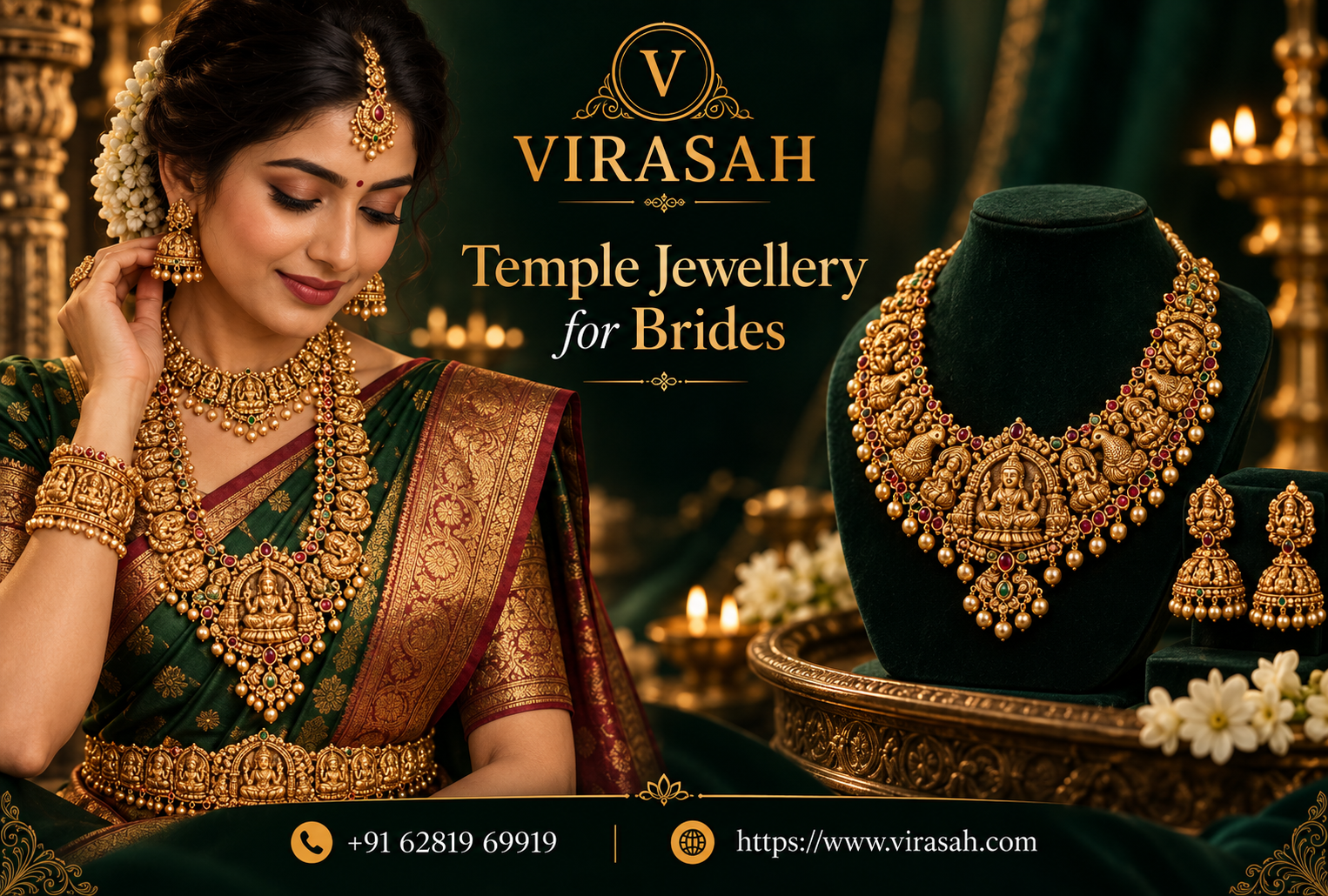
Why Temple Jewellery for Brides Has Such Lasting Appeal
Temple Jewellery for Brides has a distinctive visual language. Gold-toned surfaces, sculptural deity-inspired motifs, lotus forms, peacocks, mango shapes, coins, floral borders, pearls and red-green stones create a ceremonial richness that photographs beautifully and pairs naturally with Indian bridal textiles. The style is especially associated with South Indian wedding dressing, yet its design vocabulary is now used across sarees, lehengas and fusion bridal looks throughout India and among Indian communities worldwide.
Part of the attraction of Temple Jewellery for Brides is that it can look grand without depending only on stone size. Much of the drama comes from silhouette and detail: a broad pendant, a row of repeating coins, a goddess motif framed by floral work, pearl drops that move while the bride walks, or a long necklace that creates a strong vertical line over a richly woven saree. This makes temple-inspired jewellery particularly effective for wedding photography, where texture and scale matter as much as sparkle.
Another reason Temple Jewellery for Brides remains relevant is its ability to connect old and new styling. A bride may choose a traditional Kanjeevaram and wear a full layered set, or she may combine a clean silk saree with just one antique-finish necklace and statement jhumkas. The same jewellery language can therefore support a deeply traditional muhurtham look, a restrained engagement look or a fashion-forward reception style.
The National Museum in New Delhi describes Indian jewellery as part of a long aesthetic and cultural history and displays South Indian pieces such as manga malai necklaces made with gold, rubies and white sapphires. That museum context helps explain why Temple Jewellery for Brides often feels larger than a passing fashion trend: it draws from forms that have existed within Indian adornment traditions for generations.
Understanding the Heritage Behind the Style
The term Temple Jewellery for Brides is commonly used today for bridal ornaments inspired by jewellery associated with temple iconography, classical dance traditions and historic South Indian adornment. It should not be treated as one rigid design category. Different regions, communities, workshops and eras have produced different interpretations, and modern bridal collections may combine several traditions in one coordinated set.
Historically inspired Temple Jewellery for Brides often includes sculptural imagery of Lakshmi and other sacred figures, along with peacocks, lotus petals, mango forms, yali-like creatures, floral scrolls, bells and coin-like discs. These forms may appear in pendants, hair ornaments, armlets, waist belts and earrings. Contemporary pieces can be made in precious gold, gold-plated silver, other metal alloys or fashion-jewellery constructions, so the buyer should always confirm the actual material rather than assuming it from appearance.
Museum collections also show how varied Indian jewellery construction can be. South Indian necklaces may use repeating shaped units, woven gold cords, cabochon gemstones, pearls or sculptural pendants. When brides shop for Temple Jewellery for Brides, it is useful to look beyond the front view and examine how those units are linked, how the pendant is supported, how the clasp works and how the weight is distributed around the neck.
For brides who enjoy learning about India’s broader gemstone heritage, Virasah’s guides on rare gemstones in India and the complete wedding jewellery checklist for Indian brides provide useful context. These resources can help you see Temple Jewellery for Brides as part of a complete jewellery wardrobe rather than as a single necklace purchase.
Signature Motifs to Look For
Lakshmi-Inspired Motifs
Among the most recognisable details in Temple Jewellery for Brides are goddess-inspired central motifs. They often form the focal point of a pendant, choker, long haram or waist belt. Because the motif is already visually powerful, the surrounding stones and pearl drops can be kept disciplined so the design remains readable in photographs.
Peacocks
Peacock forms add graceful curves and symmetry to Temple Jewellery for Brides. They work especially well on broad pendants, earrings and side elements. Red and green stones are frequently used around the feathers, creating colour contrast against antique or high-polish gold finishes.
Lotus and Floral Borders
Lotus petals and floral bands soften the sculptural quality of Temple Jewellery for Brides. Brides who find large deity motifs too dominant can choose floral-led pieces that still feel traditional but transition more easily to post-wedding festive wear.
Mango Forms
Mango-shaped units are a familiar South Indian jewellery form. In Temple Jewellery for Brides, repeating mango motifs can create a rhythmic necklace line that sits beautifully against silk sarees. The shape is particularly effective when the stones are graduated in size toward the centre.
Coin Details
Coin necklaces create a strong ceremonial look. In Temple Jewellery for Brides, rows of coin-like discs can function as a medium-length necklace or long haram. They are best paired with a blouse neckline that gives the necklace enough open space to sit flat.
Pearl Drops and Ghungroo-Like Edges
Small pearls, bead fringes and bell-like drops add movement to Temple Jewellery for Brides. These finishing elements can lighten a heavy visual design, soften the lower edge of a choker and create delicate motion in video and candid wedding photography.
Essential Temple Jewellery Pieces for a Bridal Set
1. The Temple Choker
A choker is often the anchor of Temple Jewellery for Brides because it sits close to the neckline and creates a strong frame around the face. It can be sculptural and wide, or comparatively slim with a central motif. A choker is especially useful when the blouse has a deeper neckline, because it fills the upper chest while leaving room below for a second necklace.
When trying a choker from a Temple Jewellery for Brides collection, check more than the circumference. Look at the curve of the base, whether the central section tilts forward, whether the back tie or chain can be adjusted securely, and whether the lower edge touches the collarbone uncomfortably when you turn your head. Bridal jewellery should still allow the bride to smile, speak, eat and move naturally.
2. The Long Haram
The long haram gives Temple Jewellery for Brides vertical balance. It can visually elongate the torso, connect a high-detail blouse to the saree or dupatta below, and create a layered royal effect when combined with a choker. The most flattering length is the one that leaves a visible gap between the short and long necklaces rather than allowing both pieces to overlap chaotically.
For brides choosing a heavy silk saree, the long element of Temple Jewellery for Brides should be tested against the actual blouse and pallu placement. Embroidery, zari borders and pleats can lift or tilt the necklace. A trial with the full outfit is far more reliable than judging the length over a T-shirt in a jewellery store.
3. Kasu Mala or Coin Necklace
A kasu-style necklace is one of the most recognisable options within Temple Jewellery for Brides. Repeating coin forms create a rich but orderly look, making this style useful when the bridal outfit already contains several patterns. Brides can select a compact coin necklace for layering or a longer version that becomes the dominant jewellery line.
4. Mango-Motif Necklace
Mango-shaped units offer another elegant approach to Temple Jewellery for Brides. The repeating form can be set with coloured stones and finished with pearls, giving the necklace both structure and softness. Brides who want traditional influence without an oversized central deity pendant often find this format easier to restyle after the wedding.
5. Jhumkas and Statement Earrings
Earrings complete the upper frame of Temple Jewellery for Brides. Jhumkas can echo the motifs of the necklace, repeat its pearl fringe or introduce a slightly different silhouette while keeping the same metal finish. If the necklace is very broad, earrings with a compact dome usually feel more balanced than shoulder-length pieces.
Brides should also consider physical support when selecting earrings from a Temple Jewellery for Brides set. Large jhumkas may need a supporting chain, ear-lobe patch or other stabilising solution depending on construction and comfort. Test them for at least fifteen to twenty minutes during the trial instead of wearing them only for a few seconds in front of a mirror.
6. Vaddanam or Waist Belt
A waist belt can make Temple Jewellery for Brides feel complete because it visually ties the jewellery to the saree drape. A sculptural central motif works well with pleated silk sarees, while a more flexible chain-based design can suit lehengas and lighter drapes. The belt should sit securely without restricting breathing or digging into the waist while seated.
7. Armlets, Bangles and Rings
Armlets and bangles extend Temple Jewellery for Brides beyond the neckline. The key is repetition, not duplication. An armlet can repeat the central motif while the bangles use simpler floral or stone borders. This prevents every accessory from competing for attention at the same visual intensity.
8. Hair Jewellery and Forehead Pieces
Hair accessories can transform Temple Jewellery for Brides when the hairstyle is a long braid, bun or structured traditional updo. Depending on regional custom and personal preference, the bride may use a forehead ornament, sun-and-moon elements, braid decorations or a bun accessory. The jewellery should be anchored into the hairstyle by a professional so decorative pieces do not pull on the hairline.
How to Layer Temple Jewellery for Brides Without Looking Overdone
Layering is one of the most important skills in styling Temple Jewellery for Brides. The goal is not to wear every piece you own; the goal is to create clear levels. A short choker should occupy one zone, a medium necklace another and a long haram a third. When all three lengths collapse into the same area, even expensive jewellery can look cluttered.
A reliable formula for Temple Jewellery for Brides is to choose one hero piece and let the other pieces support it. If the long haram has an elaborate goddess pendant, use a cleaner short necklace. If the choker is highly sculptural, choose a longer strand with repeated motifs rather than another enormous pendant. This hierarchy makes the overall styling feel intentional.
Colour repetition also helps Temple Jewellery for Brides look cohesive. If the choker contains ruby-red and emerald-green stones, the long necklace does not need identical stones in identical positions, but it should repeat at least one colour or the same antique-gold tone. Pearls can act as a neutral connector between two pieces that are otherwise different.
Brides considering gemstone accents can explore Virasah’s ruby jewellery guide, sapphire jewellery guide and emerald jewellery designs for weddings. These guides are helpful when Temple Jewellery for Brides includes coloured stones and you want the necklace to harmonise with the saree border, blouse embroidery or other bridal gems.
Choosing the Right Necklace for Your Bridal Neckline
The relationship between blouse neckline and Temple Jewellery for Brides matters more than many brides expect. Jewellery should sit either clearly on skin or clearly over fabric. When a necklace edge repeatedly catches on a heavily embroidered neckline, the visual line becomes untidy and the bride may spend the day adjusting it.
| Blouse or Outfit Neckline | Jewellery Approach | Styling Reason |
|---|---|---|
| Deep round or U-neck | Broad choker plus long haram | Gives Temple Jewellery for Brides enough open space to show both levels clearly. |
| V-neck | Necklace with a defined central pendant | The pendant can visually follow the V and create a strong centre line. |
| High neck | Long haram or medium necklace over the fabric | Keeps Temple Jewellery for Brides visible instead of crowding the neck. |
| Boat neck | Medium-to-long necklace with limited width near the collarbone | Creates vertical balance and avoids competing horizontal lines. |
| Square neck | Structured choker or necklace with a broad central section | The geometry gives Temple Jewellery for Brides a clean frame. |
| Off-shoulder or contemporary blouse | One statement necklace or choker | Lets heritage-inspired jewellery become the intentional contrast in a modern look. |
If you are ordering Temple Jewellery for Brides online, measure a necklace you already own and like. Record both the wearable chain length and the pendant drop. Product photos can make a piece appear longer or shorter depending on the model’s proportions, so measurements are more dependable than visual guesswork.
Matching Temple Jewellery for Brides With Saree Colours
Gold-toned Temple Jewellery for Brides works with a wide spectrum of bridal colours, but the final effect changes dramatically depending on contrast. Deep reds and maroons produce a classic ceremonial look. Bottle green and emerald tones make warm gold stand out sharply. Ivory, cream and off-white create a calmer, more sculptural look in which the jewellery itself becomes the main source of colour.
For a red Kanjeevaram, Temple Jewellery for Brides with green stones can create an effective complementary contrast. If the saree already contains green borders, repeat that tone once in the necklace or earrings rather than in every accessory. Too much exact colour matching can make the outfit feel overly coordinated; controlled repetition tends to look richer.
With green silk, Temple Jewellery for Brides featuring ruby-coloured accents, pearls or white stones can create definition. Brides wearing mustard, turmeric yellow or antique gold textiles can choose pieces with deeper red or green details to prevent the jewellery from disappearing into the fabric.
Pastel sarees can also work with Temple Jewellery for Brides. A blush pink, muted lavender, dusty blue or sage outfit can make an antique-gold finish look especially refined. In this case, consider a slightly lighter necklace combination and let the traditional motifs provide the heritage element rather than adding maximum visual weight everywhere.
Styling Temple Jewellery for Brides With Different Bridal Outfits
Kanjeevaram and Other Rich Silk Sarees
Silk sarees are a natural partner for Temple Jewellery for Brides because both rely on strong texture and ceremonial presence. The weave, zari border and jewellery can all be elaborate, so visual hierarchy is important. If the saree has a very broad border and a heavily embroidered blouse, choose one dominant necklace and one supporting layer instead of three equally ornate necklaces.
Banarasi Sarees
Brides can style Temple Jewellery for Brides with Banarasi sarees by using tone as the bridge. An antique finish can complement old-gold zari, while polished yellow gold can work with brighter zari. Because Banarasi patterns can be dense, a necklace with a clear central motif may read better than a design filled with many tiny competing details.
Lehengas
A lehenga can give Temple Jewellery for Brides a more contemporary expression. Instead of copying a saree-style jewellery arrangement, look at the blouse neckline and dupatta placement first. A temple choker with sculptural earrings can be enough for a richly embroidered lehenga, while a simpler lehenga can carry a long haram and waist belt more comfortably.
Half-Saree and Regional Bridal Ensembles
For half-sarees and other regional ensembles, Temple Jewellery for Brides can be planned around the drape line. Long necklaces should not disappear under the dupatta or pallu. A styling trial helps determine whether a pendant needs to sit above the fabric edge, over it or below it.
Minimal or Contemporary Sarees
One of the easiest ways to modernise Temple Jewellery for Brides is to pair a bold heritage necklace with a quiet saree. A plain silk or tissue saree, clean blouse and structured bun allow the jewellery motifs to be read clearly. This approach is especially useful for an engagement, intimate wedding or post-wedding event where the bride wants tradition without a fully maximal look.
Ceremony-by-Ceremony Styling Plan
Engagement
For an engagement, Temple Jewellery for Brides can be introduced in a lighter way. Consider one medium necklace, coordinated earrings and bangles, then reserve the layered haram and waist belt for the wedding ceremony. This creates visual progression across events and prevents all photographs from looking identical.
Haldi
Traditional precious or delicate Temple Jewellery for Brides may not be the most practical choice around turmeric, oils and water. Brides who want the aesthetic can use a lighter, easily managed piece or floral jewellery and save the more valuable temple-style set for a dry event. Protecting the finish and stone settings is more important than forcing one jewellery theme across every function.
Mehendi
During mehendi, hands and wrists need freedom. A bride can keep Temple Jewellery for Brides concentrated around the neck and ears rather than stacking many bangles before the henna is complete. A compact choker or medium necklace also allows the bride to sit comfortably for long periods.
Sangeet
If dancing is central to the sangeet, choose Temple Jewellery for Brides that is secure and relatively light. Long necklaces can swing, large earrings can pull, and loosely tied waist belts can shift. A locked clasp, properly supported earrings and fewer moving elements create a safer, more comfortable look.
Wedding Ceremony
The wedding ceremony is where a full expression of Temple Jewellery for Brides often makes the most sense. A choker, long haram, jhumkas, waist belt, bangles and hair jewellery can work together when they share a coherent finish and motif language. Allow enough space between major pieces so each one remains visible.
Reception
For the reception, Temple Jewellery for Brides can be edited rather than repeated exactly. Remove the long haram and keep the choker, or change into a gown and use only one temple necklace as a contrast piece. Brides who prefer gemstones for the reception can explore Virasah’s guide to tanzanite jewellery for a completely different colour direction.
Gemstones and Colour Accents in Temple Jewellery
Traditional-looking Temple Jewellery for Brides may include natural gemstones, lab-grown stones, glass, synthetic stones, cultured pearls or other decorative materials depending on the product and price point. A bride should never infer gemstone identity from colour alone. Ask for a clear material description and, for significant precious-stone purchases, appropriate documentation from a reputable seller or laboratory where relevant.
Ruby tones are especially popular in Temple Jewellery for Brides because saturated red contrasts strongly with yellow or antique gold. If you are considering fine ruby jewellery elsewhere in the bridal wardrobe, Virasah’s article on Burmese ruby and its rarity explains why origin, treatment and quality discussions matter in the high-value gemstone market.
Green stones give Temple Jewellery for Brides freshness and contrast, particularly against red, maroon and gold sarees. Fine emeralds require more careful handling than ruby or sapphire, so the cleaning method should depend on the actual gemstone and its treatment. If the piece contains true emeralds, avoid assuming that any generic jewellery cleaner is safe.
Sapphire accents are less conventional in some versions of Temple Jewellery for Brides, but blue can create a distinctive bridal palette. Brides researching fine blue stones can read Virasah’s guide to Kashmir sapphire rarity. Such educational reading is particularly useful when a wedding wardrobe combines temple-inspired gold jewellery with a separate fine-gemstone ring, bracelet or reception necklace.
Diamonds and white stones can also sharpen the look of Temple Jewellery for Brides. A border of bright white stones around a sculptural gold motif adds contrast without changing the overall heritage character. Brides planning a diamond engagement ring alongside their wedding jewellery can also consult Virasah’s guide to diamond cuts for engagement rings.
How to Choose Temple Jewellery for Brides Based on Face Shape and Proportion
Face-shape rules should be treated as starting points, not restrictions. With Temple Jewellery for Brides, scale is often more important than a strict oval-round-square classification. A petite bride can absolutely wear a bold necklace if the width, pendant size and earring length are balanced with her frame and blouse.
For a round face, Temple Jewellery for Brides with some vertical movement can create length. Medium jhumkas, a longer haram and a pendant that draws the eye downward may feel balanced. Extremely wide earrings combined with a tight broad choker can create a very horizontal effect, so try the full set before deciding.
For a longer face, Temple Jewellery for Brides can include broader chokers and fuller earrings that add width. A long haram can still work, but it should not be the only necklace line. Layering a short piece above it usually creates better proportion.
For angular features, curved peacock, lotus or mango motifs can soften the geometry of Temple Jewellery for Brides. For softer features, structured coin rows or a defined central pendant can add clarity. These are visual tools rather than rules; the bride’s own preference should remain the final deciding factor.
Hair, Makeup and Veil/Dupatta Coordination
Jewellery is most successful when the entire upper-body composition is planned together. With Temple Jewellery for Brides, a centre-parted bun, braid, flowers and forehead jewellery can create a strong traditional frame. If every element is large, however, the face can become visually crowded. Decide whether the primary focal point is the necklace, earrings, hair jewellery or makeup.
For bridal makeup, Temple Jewellery for Brides usually benefits from skin that looks polished rather than overly reflective under strong lights. Deep eye definition and a lip tone that relates to the saree or stone accents can create cohesion. The exact makeup palette should be tested under the same warm or cool lighting expected at the venue.
Dupatta placement can affect Temple Jewellery for Brides dramatically. A dupatta pinned close to the neck can hide earrings, snag pearl drops or cover the outer edge of a necklace. Ask the draping artist and hairstylist to coordinate with the jewellery trial rather than treating each service independently.
Comfort Matters: Weight, Fit and Movement
Wedding jewellery is worn for hours, which makes comfort a practical design requirement. A beautiful set of Temple Jewellery for Brides can become distracting if the necklace edge scratches the skin, the earrings pull, the waist belt restricts sitting or the pendant repeatedly turns. Try the complete set long enough to discover these issues before the wedding day.
Weight distribution is particularly important in Temple Jewellery for Brides. Two moderate necklaces can sometimes feel more comfortable than one extremely heavy choker because the load is distributed across different points. Conversely, too many layers can create friction and tangling. The ideal combination depends on construction, not merely total grams.
Fastenings are another priority. Check every hook, screw, safety chain, tie cord and clasp in Temple Jewellery for Brides. Ask someone from the bridal party to learn how each piece opens and closes. On the wedding morning, this small preparation can save time and prevent accidental force on delicate components.
Buying Temple Jewellery for Brides: A Detailed Checklist
Buying Temple Jewellery for Brides should begin with a written plan: which ceremony the set is for, which outfit it will accompany, how long it must be worn and whether the bride wants precious jewellery, premium fashion jewellery or a mixture. Defining these points first prevents a beautiful showroom piece from becoming an impractical wedding-day purchase.
- Confirm the metal: Ask exactly what the base metal is, whether the item is solid precious metal, silver with gold finish, or another alloy.
- Confirm stones and pearls: Natural, lab-grown, synthetic and imitation materials can look similar in photographs but differ greatly in value and care requirements.
- Check the total weight: For Temple Jewellery for Brides, weight affects comfort as much as price.
- Inspect the reverse: A smooth, well-finished back is especially important for chokers and broad pendants that rest directly on skin.
- Test articulation: Repeating necklace units should move enough to follow the body without folding unpredictably.
- Inspect prongs and settings: No sharp edge should catch the saree, veil, dupatta or hair.
- Check adjustability: A few centimetres of adjustment can make Temple Jewellery for Brides much easier to coordinate with different blouse necklines.
- Ask about after-sales service: Understand repair, replating, resizing, stone replacement and exchange policies before purchase.
- Keep invoices and documentation: Precious-metal and significant gemstone purchases should have clear records.
Hallmarking, Purity and Documentation
If your Temple Jewellery for Brides is being purchased as gold jewellery in India, learn how hallmarking applies to the article you are buying. The Bureau of Indian Standards explains hallmarking as the official recording of precious-metal fineness and provides consumer information about verifying hallmarked jewellery and HUID details. Requirements and exemptions can change, so use the current BIS guidance rather than relying on old social-media posts.
For high-value Temple Jewellery for Brides, the invoice should clearly describe what you paid for. Ask the seller to separate or explain metal weight, purity, stone information, making charges and any other charges that matter to the transaction. A premium appearance is not a substitute for documentation.
When a set contains gemstones, remember that Temple Jewellery for Brides can use many different materials to achieve similar colours. If the seller describes stones as natural precious gemstones and the value is material to your purchase, ask what evidence supports that description and whether a recognised independent laboratory report is available or appropriate.
Care and Storage After the Wedding
Correct care extends the life of Temple Jewellery for Brides. Put jewellery on after perfume, hairspray, makeup and body products have been applied. After the event, wipe accessible surfaces gently with a clean, soft cloth and allow any moisture from wear to dissipate before storing the piece in a dry place.
Do not apply one aggressive cleaning method to every type of Temple Jewellery for Brides. Gemstones differ in toughness and treatment. GIA, for example, notes that emeralds often require gentler care than ruby and sapphire. If you do not know the material or treatment, ask the jeweller before using ultrasonic cleaners, steam, chemical dips or abrasive powders.
Store each major piece of Temple Jewellery for Brides separately so chains, prongs and stones do not scratch one another. Support broad necklaces flat, keep long necklaces from tangling, place earrings in separate compartments and avoid piling a heavy waist belt on top of delicate pearl drops.
If Temple Jewellery for Brides uses plated or antique-finish surfaces, keep it away from unnecessary water, sweat, perfume and household chemicals. A soft pouch or lined box can reduce abrasion. For heirloom or fine precious jewellery, periodic inspection by a trusted professional can identify loose settings or worn links before they become expensive repairs.
Common Styling Mistakes Brides Can Avoid
The first mistake with Temple Jewellery for Brides is choosing every accessory at maximum scale. A huge choker, enormous jhumkas, broad waist belt, heavy forehead ornament, layered bangles and dense hair decorations may each be beautiful individually, but together they can compete with the bride’s face. Select a hierarchy and allow some quiet space.
The second mistake is buying Temple Jewellery for Brides before finalising the blouse neckline. Even a perfectly designed necklace can sit awkwardly when the blouse embroidery rises into the same area. Finalise or at least measure the blouse before locking the necklace length.
The third mistake is ignoring photography. Highly reflective Temple Jewellery for Brides, white stones, zari and bright stage lighting can all interact differently on camera. Take phone photos and, if possible, one trial photo using flash. This helps reveal whether the jewellery disappears into the outfit or overwhelms it.
The fourth mistake is treating comfort as a wedding-day problem. Temple Jewellery for Brides should be tested in advance with the hairstyle and outfit. A necklace that rolls, an earring that tilts or a waist belt that loosens will not become easier when the ceremony begins.
Authoritative Resources for Further Reading
Brides who want to go beyond styling advice can use the following museum, standards and gemological resources to understand Indian jewellery heritage, precious-metal verification, gemstone care and craftsmanship. These are included as dofollow reference links and can be useful when researching Temple Jewellery for Brides in greater depth.
- National Museum, New Delhi — Jewellery Collection
- Bureau of Indian Standards — Hallmarking Overview
- Gemological Institute of America — Sapphire Care and Cleaning
- Gemological Institute of America — Emerald Care and Cleaning
- Victoria and Albert Museum — Jewellery Collection and Indian Jewellery Resources
- The Metropolitan Museum of Art — Indian Jewelry Tradition
A Practical Bridal Styling Formula
For brides who feel overwhelmed by choices, use this simple formula for Temple Jewellery for Brides: choose one hero necklace, one supporting necklace if needed, earrings that repeat one motif, a waist or hair element that echoes the same finish, and bangles that fill the remaining visual space without duplicating every detail. Then remove one item if the face no longer feels like the focal point.
For a classic South Indian bridal look, Temple Jewellery for Brides can be built around a short Lakshmi-style necklace, a longer haram, jhumkas, a vaddanam and coordinated hair ornaments. For a contemporary version, keep the same heritage language but reduce the number of pieces to a choker, earrings and one statement bangle stack.
Most importantly, the right Temple Jewellery for Brides should make the bride feel recognisable as herself. Tradition can guide the design, family pieces can add meaning and styling can create polish, but the final combination should suit the person wearing it. That is what makes a bridal look memorable rather than merely elaborate.
Frequently Asked Questions About Temple Jewellery for Brides
1. What is temple jewellery in bridal styling?
Temple Jewellery for Brides generally refers to bridal jewellery inspired by South Indian temple iconography, historic ornaments and classical design vocabulary. Common features include goddess motifs, peacocks, lotus forms, mango shapes, coins, pearls and red-green stone accents. Modern pieces may be made in precious metals or fashion-jewellery materials, so always verify the actual construction.
2. Can a bride wear temple jewellery with a lehenga?
Yes. Temple Jewellery for Brides can work beautifully with a lehenga, especially when the jewellery is treated as a deliberate heritage contrast. Match the scale of the necklace to the blouse neckline and embroidery. A bold choker may be enough for a heavily worked lehenga, while a simpler outfit can support a second long layer.
3. How many necklaces should a bride layer?
There is no fixed number. With Temple Jewellery for Brides, two necklaces are often sufficient: one short piece and one long haram with a clear gap between them. A third layer can work if the outfit is relatively controlled and each necklace occupies a distinct length.
4. Which saree colours look best with temple jewellery?
Temple Jewellery for Brides pairs well with red, maroon, green, mustard, royal blue, purple, ivory, cream and many pastel silk shades. Instead of searching for one “best” colour, decide whether you want contrast or harmony. Green stones against red silk create contrast, while warm gold on cream creates a softer tonal effect.
5. Is temple jewellery suitable for a reception?
Absolutely. temple bridal jewellery can be edited for a reception by wearing only the choker, only the long necklace, or a single sculptural pendant with a gown or contemporary saree. Changing the hairstyle and removing some supporting pieces can make the same jewellery look completely different from the ceremony styling.
6. How do I know whether a temple necklace will be too heavy?
Ask for the weight, then wear the piece long enough to evaluate it. The comfort of this bridal jewellery style depends on weight distribution, necklace curvature, backing, ties and how multiple layers interact. A thirty-minute trial with the blouse is more useful than a few seconds in front of a counter mirror.
7. Should all bridal temple jewellery pieces match exactly?
No. temple bridal jewellery usually looks more sophisticated when pieces coordinate rather than duplicate one another. Repeat the metal finish, one motif, one stone colour or pearl detail, but allow different silhouettes. This creates unity without making the set appear overly uniform.
8. How should temple jewellery be stored?
Store this bridal jewellery style in a cool, dry place, ideally with each major piece separated. Keep broad necklaces supported, prevent chains from tangling, avoid pressure on pearl fringes and follow the seller’s care instructions for plated finishes or specific gemstones.
9. Can temple jewellery be mixed with diamonds?
Yes. temple bridal jewellery can be mixed with diamonds or white-stone jewellery when there is a visual bridge, such as a shared gold tone or repeated white accents. For example, a temple necklace can be paired with a diamond nose pin or ring without making every accessory part of the same set.
10. What should I check when buying temple jewellery online?
For this bridal jewellery style bought online, review exact dimensions, total weight, material description, stone description, fastening method, close-up photographs, return policy and care instructions. Compare the measurements with jewellery you already own so you understand where the piece will sit.
11. Is antique-finish temple jewellery the same as antique jewellery?
No. An antique-style or antique-finish piece of temple bridal jewellery may be newly made with a surface treatment designed to create an aged appearance. “Antique” as a description of actual age is a different claim. Ask the seller for clear product information if provenance or age affects the value.
12. How early should I finalise bridal temple jewellery?
Finalise this bridal jewellery style after the main outfit and blouse design are sufficiently clear, but early enough to allow alterations, repairs or exchanges if needed. Build in time for a complete styling trial with the blouse, hairstyle concept and dupatta or saree drape.
Final Thoughts
temple bridal jewellery works best when heritage, proportion, comfort and personal style are considered together. Learn the motifs, decide which piece should lead the look, create clear necklace levels, coordinate the jewellery with the blouse and drape, verify materials before purchasing and protect delicate finishes after the celebration. A well-planned set can feel ceremonial on the wedding day and still remain meaningful for future festivals, family functions and heirloom styling.
Contact Virasah:
Explore bridal jewellery inspiration, gemstone education and wedding styling guides .
Website:www.virasah.com.
Phone: +91 62819 69919