Solitaire Diamond Rings: Complete Buying Guide for First-Time Buyers
Buying your first diamond ring is an exciting milestone, but it can also feel surprisingly complicated. Between carat weight, cut, clarity, colour, certification, settings, metals and budgets, first-time shoppers often discover that choosing Solitaire Diamond Rings requires more thought than simply selecting the largest diamond they can afford.
A beautifully chosen solitaire is one of the most timeless pieces in fine jewellery. Its strength lies in simplicity: one central diamond becomes the entire visual focus of the ring. Because there are no surrounding gemstones competing for attention, proportion, craftsmanship and diamond quality become especially important.
This comprehensive Virasah guide explains how Solitaire Diamond Rings work, what determines their price, how to understand the 4Cs, how different diamond shapes affect appearance, which settings are practical for daily wear and how to compare two diamonds intelligently before purchasing.
Whether your ring represents an engagement, anniversary, personal milestone or an investment in timeless jewellery, this guide will help you approach Solitaire Diamond Rings with greater confidence.
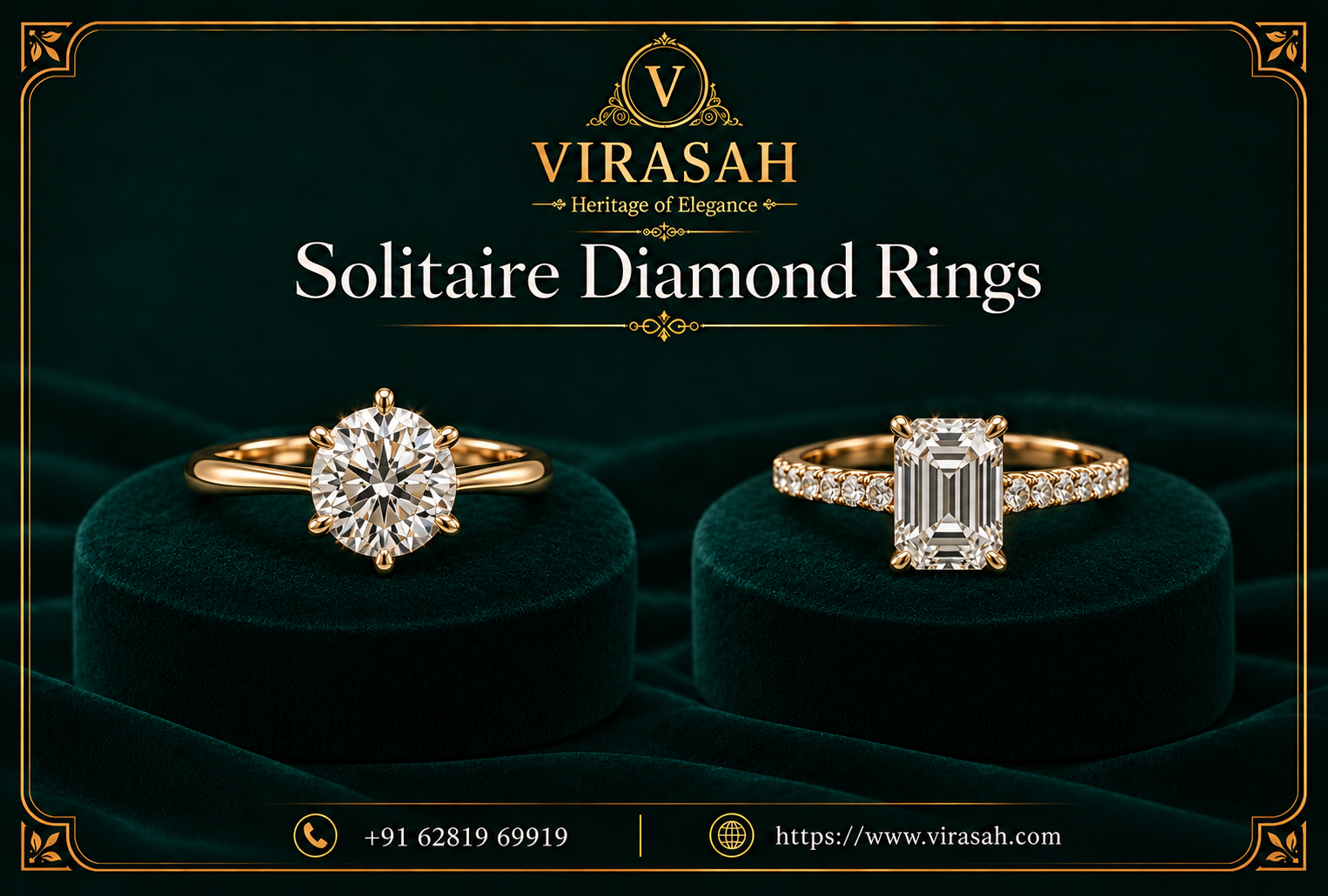
- What makes a solitaire ring different
- How the diamond 4Cs affect beauty and price
- How to select the right carat weight
- Which diamond shapes offer the best visual impact
- How to compare prong, bezel and other settings
- How gold and platinum influence the finished design
- How certification protects first-time buyers
- How to establish a realistic diamond-ring budget
- Common buying mistakes to avoid
- What questions to ask your jeweller before purchasing
What Are Solitaire Diamond Rings?
Solitaire Diamond Rings are rings designed around one primary diamond. The word “solitaire” refers to the presence of a single dominant gemstone rather than a cluster, halo or multiple-stone arrangement.
The classic design usually combines a central diamond, a metal band and a carefully engineered setting. Because the concept is intentionally restrained, the diamond attracts almost all of the viewer's attention.
This simplicity is precisely why Solitaire Diamond Rings have remained popular across generations. They work with changing fashion trends, pair easily with wedding bands and can be customised without losing their essential character.
Solitaire rings are commonly associated with engagements, although modern buyers also choose them for anniversaries, milestone gifts and luxury everyday jewellery. A solitaire can feel traditional, contemporary or architectural depending on the diamond shape, band proportions and setting style.
Why Solitaire Diamond Rings Remain Timeless
Jewellery trends change continuously, but Solitaire Diamond Rings maintain their appeal because the design is fundamentally centred on the natural beauty of a diamond.
An elaborate ring may depend heavily on a particular fashion period. A well-proportioned solitaire, however, can remain elegant decades after it was purchased. This makes it particularly suitable for jewellery intended to become an heirloom.
1. The Diamond Is the Hero
With Solitaire Diamond Rings, there is nowhere for an average centre stone to hide. Light performance, proportions, symmetry and craftsmanship become visually important. For buyers who appreciate diamonds themselves rather than heavily decorated settings, the solitaire format is especially attractive.
2. Easy to Personalise
The minimalist foundation of Solitaire Diamond Rings leaves room for personalisation through diamond shape, metal choice, setting height, band thickness, prong design and hidden detailing.
3. Easy to Pair with Other Jewellery
A solitaire generally coordinates naturally with wedding bands, eternity rings and stackable jewellery. This flexibility is one reason Solitaire Diamond Rings remain a popular starting point for bridal jewellery collections.
4. Suitable for Different Generations
From vintage-inspired round diamonds to sleek emerald cuts, Solitaire Diamond Rings can accommodate very different aesthetics without abandoning their classic structure.
Understand the Diamond 4Cs Before Buying
The internationally recognised 4Cs—cut, colour, clarity and carat weight—provide a framework for describing and comparing diamonds. First-time buyers considering Solitaire Diamond Rings should understand all four because they interact with one another.
A grading report is useful, but two diamonds that appear similar on paper can still look different in person. Specifications should therefore guide your comparison rather than replace visual judgement.
Buyers who want additional educational information can review the International Gemological Institute consumer education resources, which explain diamond grading concepts including cut, colour, clarity and carat.
1. Diamond Cut: Usually the Most Important Visual Factor
For many Solitaire Diamond Rings, cut quality has the greatest influence on sparkle. Diamond cut refers to the craftsmanship and proportions that determine how efficiently light travels through and returns from the stone.
A beautifully cut diamond can appear lively, crisp and brilliant. A poorly proportioned diamond may look darker or less energetic even if it has excellent colour and clarity grades.
This is why first-time buyers should be cautious about sacrificing cut merely to obtain additional carat weight.
What Does Good Diamond Cut Create?
An effective cut can enhance three important visual characteristics:
- Brightness: the return of white light.
- Fire: flashes of spectral colours created as light disperses.
- Scintillation: the pattern of bright and dark flashes visible as the diamond or observer moves.
In Solitaire Diamond Rings, these characteristics become particularly noticeable because the centre diamond carries the entire composition.
2. Diamond Colour
Diamond colour grading evaluates how much body colour is visible in diamonds graded within the traditional colourless-to-light-colour range. When purchasing Solitaire Diamond Rings, the ideal colour depends partly on the setting metal and your personal sensitivity to warmth.
Colour grades near the colourless range usually command higher prices, but that does not automatically mean every buyer needs the highest available grade.
Metal Colour Changes Perception
White gold and platinum create a cool visual environment. Consequently, colour differences in the diamond may be somewhat easier to notice depending on the shape and grade.
Yellow or rose gold can visually complement diamonds with slight warmth. This allows buyers of Solitaire Diamond Rings to consider a broader range of colour grades while still achieving a harmonious result.
Remember that the appearance of colour also changes with diamond shape, size and viewing conditions.
3. Diamond Clarity
Natural diamonds may contain internal characteristics called inclusions and surface characteristics called blemishes. Clarity grading assesses their nature, location, number, relief and overall visibility.
The most important practical question when choosing Solitaire Diamond Rings is often not whether the diamond is technically flawless, but whether visible inclusions negatively affect its beauty.
A diamond that is clean to the unaided eye can provide excellent visual value even when its laboratory clarity grade is lower than premium grades.
Why Inclusion Location Matters
Two diamonds with identical clarity grades can look different. An inclusion hidden near the edge may be less noticeable and could potentially be positioned beneath a prong, while a dark inclusion near the centre of the table may attract attention more easily.
When comparing Solitaire Diamond Rings, inspect the centre stone under normal viewing conditions rather than evaluating clarity only through highly magnified online photographs.
4. Carat Weight
Carat refers to a diamond's weight, not its physical diameter. One carat equals 200 milligrams. This distinction is important because two diamonds of equal weight can have different visible dimensions.
When shoppers begin researching Solitaire Diamond Rings, carat weight is often the first number they focus on. However, size alone cannot determine beauty.
A well-cut diamond may face up attractively and appear proportionally impressive, while a poorly proportioned stone of the same weight might carry unnecessary weight below the visible surface.
Popular Carat Weight Considerations
| Carat Range | General Impression | Suitable For |
|---|---|---|
| 0.30–0.49 ct | Elegant and understated | Minimalist buyers and delicate rings |
| 0.50–0.74 ct | Noticeable yet practical | Daily wear and moderate budgets |
| 0.75–0.99 ct | Strong visual presence | Buyers balancing size and value |
| 1.00–1.49 ct | Classic luxury proportion | Traditional premium solitaire designs |
| 1.50–1.99 ct | Substantial centre stone | Luxury statement rings |
| 2.00 ct+ | High-impact appearance | Collectors and luxury buyers |
The best carat weight for Solitaire Diamond Rings depends on finger size, ring design, diamond shape and personal preference rather than an arbitrary benchmark.
Which Diamond Shape Is Best for Solitaire Diamond Rings?
The diamond's shape defines much of a solitaire's personality. While round brilliant diamonds remain iconic, buyers today have many options.
Before choosing Solitaire Diamond Rings, compare several shapes on the hand rather than assuming your preferred shape from photographs will automatically suit you best.
Round Brilliant Diamond
The round brilliant is associated with strong sparkle and classic appeal. It suits almost every ring style and is an excellent choice for buyers who want Solitaire Diamond Rings that will remain visually timeless.
If you want a deeper comparison of shapes and cutting styles, explore Virasah's guide to the best diamond cuts for engagement rings.
Oval Diamond
Oval diamonds provide brilliant-style sparkle with an elongated outline. They can create an impression of greater finger length and often appear larger face-up than some round diamonds of similar weight.
Oval Solitaire Diamond Rings have become particularly attractive to buyers who want a modern alternative to the traditional round solitaire.
Emerald Cut
Emerald-cut diamonds produce a sophisticated hall-of-mirrors effect rather than the intense sparkle associated with round brilliants. Their large open facets also mean clarity becomes visually important.
For buyers who prefer understated luxury, geometric precision and Art Deco influence, emerald-cut Solitaire Diamond Rings can be exceptional.
Princess Cut
Princess-cut diamonds combine angular geometry with brilliant faceting. Their square silhouette creates a contemporary appearance and suits structured ring designs.
Because their corners can be vulnerable, Solitaire Diamond Rings featuring princess-cut stones should use a setting that adequately protects them.
Pear Shape
A pear-shaped diamond combines characteristics of round and marquise shapes. Its teardrop outline produces an elegant, distinctive centre stone.
Pear-shaped Solitaire Diamond Rings can make the finger appear elongated and allow the wearer to choose whether the point faces toward or away from the hand.
Marquise Diamond
With its elongated body and pointed ends, the marquise shape offers substantial visual spread. This can be attractive for buyers who want Solitaire Diamond Rings with dramatic finger coverage.
Cushion Cut
Cushion diamonds combine rounded corners with a square or rectangular outline. Depending on their faceting style, they can display broad flashes of light or a more crushed-ice appearance.
Cushion Solitaire Diamond Rings offer a romantic balance between vintage softness and contemporary luxury.
Radiant Cut
Radiant-cut diamonds combine rectangular or square geometry with brilliant faceting. They appeal to buyers who like the outline of an emerald cut but want more scintillation.
Radiant Solitaire Diamond Rings can look especially dramatic in larger centre-stone sizes.
Diamond Shape Comparison
| Shape | Style | Sparkle | Visual Effect |
|---|---|---|---|
| Round | Classic | Very high | Balanced and timeless |
| Oval | Elegant | High | Elongates the finger |
| Emerald | Sophisticated | Subtle | Clean, architectural look |
| Princess | Modern | High | Sharp geometric appearance |
| Pear | Romantic | High | Unique elongated silhouette |
| Marquise | Dramatic | High | Large visual spread |
| Cushion | Romantic/Classic | Moderate to high | Soft rounded appearance |
| Radiant | Contemporary | High | Angular with brilliant sparkle |
Choosing the Right Setting
The setting has two jobs: protecting the diamond and presenting it beautifully. Well-designed Solitaire Diamond Rings balance these requirements without allowing excessive metal to distract from the centre stone.
Four-Prong Setting
A four-prong setting leaves more of the diamond visible. It can create a light, open appearance and is commonly used for round, oval and other shapes.
Four-prong Solitaire Diamond Rings may appeal to buyers who want minimal metal around the centre stone.
Six-Prong Setting
A six-prong arrangement creates additional contact points around the diamond. On round diamonds, it can also produce a beautiful traditional appearance.
Some buyers prefer six-prong Solitaire Diamond Rings for the feeling of additional security, especially with important centre stones.
Bezel Setting
A bezel surrounds much or all of the diamond's perimeter with metal. The result can look streamlined and contemporary while offering excellent edge protection.
Bezel-set Solitaire Diamond Rings can be particularly practical for active lifestyles or professions where raised prongs may regularly catch on objects.
Cathedral Setting
A cathedral design raises the central setting using gracefully ascending shoulders. This can make the ring feel more architectural and formal.
Cathedral Solitaire Diamond Rings often provide additional height without requiring extensive decorative elements.
High Setting vs Low Setting
A high setting allows more space beneath the diamond and can give a solitaire greater visual prominence. However, it may catch on clothing or objects more easily.
Low-set Solitaire Diamond Rings generally sit closer to the finger, which can make them convenient for frequent daily wear. The trade-off is that certain wedding bands may not sit perfectly flush beside very low settings.
Choosing the Metal for Your Solitaire Ring
The metal influences not only appearance but also maintenance, durability and how the diamond's colour is perceived.
18K Yellow Gold
Yellow gold offers warmth and traditional luxury. It works beautifully with both colourless diamonds and stones that display subtle warmth.
Yellow-gold Solitaire Diamond Rings are especially attractive for buyers who love classic Indian jewellery traditions but want a modern minimalist design.
18K White Gold
White gold gives the ring a crisp contemporary appearance and coordinates naturally with a colourless-looking diamond.
White-gold Solitaire Diamond Rings remain popular for engagement jewellery because of their clean visual continuity between stone and metal.
Rose Gold
Rose gold has a distinctive warm pink tone. It can make Solitaire Diamond Rings feel romantic, modern and slightly unconventional while remaining elegant.
Platinum
Platinum is naturally white, dense and highly regarded for fine jewellery. Its neutral colour pairs well with diamonds and its durability makes it popular for rings intended for long-term wear.
Platinum Solitaire Diamond Rings can cost more than comparable gold designs because of the metal itself and the way platinum jewellery is manufactured.
18K Gold or Platinum: Which Should You Choose?
| Feature | 18K Gold | Platinum |
|---|---|---|
| Colour options | Yellow, white and rose | Naturally white |
| Weight | Lighter | Denser and heavier |
| Initial price | Generally lower | Generally higher |
| Appearance | Varies by alloy | Cool white appearance |
| Maintenance | White gold may require periodic refinishing | Develops a natural patina |
| Best for | Versatility and colour choice | Premium naturally white setting |
Why Diamond Certification Matters
When purchasing valuable Solitaire Diamond Rings, an independent diamond grading report can provide important information about the centre stone.
The report may document carat weight, colour, clarity, proportions, measurements, polish, symmetry and other characteristics depending on the laboratory and diamond.
Certification should not be confused with an appraisal. A grading laboratory evaluates diamond characteristics; an appraisal usually estimates monetary value for purposes such as insurance.
Educational information about grading is available from organisations such as the International Gemological Institute and the De Beers Institute of Diamonds.
Natural Diamonds vs Laboratory-Grown Diamonds
Modern first-time buyers researching Solitaire Diamond Rings frequently encounter both natural and laboratory-grown diamonds.
Natural diamonds form through geological processes within the earth. Laboratory-grown diamonds are created using technological processes designed to reproduce the conditions necessary for diamond crystal growth.
Because disclosure is important, buyers should always know exactly what type of diamond they are purchasing.
The U.S. Federal Trade Commission Jewelry Guides provide useful consumer information concerning representations and disclosures used in jewellery marketing.
For clients seeking natural-diamond jewellery, Virasah focuses on helping buyers understand the quality, provenance, craftsmanship and design considerations that shape an important jewellery purchase.
How Much Should You Spend?
There is no universal rule stating how much somebody should spend on Solitaire Diamond Rings. Traditional salary-based formulas are marketing conventions, not financial requirements.
A better approach is to establish a comfortable maximum budget first and then decide how to distribute that budget among the diamond and setting.
A Practical Budget Strategy
For most Solitaire Diamond Rings, the centre diamond represents the largest share of the total price. Buyers should therefore begin by prioritising the characteristics that affect visible appearance most.
- Set an overall budget you are genuinely comfortable with.
- Choose your preferred diamond shape.
- Prioritise cut and visual performance.
- Select a colour range appropriate for your metal.
- Choose clarity based on visible cleanliness rather than rarity alone.
- Compare actual dimensions as well as carat weight.
- Reserve enough budget for a secure, beautifully crafted setting.
This process usually creates better Solitaire Diamond Rings than selecting a carat target first and compromising every other quality factor to reach it.
Carat Weight vs Visible Size
One of the biggest misconceptions about Solitaire Diamond Rings is that carat weight directly indicates how large a diamond will appear.
A diamond's visible size depends on its millimetre dimensions, proportions and shape. Two one-carat diamonds may therefore present differently when viewed from the top.
Elongated shapes such as oval, pear and marquise diamonds can offer significant finger coverage. Round diamonds are highly balanced, while deeper-cut shapes may retain more of their weight vertically.
When purchasing Solitaire Diamond Rings, ask for both carat weight and actual measurements.
Should You Buy Exactly 1 Carat?
One-carat diamonds are popular psychological milestones, which can influence pricing. Some buyers find excellent Solitaire Diamond Rings using diamonds just below a major carat threshold.
For example, depending on dimensions and cut quality, a diamond slightly below one carat can look very similar in diameter to a one-carat stone when viewed without direct side-by-side comparison.
Never compromise significantly on cut simply to reach a round-number carat milestone.
How Ring Band Width Changes the Appearance
Band proportions can dramatically influence Solitaire Diamond Rings. A narrow band visually emphasises the centre diamond, while a broader band creates a stronger architectural presence.
Thin Bands
Thin bands can make the centre diamond appear proportionally larger. They create a delicate, contemporary style but still need adequate structural strength for long-term wear.
Medium Bands
A moderate-width band offers an excellent balance between visual refinement and practical durability. Many classic Solitaire Diamond Rings use this approach.
Wide Bands
Wider bands create a bolder design. However, they can make a smaller centre diamond appear proportionally less prominent, so the relationship between stone and band should be considered carefully.
How Finger Shape Influences Your Choice
There are no strict rules about matching diamond shapes to hands, but proportions can change how Solitaire Diamond Rings appear when worn.
Elongated diamonds such as oval, pear, emerald and marquise cuts can visually lengthen shorter fingers. Round and cushion shapes create balanced symmetry, while larger rectangular stones can produce a striking look on longer fingers.
The most reliable method is simply to try several Solitaire Diamond Rings and evaluate them from normal viewing distance.
How to Judge Sparkle Correctly
Jewellery-store lighting is designed to make gemstones sparkle dramatically. When comparing Solitaire Diamond Rings, view the diamond under more than one lighting environment whenever possible.
Look at the stone under bright display lighting, ordinary indoor lighting and natural daylight. A strong diamond should remain attractive across realistic conditions, not only beneath intense spotlights.
Also move the ring gently. Sparkle is dynamic; observing how light changes across the diamond can reveal more than a perfectly illuminated still photograph.
Importance of Symmetry and Polish
Diamond reports often include grades for polish and symmetry. These factors describe aspects of finishing and facet alignment.
High-quality finishing supports the refined appearance expected from premium Solitaire Diamond Rings. However, first-time buyers should evaluate these grades alongside the diamond's complete proportions rather than treating any single specification in isolation.
Understanding Fluorescence
Some diamonds fluoresce when exposed to ultraviolet light. Fluorescence can range from none to stronger intensities depending on the grading system.
It should not automatically be considered positive or negative when purchasing Solitaire Diamond Rings. Its effect depends on the individual diamond.
In many diamonds, fluorescence has little noticeable effect in normal viewing conditions. Strong fluorescence may affect appearance in some stones, which is another reason individual visual inspection is useful.
The Importance of Gold Hallmarking in India
Indian shoppers purchasing gold Solitaire Diamond Rings should understand hallmarking.
The Bureau of Indian Standards explains that hallmarking provides an official indication of precious-metal fineness. BIS currently recognises multiple grades for gold jewellery and uses a Hallmark Unique Identification system for hallmarked articles.
Consumers can learn more through the official Bureau of Indian Standards Hallmarking portal.
When evaluating Solitaire Diamond Rings in gold, ask the jeweller about the purity, hallmark and documentation supplied with the finished piece.
Responsible Diamond Sourcing
Responsible sourcing has become increasingly important to modern jewellery buyers. Customers considering Solitaire Diamond Rings should feel comfortable asking their jeweller questions about the diamond supply chain and sourcing policies.
One important international initiative is the Kimberley Process, an intergovernmental initiative designed to prevent conflict diamonds from entering the legitimate rough-diamond trade.
Responsible jewellery purchasing goes beyond a single certification system, so buyers can also ask brands about transparency, suppliers and their wider sourcing practices.
Common Mistakes First-Time Buyers Should Avoid
Mistake 1: Buying Only by Carat Weight
A larger diamond does not automatically make better Solitaire Diamond Rings. Cut quality, dimensions, colour, clarity and setting craftsmanship determine the finished appearance.
Mistake 2: Paying for Clarity You Cannot See
Very high clarity grades can command substantial premiums. If two diamonds appear equally clean without magnification, spending more for microscopic rarity may not deliver a proportional visual benefit.
Mistake 3: Ignoring the Setting
The setting is not merely decoration. It protects the diamond and influences comfort, durability and long-term security. Premium Solitaire Diamond Rings require precise craftsmanship as well as high-quality stones.
Mistake 4: Ignoring Millimetre Dimensions
Carat measures weight. Measurements indicate physical dimensions. Always consider both when comparing diamonds.
Mistake 5: Choosing Based Only on Online Magnification
A diamond enlarged dramatically on a screen can make tiny inclusions look severe. Remember that Solitaire Diamond Rings are normally viewed from a natural distance.
Mistake 6: Forgetting Lifestyle
A very high-mounted ring may look impressive but may not be convenient for everyone. Your daily routine should influence setting height, prong design and metal selection.
Mistake 7: Forgetting Future Wedding-Band Pairing
If the ring will later be worn with a wedding band, ask whether the chosen design allows another band to sit flush against it.
Mistake 8: Ignoring Documentation
Important Solitaire Diamond Rings should be purchased with clear invoices, relevant diamond grading documentation, metal-purity details and after-sales information.
How to Compare Two Diamonds Properly
Suppose you are comparing two diamonds for Solitaire Diamond Rings. One is slightly larger but has a weaker cut, while another is marginally smaller with superior proportions.
Do not assume the heavier diamond offers better value.
- Cut quality and light performance
- Face-up dimensions
- Colour appearance
- Visibility and location of inclusions
- Polish and symmetry
- Fluorescence where applicable
- Certification
- Price difference
- How each diamond looks in your chosen setting
A disciplined side-by-side comparison makes shopping for Solitaire Diamond Rings much easier because it shifts the decision from abstract grades to actual beauty and value.
Explore Virasah's Fine Jewellery Buying Guides
Understanding diamonds becomes even more useful when placed within the wider world of fine gemstones and jewellery. While researching Solitaire Diamond Rings, you may also find the following Virasah resources helpful.
For buyers interested in rare blue-violet gemstones, read our detailed guide to Tanzanite jewellery, meaning, rarity and buying considerations.
Collectors exploring exceptional red gemstones can learn about the history and scarcity of Burmese ruby and why it is considered one of the world's valuable gemstones.
If your interests extend to historically important sapphires, explore why Kashmir sapphire is exceptionally rare and valuable.
India's jewellery heritage also includes a remarkable variety of coloured stones. Our guide to rare gemstones in India introduces collectors and jewellery lovers to several notable options.
If sapphire is part of your jewellery shortlist, see our sapphire jewellery buying guide for practical information about selecting the right stone.
Ruby enthusiasts can also explore our ruby jewellery guide covering meaning, quality and buying tips.
For weddings and formal occasions, emerald jewellery can provide a completely different visual character from Solitaire Diamond Rings. Discover our selection advice in emerald jewellery designs for weddings and special occasions.
If you are specifically comparing centre-stone shapes for Solitaire Diamond Rings, our complete diamond cuts for engagement rings guide provides additional context.
Brides planning their entire jewellery collection can also explore the complete wedding jewellery checklist for Indian brides.
Natural Diamond Jewellery in Hyderabad
For buyers who want to experience diamonds physically rather than relying only on photographs and grading reports, evaluating jewellery in person offers valuable perspective.
Virasah also provides guidance on choosing natural diamond jewellery in Hyderabad, including considerations relating to diamond quality, craftsmanship and lasting design.
This is particularly relevant when evaluating Solitaire Diamond Rings, because relatively small differences in proportion, mounting and stone character can create a noticeable difference when a ring is actually worn.
Solitaire Rings for Engagements
Among engagement-ring designs, Solitaire Diamond Rings remain one of the most recognisable choices.
The design symbolically places one central diamond at the heart of the piece. It also offers practical flexibility because the engagement ring can later be combined with plain, diamond-set or shaped wedding bands.
A classic round diamond in a six-prong setting creates a traditional expression, whereas an oval, emerald or pear-shaped diamond can make Solitaire Diamond Rings feel more individual.
Solitaire Rings Beyond Engagements
Engagements are not the only reason to choose Solitaire Diamond Rings. Increasingly, fine jewellery buyers purchase solitaires to commemorate career achievements, anniversaries, birthdays and important personal milestones.
A solitaire also makes an effective self-purchase because the design is easy to wear across both formal and everyday occasions.
Well-designed Solitaire Diamond Rings can therefore become personal signatures rather than jewellery reserved exclusively for bridal occasions.
Should You Choose a Classic or Contemporary Design?
Classic Solitaire Diamond Rings typically feature simple bands, symmetrical prongs and familiar round or oval diamonds. Contemporary designs may introduce east-west settings, sculptural prongs, knife-edge bands or low-profile architecture.
Neither approach is inherently superior. The important consideration is longevity.
Ask yourself whether you are responding to a short-lived trend or whether the design genuinely reflects your personal style. Important jewellery should continue to feel meaningful years later.
Can Solitaire Rings Be Customised?
Absolutely. Customisation can transform seemingly simple Solitaire Diamond Rings into deeply personal pieces without overwhelming the centre diamond.
Options may include:
- Custom band width and profile
- Choice of yellow, white or rose gold
- Platinum construction
- Four-prong or six-prong baskets
- Hidden initials or engraving
- Custom setting height
- Knife-edge or rounded bands
- Hidden gemstone accents
- Personalised proportions
- Custom matching wedding bands
The best custom Solitaire Diamond Rings preserve simplicity while incorporating details meaningful to the wearer.
Comfort Matters More Than First-Time Buyers Expect
Jewellery is often evaluated visually, but comfort becomes increasingly important after a ring is worn for several hours every day.
Premium Solitaire Diamond Rings should feel smooth between the fingers, sit securely and avoid unnecessarily sharp edges.
Band thickness, inside profile, setting height and prong finishing all influence comfort. Small design differences that seem unimportant during a brief showroom visit can become noticeable during long-term wear.
How to Choose the Correct Ring Size
Ring size can change depending on temperature, time of day and physiological factors. For expensive Solitaire Diamond Rings, professional sizing is preferable to estimating from another ring unless that ring is known to fit perfectly on the same finger.
A correctly fitted ring should pass over the knuckle with slight resistance while remaining comfortable at the base of the finger.
If the band is unusually wide or the design has special structural requirements, discuss sizing with your jeweller before production.
How to Care for Solitaire Diamond Rings
Diamonds are extremely durable, but jewellery still requires thoughtful care. The metal and setting around the diamond can scratch, bend or accumulate residue.
Regular Cleaning
Lotions, oils, soap and everyday residue can collect underneath the diamond and reduce apparent sparkle. Gently cleaning Solitaire Diamond Rings periodically helps maintain their brilliance.
Professional Inspection
Prongs and settings experience gradual wear. Periodic professional inspection can identify looseness or damage before it becomes more serious.
Avoid Harsh Activities
Remove valuable Solitaire Diamond Rings before heavy exercise, gardening, construction work or activities that expose the jewellery to force or abrasive surfaces.
Store Separately
Diamonds can scratch other jewellery. Store important pieces separately in soft-lined compartments rather than allowing them to rub against other gemstones and metals.
Do Solitaire Diamond Rings Hold Their Value?
The financial resale performance of jewellery depends on many factors and should never be guaranteed simply because a piece contains a diamond.
Nevertheless, high-quality Solitaire Diamond Rings built around documented natural diamonds, good craftsmanship and classic designs can possess enduring jewellery appeal.
Buy primarily because you value the ring's beauty, meaning and craftsmanship rather than assuming short-term financial appreciation.
How to Buy an Heirloom-Quality Solitaire
When choosing Solitaire Diamond Rings with the intention of passing them to future generations, think beyond immediate trends.
Prioritise:
- A high-quality natural centre diamond
- A recognised grading report where appropriate
- Durable precious metal
- Secure setting construction
- Balanced proportions
- Timeless design
- Professional craftsmanship
- Clear purchase documentation
- Regular future maintenance
Heirloom Solitaire Diamond Rings should combine emotional significance with construction capable of supporting decades of responsible wear.
Questions to Ask Before Paying for Your Ring
- Is the centre stone a natural diamond?
- What is its exact carat weight?
- What are its millimetre dimensions?
- Which laboratory graded the diamond?
- Can I review the grading report?
- What is the diamond's colour grade?
- What is the clarity grade?
- How does the inclusion pattern look without magnification?
- What cut or proportion information is available?
- Does the diamond exhibit fluorescence?
- What precious metal is being used?
- What is the gold purity?
- Is applicable hallmarking provided?
- How is the centre diamond secured?
- Can the ring be resized later?
- Will a wedding band sit flush beside it?
- What maintenance is recommended?
- What documentation accompanies the ring?
A trustworthy consultation about Solitaire Diamond Rings should leave you understanding what you are buying rather than feeling pressured by technical terminology.
First-Time Buyer Checklist
Before finalising Solitaire Diamond Rings, work through this simplified checklist:
- Determine your budget. Decide your comfortable total spend before comparing stones.
- Choose a shape. Try round, oval, emerald, cushion, pear and other options.
- Prioritise cut. Focus on life and sparkle instead of size alone.
- Select sensible colour. Consider the metal surrounding the diamond.
- Choose practical clarity. Look for a visually clean stone rather than automatically paying for the highest grade.
- Compare dimensions. Do not rely on carat weight alone.
- Inspect certification. Match documentation with the correct diamond.
- Select the setting. Match security and height to your lifestyle.
- Check metal purity. Confirm specifications and hallmarking where applicable.
- Try the ring. Evaluate proportion, comfort and finger coverage.
- Review documentation. Keep invoices, certificates and maintenance information safely.
Following these steps removes much of the uncertainty surrounding first-time purchases of Solitaire Diamond Rings.
Expert Approach: Balance Instead of Perfection
The smartest way to buy Solitaire Diamond Rings is to seek balance.
A diamond does not need the highest grade in every category to be exceptional. In fact, demanding premium grades in colour, clarity, carat and every secondary characteristic may result in paying significant amounts for differences that have limited visual impact.
Instead, identify what you can actually see.
Choose beautiful proportions. Make sure the stone looks clean to you. Select a colour that complements your chosen metal. Choose a carat weight that suits the wearer's hand. Then invest in a setting worthy of the diamond.
This balanced strategy frequently creates Solitaire Diamond Rings that look more beautiful for the budget than specification-driven purchases.
Frequently Asked Questions About Solitaire Diamond Rings
1. What is a solitaire diamond ring?
A solitaire diamond ring features one dominant centre diamond rather than a halo or group of multiple prominent stones. Solitaire Diamond Rings are valued for their clean design and the way they place complete visual attention on the central diamond.
2. Are solitaire rings good for engagement rings?
Yes. Solitaire Diamond Rings are among the most enduring engagement-ring designs because they are elegant, easy to personalise and compatible with many styles of wedding bands.
3. Which diamond shape is best for a solitaire?
There is no single best shape. Round diamonds offer classic brilliant appeal, oval diamonds provide an elongated appearance, emerald cuts are sophisticated and geometric, while cushions, pears, princess and radiant diamonds offer alternative personalities for Solitaire Diamond Rings.
4. What is the most important of the diamond 4Cs?
All four characteristics matter, but cut quality is particularly important for diamonds where a cut grade applies because proportions and craftsmanship strongly influence light performance. A beautifully cut centre stone can dramatically improve the appearance of Solitaire Diamond Rings.
5. Is a one-carat diamond necessary?
No. Attractive Solitaire Diamond Rings can feature diamonds below or above one carat. Choose a stone based on your budget, desired finger coverage, diamond shape and overall quality rather than focusing exclusively on a round-number weight.
6. Is platinum better than gold for solitaire rings?
Both can be excellent. Platinum offers a naturally white, dense metal, while 18K gold provides several colour choices and may offer different pricing and maintenance characteristics. The best metal for Solitaire Diamond Rings depends on personal preference, budget and lifestyle.
7. Is a four-prong or six-prong setting better?
Four prongs expose more of the diamond, whereas six prongs provide additional contact points and create a traditional look on round stones. Well-constructed versions of either design can work beautifully for Solitaire Diamond Rings.
8. What clarity should I choose?
Instead of automatically targeting the highest grade, many buyers look for a diamond that appears clean to the unaided eye. The location and visibility of inclusions can matter as much as the letter-number grade when selecting Solitaire Diamond Rings.
9. Should I buy the largest diamond within my budget?
Not necessarily. A slightly smaller stone with stronger cut, better visual clarity and more balanced proportions can produce better-looking Solitaire Diamond Rings than a larger diamond chosen primarily for carat weight.
10. How can I make a solitaire diamond appear larger?
Consider a well-cut stone with good face-up dimensions, an elongated shape such as oval or pear, and a proportionally refined band. However, avoid sacrificing quality purely for apparent size. Balanced Solitaire Diamond Rings usually age better aesthetically.
11. Can solitaire rings be worn every day?
Yes. Properly designed Solitaire Diamond Rings can be excellent everyday jewellery. Choose a secure setting, maintain the ring regularly and remove it before high-impact activities.
12. Are natural diamonds suitable for heirloom jewellery?
Natural diamonds have long been used in heirloom jewellery because of their durability, rarity and emotional significance. Well-crafted Solitaire Diamond Rings can be passed between generations when properly maintained.
13. Why do two diamonds with the same carat weight look different in size?
Carat measures weight rather than diameter. Shape, depth and overall proportions determine how much surface area is visible from above. This is why physical measurements should always be reviewed when comparing Solitaire Diamond Rings.
14. Should my solitaire come with a certificate?
For an important diamond purchase, an independent grading report can provide valuable information about the stone's characteristics. Documentation helps buyers compare Solitaire Diamond Rings more objectively and understand what they are purchasing.
15. How often should a solitaire ring be inspected?
The appropriate schedule depends on how frequently the ring is worn and its setting. Rings worn every day should be periodically checked for worn or loose prongs. Professional inspection helps protect valuable Solitaire Diamond Rings over the long term.
Why Buy Fine Diamond Jewellery from Virasah?
Buying important jewellery requires more than selecting attractive photographs. Clients considering Solitaire Diamond Rings deserve clear information about the centre diamond, thoughtful design guidance and careful craftsmanship.
At Virasah, the objective is to help clients understand the relationship between rarity, quality, proportions, craftsmanship and personal style so that their jewellery feels meaningful rather than merely expensive.
Whether you are exploring engagement jewellery, rare gemstones, bridal jewellery or Solitaire Diamond Rings, taking time to understand the materials before buying can make the final choice significantly more satisfying.
Explore more fine jewellery and gemstone guidance at Virasah.
Final Thoughts
Your first diamond purchase should feel exciting rather than intimidating. Once you understand the fundamentals, comparing Solitaire Diamond Rings becomes much easier.
Start with the diamond's visual performance rather than simply its carat weight. Understand the 4Cs, but remember that laboratory grades tell only part of the story. Examine actual dimensions, consider the metal surrounding the stone and select a setting designed for your lifestyle.
Most importantly, do not assume that the most expensive specification automatically creates the most beautiful ring. The best Solitaire Diamond Rings achieve harmony between diamond quality, proportions, craftsmanship, personal taste and budget.
A thoughtfully selected solitaire can remain relevant for decades. It can mark an engagement, celebrate an achievement, commemorate an anniversary or eventually become part of a family's jewellery heritage.
Choose carefully, ask questions and allow beauty—not simply numbers—to guide your decision. When those elements come together, Solitaire Diamond Rings become much more than fine jewellery. They become lasting symbols of moments worth remembering.
Authoritative Diamond & Jewellery Resources
For buyers who would like to continue researching before purchasing Solitaire Diamond Rings, the following independent and industry resources provide useful educational information:
- International Gemological Institute – Consumer Diamond Education
- De Beers Institute of Diamonds – Diamond Grading Explained
- Federal Trade Commission – Jewelry Guides
- Bureau of Indian Standards – Hallmarking Overview
- Kimberley Process – Responsible Diamond Trade
- IGI – Understanding Diamond Colour
Discover Solitaire Diamond Rings at Virasah
Looking for an elegant natural diamond solitaire designed around your personal style?
Speak with Virasah to explore diamond shapes, quality options, precious metals and custom ring designs.
Phone: +91 62819 69919
Website: www.virasah.com